
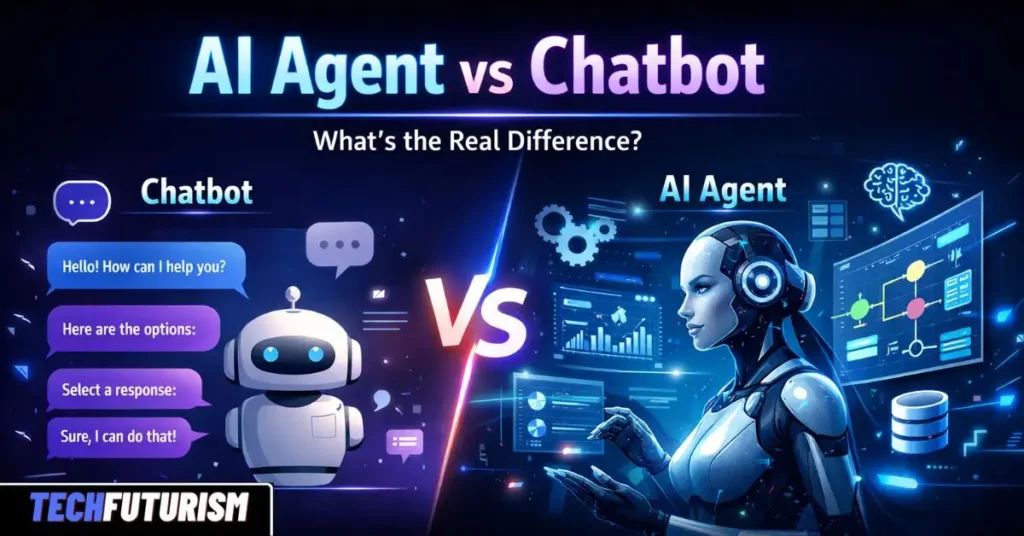
A plain-English guide to the two biggest buzzwords in AI — covering chatbots, AI agents, agentic AI, LLMs, real-world examples, and a clear framework for choosing the right tool.
April 202618 min readAI · Automation · Business tools · SEO
In this article
The words AI agent and chatbot get thrown around so much these days that they start to blur together. One week your LinkedIn feed says chatbots are the future. The next week, AI agents are taking over. So which one actually matters for you — and are they even the same thing?
The short answer is: no, they are not the same. The AI agent vs chatbot distinction matters more than you might think — especially if you are a business owner, a developer, or simply someone figuring out where to invest time and money in artificial intelligence tools.
By the end of this article, you will know exactly what sets these two technologies apart, when to use each one, and how to make a confident, well-informed decision for your specific situation. Let’s start with a story that makes the whole thing click.
- The coffee shop moment that changed how I think about AI
- What is a chatbot? The foundation of conversational AI
- What is an AI agent? Autonomous intelligence that acts
- AI agent vs chatbot: head-to-head comparison
- Is ChatGPT a chatbot or AI agent? The answer might surprise you
- AI agent vs ChatGPT: what's the practical difference?
- AI agent vs agentic AI: is there really a difference?
- LLM vs chatbot: understanding the technology stack beneath
- AI agent chatbot on GitHub: what developers are actually building
- AI agent examples: real systems doing real work in 2026
- AI vs bot in games: the same concept, a different arena
- Real-world use cases: where each technology shines
- Step-by-step guide: how to choose the right tool for your needs
- How to get started today: a practical path forward
- The bottom line: AI agent vs chatbot, decoded
- FAQs
The coffee shop moment that changed how I think about AI
A friend of mine runs a small e-commerce store. Last year, she added a chatbot to her website to handle customer questions. It worked well — until a customer asked the bot to “cancel my order, rebook it for next Tuesday, apply my loyalty discount, and email me a confirmation.” The bot cheerfully replied with a help article about the return policy. My friend spent the next 40 minutes completing all of that manually. That is when she finally asked the right question: what is actually the difference between a chatbot and an AI agent?
That story captures the gap perfectly. A chatbot responds. An AI agent acts. But let’s unpack each one properly before placing them side by side — because that distinction, small as it sounds, changes everything about how you build, buy, and use AI tools.
What is a chatbot? The foundation of conversational AI
A chatbot is a software program designed to simulate conversation with a human user. It lives inside a chat interface — a website widget, a messaging app, or a customer service portal — and responds to what you type or say.
There are two main types. First, there are rule-based chatbots. These follow a strict decision tree: if the user says X, respond with Y. They are fast, predictable, and inexpensive to build. However, they break down the moment someone asks something outside the script.
Second — and far more capable — are conversational AI chatbots. These use natural language processing (NLP) and large language models (LLMs) to understand what you mean, not just what you typed. Tools like Claude, ChatGPT, and Google Gemini belong in this category. They hold nuanced conversations, answer follow-up questions, summarize documents, write content, and explain complex topics clearly.
Here is the key limitation: a chatbot is fundamentally reactive. It waits for you to say something, processes your input, and sends back a response. Then it waits again. Without you guiding every single step, it cannot book an appointment, place an order, or send an email. That boundary defines it.
Definition
Chatbot — a conversational interface powered by rules or AI that responds to user messages in real time, within a single session, without taking independent action inside external systems.
What is an AI agent? Autonomous intelligence that acts
An AI agent is several significant steps beyond a chatbot. Where a chatbot responds, an AI agent reasons, plans, and acts. It breaks a complex goal into sub-tasks, executes those tasks in sequence — often using external tools — checks its own results, and adjusts its approach when something goes wrong.
Think of it this way. A chatbot is like a knowledgeable librarian who can answer any question you bring to the desk. An AI agent is like a capable personal assistant who not only answers the question but also calls the restaurant, checks your calendar, books the reservation, and sends you a confirmation — all after a single instruction from you.
Think about how a contractor builds a house. You don’t stand beside them saying “now pick up the hammer… now hit the nail… now move the board.” You describe what you want built, and they figure out the steps, adapt when materials change, and report back when the job is done. That is an AI agent. A chatbot, by contrast, is a very articulate phone menu that talks back.
AI agents connect to external tools — web search, code execution, calendar APIs, email systems, databases, and CRMs — and use a technique called chain-of-thought reasoning to work through problems step by step before taking action. Many are built on the ReAct framework (Reason + Act), which lets the model loop between thinking and doing until the task reaches completion.
Furthermore, AI agents operate autonomously over longer time horizons. You give them a goal; they pursue it — checking in only when they genuinely need a decision from you.
Definition
AI agent — an autonomous system powered by a large language model that perceives its environment, forms multi-step plans, uses external tools, and executes tasks toward a defined goal with minimal human intervention at each step.
AI agent vs chatbot: head-to-head comparison
Now that we understand both technologies clearly, let’s place them side by side. The contrast becomes sharp when you compare them on the dimensions that matter in practice.
Chatbot
- Responds to messages
- Single-turn interactions
- Stays within the chat interface
- Requires user guidance at each step
- Ideal for Q&A, support, and FAQs
- Simpler and faster to deploy
- Predictable, lower risk
- Best for structured, known scenarios
AI agent
- Plans and executes multi-step tasks
- Autonomous, multi-turn operation
- Connects to external tools and APIs
- Works toward a goal end-to-end
- Ideal for workflows and automation
- More complex to configure
- Requires oversight and guardrails
- Best for complex, open-ended tasks
As you can see, neither is objectively “better.” They serve different purposes. The right question is always: what do you actually need done? That answer determines everything.
Is ChatGPT a chatbot or AI agent? The answer might surprise you
This is one of the most searched questions in AI right now — and the answer is: it depends entirely on how you use it.
At its core, ChatGPT is an AI chatbot. It is a conversational interface powered by OpenAI’s GPT large language model. You send it a message; it sends one back. That is chatbot behavior. In its default configuration, ChatGPT does not autonomously browse the web, execute code unprompted, or take actions across your tools without your direction at every step.
However, when you enable plugins, connect it to external tools, or deploy it within an Assistants API workflow, ChatGPT begins to exhibit agentic behavior — it can search the web, run code, read files, and chain actions together toward a goal. In those configurations, it starts to function more like an AI agent. So is ChatGPT an AI chatbot? Yes, by default. With the right integrations, however, it can also act as a capable agent — the architecture determines the behavior.
AI agent vs ChatGPT: what’s the practical difference?
People often frame the AI agent vs ChatGPT debate as if they are two rival products competing for the same job. In reality, they represent two different layers of AI capability that frequently overlap.
ChatGPT is a specific product — a consumer-facing chat application built on top of a large language model. An AI agent is an architectural pattern: any system that combines an LLM with tools, memory, and autonomous decision-making to complete multi-step tasks without constant human direction.
Think of it this way. ChatGPT is a brand of car. An AI agent is the concept of autonomous driving. You can build an autonomous vehicle using many different engines — ChatGPT’s underlying GPT model, or Claude from Anthropic, or Gemini from Google. The agent is the architecture; the LLM is the engine. Claude, for instance, can operate as a sophisticated standalone chatbot or as the reasoning core of a fully autonomous multi-step agent — the difference lies entirely in how it is deployed and what tools it is given access to.
AI agent vs agentic AI: is there really a difference?
Here is a distinction that trips up even experienced developers: AI agent vs agentic AI — are these actually the same thing?
Technically, no — though they are very closely related. An AI agent is a discrete, packaged system: a specific program or workflow designed to autonomously complete tasks using tools and reasoning loops. Agentic AI, on the other hand, is the broader concept that describes any AI behavior exhibiting agency — the capacity to perceive, decide, and act toward a goal without constant human direction.
In other words, all AI agents are instances of agentic AI, but not all agentic AI comes packaged as a standalone named agent. A model that autonomously revises its own output, checks it against a rubric, and tries again is displaying agentic behavior — even if nobody has labeled it an “agent.” As Anthropic’s research on building effective agents explains, the most capable production systems combine multiple agentic patterns — including planning loops, tool use, reflection, and multi-agent coordination — rather than relying on any single architecture.
LLM vs chatbot: understanding the technology stack beneath
To fully understand the AI agent vs AI chatbot landscape, you need one more foundational concept: the difference between an LLM and a chatbot.
A large language model (LLM) is the underlying AI technology — a neural network trained on vast amounts of text data that learns to understand and generate human language at a high level. Well-known examples include Claude (Anthropic), GPT-4 (OpenAI), Gemini (Google), and Llama (Meta). An LLM is, at its core, a sophisticated language prediction system.
A chatbot is an application built on top of an LLM (or simpler logic). It is the interface and experience layer — the thing users actually talk to. An AI agent then adds a third layer: tools, persistent memory, and autonomous action loops.
Layer 1
LLM
The intelligence engine
→
Layer 2
Chatbot
The conversation interface
→
Layer 3
AI agent
Autonomous action system
Each layer builds meaningfully on the previous one. You need an LLM to power a chatbot. You need a chatbot-grade model to power an agent. But the reverse is not true: most LLMs exist without any chatbot interface, and most chatbots operate without agent capabilities.
AI agent chatbot on GitHub: what developers are actually building
If you search for AI agent chatbot on GitHub, you will find thousands of open-source projects that deliberately blur the boundary between the two concepts — and that is by design. Developers today build systems that start as chatbots and progressively gain agentic capabilities as more tools are connected.
The most widely adopted open-source frameworks for building AI agent chatbots include LangChain (a Python and JavaScript framework for chaining LLM calls with tool use), AutoGen (Microsoft’s multi-agent conversation framework), CrewAI (for orchestrating multiple specialized agents working together), and Anthropic’s Python SDK for building Claude-powered agents with full tool use support.
Additionally, Anthropic’s Model Context Protocol (MCP) has rapidly become a widely adopted open standard on GitHub for connecting AI models to external data sources and tools — making it significantly easier for developers to transform a basic chatbot deployment into a fully capable agent without rebuilding from scratch.
Developer note
The line between “chatbot” and “agent” in open-source projects often comes down to one design decision: does the model have access to tools? Add tool use plus a reasoning loop, and your chatbot becomes an agent. That shift can be as simple as a few additional lines of configuration.
AI agent examples: real systems doing real work in 2026
Talking about AI agent examples in theory is useful. Seeing them operating in real production environments makes the concept genuinely concrete — and motivating. Here are six categories of AI agents already handling serious workloads today.
Development
Claude Code
Reads a full codebase, writes fixes, runs tests, and commits changes with minimal human input.
Coding agent
Research
Claude deep research
Browses dozens of live sources, synthesizes findings, and produces structured, cited reports.
Research agent
Browsing
Claude in Chrome
Controls the browser to navigate pages, complete forms, and execute web-based tasks on your behalf.
Browsing agent
Sales ops
Salesforce Agentforce
Autonomously qualifies leads, updates CRM records, and drafts follow-up sequences.
Sales agent
Task automation
Completes multi-step web tasks — booking, purchasing, form submissions — end-to-end.
Task agent
Engineering
Coordinates multiple specialized sub-agents to collaboratively solve complex engineering problems.
Multi-agent
These are not prototypes or demos. They are production-grade systems handling real workloads at scale — and the category is expanding rapidly as open standards like MCP continue to lower the barrier to building connected, capable agents.
AI vs bot in games: the same concept, a different arena
Interestingly, the AI vs bot question is not exclusive to business software. In the world of video games, the distinction maps almost perfectly onto the chatbot-versus-agent split — and understanding one helps illuminate the other.
A traditional game bot is a rule-based system. It follows scripted decision trees to simulate an opponent: react to the player’s move with a predefined counter-move. It does not truly reason or adapt to novel situations. Sound familiar? That is chatbot logic applied to gameplay — reactive, bounded, and predictable by design.
An AI-powered game agent, on the other hand — such as those built with reinforcement learning or the systems behind DeepMind’s AlphaGo and OpenAI Five — forms long-term strategies, adapts dynamically to new opponents and situations, and discovers novel approaches that human players have never used. That is genuine agency: perception, planning, and autonomous action in pursuit of a goal. The underlying principle is identical whether the “environment” is a game board, a web browser, or an enterprise software workflow.
Real-world use cases: where each technology shines
Where chatbots excel
Customer support automation is a natural, proven fit for chatbots. When someone asks “What is your return policy?” or “What are your store hours?”, a well-configured chatbot delivers an instant, accurate answer at any hour with nobody on your team involved. Consequently, lead qualification (asking site visitors a structured series of screening questions), appointment scheduling integrated with a booking system, and user onboarding flows that guide new customers through a product are all tasks where chatbots deliver excellent, cost-effective results at scale.
In short: chatbots excel at structured, conversational tasks where the range of possible interactions is reasonably predictable and no external action beyond the chat window is required.
Where AI agents take over
Consider a sales operations manager who needs to pull last week’s CRM data, identify leads that have not been followed up in seven days, draft personalized outreach emails for each, and schedule them to send the following morning. That is not a chatbot job. That is an AI agent job, and it is precisely the kind of work agents are designed for.
Other compelling AI agent use cases include software development automation, competitive research and analysis, supply chain management, and financial data processing pipelines that run reliably without constant human oversight. In every case, the common thread is the same: multiple steps, multiple systems, and a need for autonomous judgment along the way.
Step-by-step guide: how to choose the right tool for your needs
Still unsure which option fits your situation? Follow this six-step decision process — it works whether you are a solo founder, an enterprise architect, or a marketer building your first AI workflow.
- Define your goal in one clear sentence. Write it down before you evaluate any tool. “Answer customer questions about our product” points toward a chatbot. “Automatically process incoming invoices and update our accounting system” points firmly toward an agent. The more your goal requires action across multiple platforms, the more you need an agent.
- Count the steps involved. If completing your task takes more than two or three steps — and those steps span different tools or platforms — you are in agent territory. A clean single-turn question and answer? That is a chatbot task. Do not over-engineer it.
- Ask: does this task require accessing external systems? If your AI needs to read from or write to a database, send emails, browse the web, update a CRM, or execute code — you need an agent. Chatbots live inside the conversation; agents reach outside it.
- Consider your tolerance for unpredictability. Chatbots are easier to audit, control, and explain to stakeholders. Agents are more powerful but also require guardrails, thoughtful design, and ongoing monitoring. Make sure your team has the capacity to oversee an autonomous system before you deploy one in a high-stakes context.
- Start small, validate, then expand. If you are new to AI automation, deploy a smart chatbot first. Get comfortable with the technology, gather real data on what your users actually need, and layer in agentic capabilities once a specific use case justifies the added complexity. You do not need to solve every problem on day one.
- Evaluate your technology stack carefully. Confirm that your chosen AI platform supports tool use, computer use, and API integrations via MCP. Without these, even the most powerful underlying model remains, at its core, just a chatbot.
When you understand the difference between an AI agent and a chatbot, it becomes easier to see how AI-powered SEO agents can do real work like finding keywords, improving content, and handling tasks on their own.
How to get started today: a practical path forward
The barrier to entry for both chatbots and AI agents has never been lower. Here is a practical path depending on where you are starting from.
To deploy a chatbot: Platforms like Intercom, Drift, and HubSpot’s chatbot builder let you go from zero to live in an afternoon. For a fully customizable, branded experience, build directly on the Claude API — it takes just a few lines of code and gives you complete control over tone, knowledge, and behavior.
To deploy an AI agent: Start with Claude Code if your primary use case involves software development. For broader workflow automation, explore agent frameworks like LangChain, CrewAI, or Anthropic’s Model Context Protocol (MCP) — an open standard for connecting AI models directly to your existing tools, data sources, and APIs.
For non-developers, Anthropic’s growing suite of agent-powered products makes agentic AI genuinely accessible without writing a single line of code: Claude in Chrome (a live browsing agent), Claude for Excel (a spreadsheet agent), Claude for PowerPoint (a slides agent), and Cowork — a desktop tool for automating file and task management workflows end-to-end.
Pro tip
The most effective AI implementations today combine both technologies: a chatbot as the accessible conversational front end, with an AI agent running in the background to handle complex tasks when triggered. You do not have to choose one and ignore the other — used together, they form a powerful, layered system that serves both simple and sophisticated needs.
The bottom line: AI agent vs chatbot, decoded
The AI agent vs chatbot question is not about which technology wins. It is about fit. Chatbots are fast, accessible, and purpose-built for conversation. AI agents are powerful, autonomous, and purpose-built for complex, multi-step workflows that require real-world action across multiple systems.
Whether you are weighing AI agent vs ChatGPT, untangling the LLM vs chatbot distinction, browsing AI agent chatbot projects on GitHub, asking yourself “is ChatGPT an AI chatbot?”, comparing AI agent vs agentic AI, or exploring concrete AI agent examples you can adapt for your own use case — the framework is always the same. Match the tool to the task. Start with one focused use case. Validate before scaling.
The businesses winning with AI right now are not the ones chasing every new buzzword. They are the ones who took the time to understand their actual workflows, picked the right tool for the right job, and started somewhere specific. That is a strategy anyone can follow — starting today.
FAQs
Is ChatGPT an AI agent?
This is one of the most asked questions in AI right now — and the honest answer is: it depends on how you use it. In its basic, out-of-the-box form, ChatGPT is a chatbot, not a true AI agent. You type a message, it sends one back. That exchange stays inside the conversation window. ChatGPT does not independently browse the web, write and execute code on your machine, update your calendar, or take any action in the outside world unless you give it explicit direction at every single step. That reactive, turn-by-turn behavior is the hallmark of a chatbots
However, ChatGPT can absolutely behave like an AI agent when extended with the right tools. When you enable plugins, connect it to external systems via the Assistants API, or use it inside a workflow that gives it access to code execution, file reading, or web browsing, ChatGPT begins chaining actions together and working autonomously toward a goal. At that point, it is operating as an agent — because it is now perceiving, reasoning, and acting beyond the conversation window.
Think of it like a car. A car sitting in your driveway is just a machine. The same car with a full GPS route, fuel, and a driver following automated instructions becomes an autonomous vehicle. The underlying machine is the same; what changes is the system around it. ChatGPT is the engine. Whether it becomes an agent depends on the framework you wrap around it.
The short answer
ChatGPT in default chat mode = chatbot. ChatGPT with tools, APIs, and autonomous task loops = AI agent. The model itself is the same — the architecture around it determines which one it becomes.
What are the 7 types of AI agents?
Not all AI agents are built the same way or built for the same job. In fact, AI researchers and engineers recognize seven distinct types of AI agents, each with a different level of intelligence, memory, and capability. Understanding these types helps you appreciate just how wide the spectrum really is — from a simple thermostat all the way to a reasoning, self-improving system.
Type 01
Simple reflex agent Basic
Acts only on the current input using a fixed set of condition-action rules. No memory, no history, no learning. Think of a thermostat: if the temperature drops below a threshold, it turns the heat on. That is it.
Type 02
Model-based reflex agent Basic+
More sophisticated than a simple reflex agent because it maintains an internal model of the world. It uses that model to handle situations where the current input alone is not enough to make the right decision.
Type 03
Goal-based agent Intermediate
Works toward a specific defined goal, not just reacting to stimuli. It evaluates multiple possible actions and picks the one most likely to achieve its objective. Navigation systems and chess engines fit this category.
Type 04
Utility-based agent Intermediate
Goes beyond goal pursuit by optimizing for the best possible outcome among many competing options. It assigns a utility score to different outcomes and picks the path with the highest score. Smarter, but also harder to design.
Type 05
Learning agent Advanced
Can improve its own performance over time through experience. It has a learning element that updates its behavior based on feedback — making it progressively better at achieving its goals the more it operates.
Type 06
Hierarchical agent Advanced
Operates across multiple levels of abstraction simultaneously. A high-level controller sets strategic goals; lower-level sub-agents execute specific tasks. Think of a company: the CEO sets direction, managers handle departments, staff execute tasks.
Type 07
Multi-agent system (MAS) Most Complex
A network of multiple individual agents — each with its own role, tools, and logic — that work together to accomplish a shared goal. They communicate, negotiate, and divide tasks among themselves. Modern AI platforms like AutoGen and CrewAI are built on this principle. This is the most powerful and the most complex type of AI agent architecture in use today.
In practice, most modern AI agents you encounter in business tools — including those built on Claude, GPT-4, or Gemini — combine elements of types 3 through 7. They pursue defined goals, optimize for good outcomes, learn from context, and increasingly operate as part of larger multi-agent pipelines.
Who are the big 4 AI agents?
The “big 4” AI agents is not an official industry designation — but in the context of the most widely recognized, production-grade AI agent platforms making the biggest real-world impact in 2026, four names consistently stand out. These are the systems that have moved well beyond prototype status and are actively being used by thousands of businesses, developers, and researchers today.
Claude
Anthropic’s flagship agent powering coding, research, browsing, and enterprise automation via MCP.
claude.ai
ChatGPT + Operator
OpenAI’s consumer and enterprise agent suite — from GPT-4 tool use to Operator’s autonomous web task completion.
openai.com
Gemini agents
Google DeepMind’s agentic AI suite, deeply integrated with Google Workspace, Search, and the broader Google Cloud ecosystem.
deepmind.google
Microsoft Copilot
Microsoft’s AI agent layer embedded across Office 365, Teams, Azure, and GitHub Copilot — powered by OpenAI models.
copilot.microsoft.com
Each of these platforms takes a somewhat different approach. Claude (Anthropic) is particularly known for its strong Model Context Protocol (MCP) ecosystem, long-context reasoning, and safety-focused design — making it a top choice for enterprise developers building serious agent workflows. OpenAI’s Operator leads in consumer-facing autonomous web tasks. Gemini dominates where deep Google ecosystem integration matters. And Microsoft Copilot is by far the most embedded inside existing enterprise productivity tools, with hundreds of millions of users already exposed to agentic features inside Word, Excel, and Teams.
Beyond these four, a strong tier of specialized platforms is rapidly closing the gap — including Salesforce Agentforce for sales and CRM automation, AutoGen for multi-agent engineering systems, and CrewAI for coordinating networks of specialized agents on complex tasks.
Bottom line
The “big 4” dominate in reach and investment, but the right platform for you depends on your use case, your existing tech stack, and how much customization you need. For flexible, developer-friendly agent building with strong safety guarantees, Claude via the Anthropic API is consistently one of the top choices among technical teams.
What are the 5 agents of AI?
The “5 agents of AI” refers to a widely used classification framework that groups AI agents by their primary function and the type of work they are designed to do. Rather than categorizing by architecture (like the 7 types above), this framework focuses on practical roles — what the agent actually does day to day. Here is each one explained clearly.
Reactive agents — These are the simplest agents of all. They respond directly to what is happening right now, with no memory of past interactions and no ability to plan for the future. Every decision is made purely based on the current input. A basic customer service chatbot that answers FAQs from a fixed knowledge base is a reactive agent. Fast and reliable, but limited to the scenarios they were explicitly programmed for.
Deliberative agents — These agents think before they act. They build an internal model of their environment, reason about it, and then plan a course of action. Unlike reactive agents, they can handle novel, unexpected situations by working through the logic step by step. Most modern AI agents powered by large language models — including Claude and GPT-4 — are fundamentally deliberative agents. They reason through your request, form a plan, and then act.
Hybrid agents — As the name suggests, hybrid agents combine reactive speed with deliberative depth. They handle straightforward, predictable tasks reactively (fast, no overthinking needed) and switch to deliberate reasoning when the task is complex or ambiguous. This combination makes them highly versatile. Many enterprise AI systems are hybrid by design — reacting instantly to simple queries while engaging deeper reasoning for edge cases and exceptions.
Collaborative agents — These agents are designed to work alongside other agents — or alongside humans — to complete tasks that no single agent could handle effectively alone. They communicate, share information, divide work, and coordinate toward a shared goal. Platforms like AutoGen and CrewAI are built specifically for collaborative agent architectures. In a well-designed collaborative system, one agent might browse the web for data, a second might analyze it, and a third might write the final report — all automatically.
Autonomous agents — The most advanced type in this framework. Autonomous agents operate independently over extended periods, making their own decisions, using their own tools, and pursuing long-horizon goals without needing a human in the loop at every step. They perceive their environment, form plans, execute actions, evaluate results, and adapt. Claude Code, which can read an entire codebase, identify bugs, write and test fixes, and commit the results — all from a single high-level instruction — is a real-world example of an autonomous agent in production. These agents carry the most capability and the most responsibility to deploy safely.
How they connect
These five roles are not mutually exclusive. In practice, most capable AI systems today blend all five — reacting quickly when speed matters, deliberating when complexity demands it, collaborating when the task is too big for one agent, and operating autonomously when the goal is clear and the tools are trusted. The best agent for your use case is the one whose primary behavior matches what your task actually requires.