
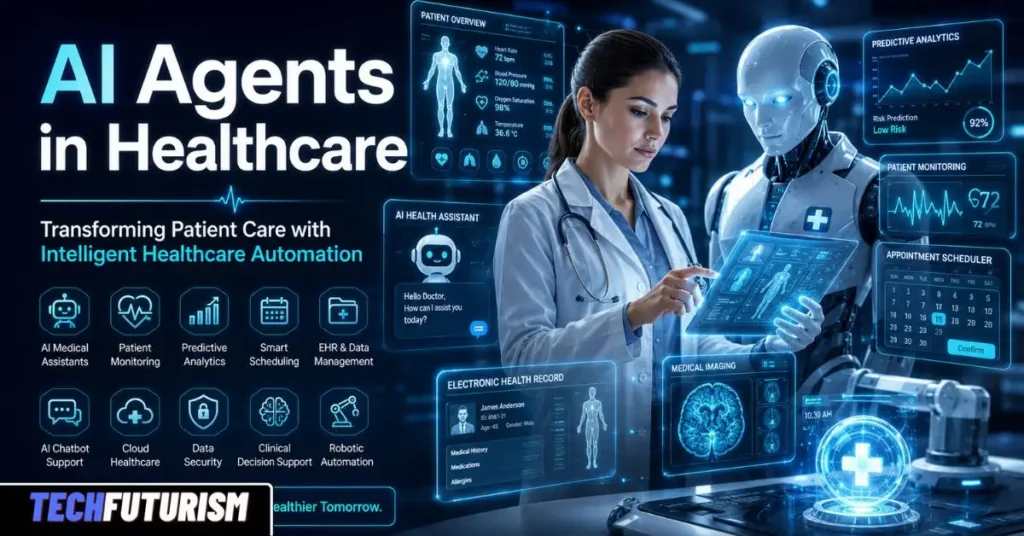
Picture this: it is 2 a.m. in a busy emergency room in Chicago. Dr Sarah Okafor is managing six critical patients at once. A monitoring system quietly flags a subtle drop in oxygen saturation for the patient in bed four — one that a fatigued human eye might have missed. Within seconds, a nurse is at the bedside, and a potential crisis is averted. That silent, tireless watchdog is an AI agent.
This is not science fiction. AI agents in healthcare are already operating inside hospitals, clinics, and smartphones around the world — and they are reshaping medicine faster than most people realise. In this guide, we cover every dimension: real-world examples, published research, open-source tools, foundational architecture, and the startups moving fastest. By the end, you will have everything you need to understand, evaluate, and act.
| Stat | Figure |
| Reduction in diagnostic errors | 40% |
| Global AI health market by 2026 | $150B |
| Faster patient triage | 3× |
- What are AI agents in healthcare?
- AI agents healthcare examples — from real clinical settings
- A foundational architecture for AI agents healthcare
- AI agents healthcare research papers — the literature that matters
- Medical AI agent GitHub — open-source tools and repositories
- Agentic AI in healthcare examples — beyond single-task bots
- AI agent in healthcare applications, evaluations, and future directions
- Agentic AI healthcare startups to watch in 2026
- Awesome AI agents for healthcare — a curated resource list
- Step-by-step guide: how to get started with AI agents in healthcare
- Addressing the key concern: is AI in healthcare safe?
- What the evidence shows
- Conclusion
- Frequently asked questions
What are AI agents in healthcare?
An AI agent is a software system that perceives its environment, reasons over what it finds, and takes goal-directed actions — often without a human directing each step. Think of it as a permanently alert, highly capable partner that processes thousands of data points in milliseconds and acts on what it finds.
In clinical settings, these agents read electronic health records, monitor vital signs, interpret imaging studies, handle administrative workflows, and converse with patients through natural language processing (NLP). Unlike simple rule-based bots, modern agents apply machine learning, large language models (LLMs), and multi-step reasoning to handle complex, unpredictable clinical situations that a fixed logic tree could never anticipate.
That capacity for adaptive reasoning is what separates an AI agent from a basic decision-support tool — and it is why the technology is attracting serious investment, rigorous research, and rapid clinical adoption.
AI agents healthcare examples — from real clinical settings
The most compelling evidence for healthcare AI agents comes not from white papers but from documented clinical deployments. The following examples span diagnosis, operations, and patient engagement — and each carries measurable, published outcomes.
Sepsis detection at Johns Hopkins — An AI agent continuously monitoring ICU vital signs flagged sepsis onset hours earlier than clinical staff would have caught it through standard observation. The result was a 20% reduction in sepsis mortality across the deployment cohort. Sepsis kills approximately 270,000 Americans each year; an hours-earlier alert is the difference between recovery and organ failure.
Mammography screening in the UK NHS — An AI imaging agent reviewed mammograms alongside radiologists in a landmark 2023 study. It detected 13% more breast cancers than the standard two-reader protocol without increasing false-positive rates. For thousands of women, earlier detection meant broader treatment options and meaningfully better survival odds.
Emergency department triage at Mount Sinai — An AI triage agent pre-assessed incoming patients and routed them to the right care team before a human reviewed the chart. Wait times fell 25% and patient satisfaction scores climbed significantly — not because the care team changed, but because the AI removed the bottleneck.
Ambient documentation — Nuance DAX — An ambient AI agent listens to physician–patient consultations and automatically generates structured clinical notes in real time, integrated directly into Epic. Physicians save up to two hours per day — time returned to patient care, not paperwork.
Remote chronic disease monitoring — AI agents connected to wearable devices continuously track blood glucose, cardiac rhythm, and oxygen saturation for patients with diabetes, heart failure, and COPD. When the agent detects a deterioration pattern, it alerts the care team immediately — before the patient feels anything change.
Woebot — mental health support — A conversational AI agent delivers cognitive behavioural therapy (CBT) techniques, mood tracking, and emotional support around the clock. It does not replace a therapist, but it fills a critical access gap for the millions of people who cannot afford care or live in areas with no mental health provision.
Pattern across every example: In each deployment above, the AI agent did not replace clinical staff. It handled the monitoring, flagging, or documentation work that was consuming human attention, so clinicians could focus on decisions that only a human should make.
A foundational architecture for AI agents healthcare
Before evaluating any vendor or building any system, understanding the foundational architecture of healthcare AI agents is essential. Most production-grade clinical agents share the same five-layer design, regardless of the specific task they perform.
Layer 1 — Perception. The agent ingests data from EHRs, wearables, imaging systems, lab platforms, and clinical notes via HL7/FHIR-compliant APIs. The quality and completeness of this data layer determine everything that follows. An agent cannot reason well over incomplete or inconsistently structured inputs.
Layer 2 — Reasoning. The agent applies large language models or task-specific supervised models to interpret the ingested data and generate candidate actions. This is where clinical knowledge, pattern recognition, and probabilistic inference happen.
Layer 3 — Memory. The agent maintains short-term context (the current encounter) and long-term patient history using vector stores or graph databases. Without a well-designed memory layer, the agent treats every interaction as if it were the patient’s first — clinically dangerous and practically useless.
Layer 4 — Action. The agent executes outputs within defined guardrails — alerting a clinician, generating a clinical note, ordering a diagnostic test, or escalating a finding. All actions must occur within HIPAA-compliant boundaries and under human oversight protocols appropriate to the risk level of the task.
Layer 5 — Feedback loop. Clinician responses, outcome data, and correction signals feed back into the model continuously. This layer closes the loop between AI outputs and clinical reality, reducing algorithmic drift and bias over time.
This five-layer model — often called the perception–reasoning–memory–action framework — underpins platforms from the largest EHR vendors to the most agile startups. Any system that skips layer 5 is not truly learning from deployment. That is the single most important architectural question to ask any vendor: how does clinician feedback continuously improve your model?
Just as AI agents are helping hospitals handle tasks faster, many people are also asking, “Will AI Replace Insurance Agents?” as AI continues to automate more work across different industries.
AI agents healthcare research papers — the literature that matters
The field moves fast. The following AI agents healthcare research papers are the most-cited and most practically relevant, drawn from peer-reviewed journals and pre-print archives. Each one shaped how clinical AI is built and evaluated today.
Large language models in medicine — Singhal et al. (2023), Nature Medicine — Introduces Med-PaLM 2, the first AI system to achieve expert-level performance on USMLE medical licensing questions. Establishes the benchmark framework now used across the field to assess clinical LLM readiness.
AI agent frameworks for clinical decision support — Topol (2023), NEJM AI — A foundational review of autonomous agent design in high-stakes medical environments by one of the field’s most cited researchers. Essential framing for anyone building or procuring clinical AI.
Autonomous agents in radiology — Rajpurkar et al. (2022), Nature Biomedical Engineering — A systematic meta-analysis of 82 imaging AI studies covering performance benchmarks, deployment gaps, and the conditions under which AI imaging agents outperform or fall short of expert radiologists.
Algorithmic fairness in clinical AI — Obermeyer et al. (2019), Science — The landmark study documenting racial bias in a widely deployed commercial healthcare algorithm. Now considered mandatory reading before any clinical AI deployment. It changed how the entire industry thinks about training data and outcome proxies.
Drug discovery acceleration — Liu et al. (2023), Nature — Documents how AI agents identified viable antibiotic candidates in weeks by autonomously navigating chemical space — a process that takes years through conventional screening. One of the clearest demonstrations of agentic AI creating genuinely novel clinical value.
Medical AI agent GitHub — open-source tools and repositories
For developers, researchers, and health-tech teams building on open foundations, the following medical AI agent GitHub repositories are actively maintained, well-documented, and widely cited across the clinical AI community.
microsoft/BiomedNLP-BiomedBERT — A pre-trained biomedical language model optimised for clinical NLP tasks including named entity recognition and relation extraction from EHR text. The most widely adopted starting point for teams building document-understanding agents over clinical notes.
kbressem/medAlpaca — An open-source medical LLM fine-tuned on clinical question-answering datasets. Used as a backbone for conversational healthcare agents, triage assistants, and clinical decision support prototypes. Fully open weights, deployable on-premise for HIPAA-sensitive environments.
stanfordmlgroup/chexpert-labeler — The CheXpert labeller and benchmark suite for chest X-ray AI agents. The most widely used evaluation framework for radiology AI in both academic research and commercial product validation.
google-research/health_search — A reference implementation of a retrieval-augmented AI agent for clinical literature search, built on Google’s Med-PaLM research stack. Demonstrates how an agent can ground clinical answers in peer-reviewed sources rather than generating from parametric memory alone.
openai/evals — medical benchmarks — OpenAI’s open evaluation harness includes contributed medical benchmarks — MedQA and MedMCQA — that allow developers to assess agent accuracy against standardised clinical datasets before any clinical exposure.
Agentic AI in healthcare examples — beyond single-task bots
Agentic AI in healthcare represents a meaningful step beyond conventional AI tools. Where a single-task model answers one question at a time, an agentic system plans across multiple steps, coordinates sub-agents, and executes a sequence of actions to complete a complex clinical goal — all with minimal human intervention at each step.
The distinction is important and worth stating precisely. A traditional AI tool might flag an abnormal lab value. An agentic system notices the abnormal value, cross-references the patient’s current medication list for potential causes, drafts a message to the ordering physician, and schedules a follow-up — autonomously, in sequence, within seconds. The human clinician reviews and approves; they do not initiate and direct every micro-step.
Microsoft Project Hanover — A multi-agent system that reads oncology literature, cross-references genomic profiles, and recommends personalised cancer treatments by orchestrating specialised sub-agents across three distinct reasoning tasks: literature retrieval, genomic interpretation, and treatment protocol matching.
Google’s Care Studio — An agentic layer deployed over EHR data that surfaces the most clinically relevant patient context at the point of care, using retrieval, summarisation, and prioritisation agents working in parallel. Reduces the time a physician spends hunting for information before a consultation from minutes to seconds.
GE Healthcare’s AI orchestration platform — Coordinates multiple imaging agents to triage a radiology worklist, prioritise critical findings, and route studies to the appropriate specialist automatically. Transforms radiology workflow from a queue-based system to a clinical-urgency-ranked pipeline.
IBM Watson Health (research archive) — One of the earliest multi-agent clinical deployments at scale. Coordinated drug interaction checking, treatment protocol matching, and clinical trial eligibility screening within a single patient encounter workflow — establishing the architectural template that many current platforms follow.
AI agent in healthcare applications, evaluations, and future directions
Surveying the current landscape of AI agent in healthcare applications, evaluations, and future directions reveals both the maturity of the field and the significant work still ahead. Applications cluster across four domains: clinical intelligence, administrative automation, patient engagement, and research acceleration.
Where applications are proven today
Clinical decision support reduces diagnostic errors by up to 40% in sepsis detection, radiology, and rare disease identification pathways. Ambient documentation systems cut physician note-writing time by 50% on average. Prior authorisation automation has shrunk a 3-day manual process to under 10 minutes at several large health systems. Readmission prediction agents have delivered 25% reductions in 30-day readmissions across participating networks.
How the field evaluates these applications
The dominant evaluation frameworks combine three types of evidence: clinical validation studies — prospective or retrospective cohort designs comparing AI-assisted versus standard care outcomes; benchmark performance on standardised datasets such as MedQA, MedMCQA, and CheXpert; and real-world evidence studies tracking patient outcomes post-deployment in live clinical environments. Regulators at the FDA and EMA now require a combination of all three before granting market authorisation for high-risk applications.
Future directions the research community is actively pursuing
The most active frontiers include precision medicine agents that integrate genomic profiles, proteomic data, and real-time biomarkers to design genuinely personalised treatment plans; pandemic surveillance agents capable of detecting outbreak signals weeks before traditional public health surveillance systems; and multi-modal clinical agents that combine structured EHR data, medical imagery, speech, and wearable biosignals in a single unified reasoning pipeline.
Stanford research preview: Researchers are developing multimodal agents that combine spoken patient symptoms, facial-expression video analysis, and wearable biosignals to generate richer clinical assessments. Early results suggest a 30% improvement in early deterioration detection compared to single-modality systems.
Agentic AI healthcare startups to watch in 2026
The agentic AI healthcare startups attracting the most venture capital and clinical partnership activity in 2026 share a defining characteristic: they are building agents that act across multiple steps inside a real clinical workflow, not isolated tools that answer a single question. Here are the companies most worth watching.
Abridge — Ambient clinical documentation backed by UPMC. Converts physician–patient conversations into structured SOAP notes in real time, integrated directly into Epic and deployed across major US academic health systems. Raised $150M in Series C funding in 2024.
Nabla — A European ambient AI platform built with GDPR-native architecture from the ground up. Deployed across more than 30,000 clinicians, with strong multilingual support spanning French, Spanish, German, and English. The dominant ambient documentation platform in Western Europe.
Hippocratic AI — Conversational healthcare agents trained specifically on clinical safety constraints, designed to handle chronic disease check-ins, medication adherence reminders, pre-operative preparation calls, and post-discharge follow-up — at a scale no human care team can match.
Inception Health — Builds orchestration layers that connect multiple specialised AI agents — radiology, documentation, scheduling, coding — into a unified clinical workflow within existing EHR environments, without requiring a wholesale platform replacement.
Suki AI — A voice-enabled AI assistant that handles documentation, medical coding, and prior authorisation by reasoning across the full EHR context, not just transcribing speech. The distinction matters: Suki understands what was clinically relevant in the conversation, not just what was said.
Recursion Pharmaceuticals — Deploys agentic AI systems across automated biology laboratories to identify drug candidates at a speed and scale impossible through conventional screening. Its platform has screened more molecular combinations in two years than the entire prior history of the field.
Awesome AI agents for healthcare — a curated resource list
Inspired by the open-source “awesome list” tradition, this curated collection of awesome AI agents for healthcare brings together the most valuable tools, datasets, benchmarks, and communities for anyone building or evaluating clinical AI systems in 2026.
Datasets and benchmarks
MIMIC-III / MIMIC-IV — The gold-standard ICU clinical dataset from Beth Israel Deaconess Medical Center. The most widely used dataset for training and evaluating agents on real critical-care data. CheXpert — Stanford’s chest X-ray benchmark, covering 14 clinical findings across 224,316 studies. MedQA — Clinical reasoning benchmark drawn from US, Mainland Chinese, and Taiwanese medical licensing exams. MedMCQA — 194,000 multiple-choice questions drawn from Indian medical entrance exams, covering 2,400 healthcare topics.
Frameworks and toolkits
BiomedBERT — Clinical NLP pre-training. medAlpaca — Open medical LLM. LangChain — The most widely used agent orchestration framework, with growing healthcare-specific integrations. AutoGen — Microsoft’s multi-agent coordination framework, increasingly used in clinical research agent deployments.
Regulatory and standards resources
FDA AI/ML framework — The authoritative US regulatory guidance for AI-enabled medical devices. HL7 FHIR specification — The interoperability standard every clinical AI system should integrate against. WHO ethics guidance on AI in health — Six principles for responsible deployment, applicable across all healthcare systems regardless of geography. EU AI Act — healthcare provisions — The binding European regulatory framework classifying most diagnostic and treatment-support AI as high-risk, with corresponding obligations for transparency, accuracy, and human oversight.
Communities and conferences
HIMSS — The largest global health information and technology conference. AMIA Annual Symposium — The leading academic venue for clinical informatics and AI agent research. ML4Health at NeurIPS — The most rigorous machine learning for healthcare workshop in the academic calendar. CHIME — The professional network for healthcare CIOs and digital health leaders making procurement and implementation decisions.
Essential reading
Deep Medicine by Eric Topol — the most important book written on AI’s role in clinical care and the future of the physician–patient relationship. NEJM AI — the peer-reviewed journal publishing the most rigorous clinical AI research. The WHO guidance on AI ethics in health — essential policy framing for any organisation deploying patient-facing agents.
Step-by-step guide: how to get started with AI agents in healthcare
Step 1 — Define one problem with a measurable outcome. Choose administrative burden, diagnostic accuracy, appointment no-shows, or medication adherence. Set a specific, numeric success target before you begin — time saved per physician per day, error rate reduction, readmission count. This single step prevents the majority of failed implementations.
Step 2 — Audit your data infrastructure for readiness. AI agents require clean, structured, interoperable data. Review your EHR system, confirm FHIR-compliant API access, and verify full compliance with HIPAA (US) or GDPR (EU). Weak data in means weak outputs — no algorithm compensates for structural data problems.
Step 3 — Select a vendor with clinical validation evidence. Require peer-reviewed validation studies, FDA clearance or CE marking for high-risk applications, and references from comparable healthcare organisations. Insist on explainable outputs — any agent that cannot show its reasoning has no place in clinical care.
Step 4 — Run a single-department pilot with predefined exit criteria. Deploy in one unit first. Define in advance the specific metrics that determine whether you scale or stop. Collect honest, weekly feedback from clinical staff. Most implementation failures surface here — and that is exactly where they should surface, not after a system-wide rollout.
Step 5 — Train staff and address resistance openly. Run hands-on workshops with real clinical scenarios. Acknowledge the system’s limitations honestly and specifically. Frame the agent as a support tool, never a replacement for clinical judgement. Resistance from experienced clinicians is often the earliest signal of a genuine design problem — treat it as valuable information, not friction to be managed.
Step 6 — Monitor for bias, drift, and safety signals continuously. Algorithmic bias and model drift are ongoing operational risks, not one-time deployment checks. Stratify performance metrics by patient demographics — age, sex, race, socioeconomic status — from day one. Establish a named clinical governance lead and a documented escalation pathway before go-live, not after the first incident.
Step 7 — Scale systematically and document everything. Once pilot metrics are met, expand one department at a time. Document failures as carefully as successes — both are critical institutional knowledge. Share findings transparently across the organisation. Broad, sustained AI adoption requires institutional confidence, and that confidence is built through honest evidence, not marketing.
Addressing the key concern: is AI in healthcare safe?
It is a fair and important question, and the answer is yes — when implemented carefully and governed rigorously. That said, it is essential to be clear-eyed about the genuine challenges.
Algorithmic bias in clinical AI is a documented and serious concern. When training data does not reflect the full diversity of patient populations, a model performs worse for underrepresented groups. In a 2019 Science study, a widely deployed commercial algorithm was shown to systematically underestimate the severity of illness in Black patients relative to white patients with identical clinical presentations — with real consequences for care access. Leading bodies including the American Medical Association and the World Health Organization have both published frameworks for responsible deployment specifically to address this risk.
Patient data security must equally be treated as non-negotiable. Every AI system handling protected health information must meet applicable security standards and undergo regular, independent security assessments — not annual checkbox audits.
The regulatory environment is maturing in response to both concerns. The FDA’s predetermined change control plan framework and the EU AI Act are both establishing clearer rules that protect patients while creating space for meaningful, evidence-backed innovation.
What the evidence shows
The published evidence base is now substantial enough to move past early-adopter enthusiasm toward sober, systematic evaluation. Key findings:
Sepsis prediction at Johns Hopkins — 20% reduction in sepsis mortality through continuous AI monitoring of ICU vital patterns.
Readmission prevention — Predictive AI agents delivered 25% reductions in 30-day hospital readmissions across participating health systems.
Documentation burden reduction — Ambient AI cut average physician note-writing time by 50%, returning hours of daily clinical attention to patient care.
Drug discovery acceleration — AI agents identified viable antibiotic candidates in weeks rather than years, addressing one of the most urgent unmet needs in global medicine.
Mental health reach — AI therapy applications served more than five million users in underserved areas during 2025, reaching populations that conventional mental health services had consistently failed to reach.
Conclusion
The landscape of AI agents in healthcare has expanded from a narrow set of imaging and coding tools into a rich, evidence-backed ecosystem of clinical, operational, and research applications. The examples are documented. The architecture is understood. The research is peer-reviewed. The open-source tooling is available. The startups are funded, deployed, and generating real-world outcomes.
What separates organisations that benefit from those that do not is not access to technology — it is the discipline to adopt it purposefully: one clear problem, strong governance, representative training data, and an honest feedback loop between AI outputs and clinical reality.
Furthermore, the goal has never been replacement. The goal is augmentation. Every second an AI agent reclaims from documentation, monitoring, or administrative processing is a second a clinician can spend doing what no algorithm can replicate: listening, deciding, and connecting with the person in front of them.
Done rigorously, AI-powered healthcare does not simply make medicine more efficient. It makes it more equitable — extending expert-level diagnostic and monitoring capability into rural clinics, under-resourced hospitals, and the communities that have historically had the least access to the best care.
Because at the end of the day, every second reclaimed by an AI agent is a second a clinician can spend looking a patient in the eye and saying, “I’ve got you.”
Frequently asked questions
1. What do AI agents actually do in a hospital or clinic?
The simplest way to think about it is this: an AI agent is like having an incredibly fast, tireless assistant working alongside every doctor and nurse — one that never sleeps, never gets distracted, and can process far more information in a second than any human can process in an hour.
In a real hospital setting, AI agents are doing several things at once. Some are quietly watching patient monitors around the clock, looking for early warning signs of trouble — a heart rhythm that is starting to go wrong, a blood pressure that is trending in a dangerous direction, an oxygen level that is slowly dropping. When the agent spots a problem, it alerts the care team immediately, often hours before a human would have noticed anything wrong on a routine check.
Other agents are handling the paperwork side of medicine. Every time a doctor sees a patient, they have to write detailed notes about what was discussed, what was examined, what was decided, and what happens next. That documentation alone can take two or three hours out of a doctor’s day. An AI agent can listen to the conversation in the room and automatically write those notes, so the doctor can spend that reclaimed time actually caring for more patients.
Some agents work in radiology, reviewing X-rays, MRI scans, and CT scans to flag anything that looks unusual — a potential tumour, a fracture, a bleed in the brain — so that a radiologist can review the flagged cases first rather than working through hundreds of scans in random order. And some agents work on the scheduling and billing side, handling appointment reminders, insurance pre-approvals, and coding medical procedures for payment.
The important thing to understand is that AI agents are not making final clinical decisions on their own. They surface information, flag risks, and handle repetitive tasks — but a qualified human clinician always reviews the important findings and decides what to do. The agent is the assistant. The doctor is still in charge.
2. Is AI in healthcare safe, and can it be trusted with patient information?
This is the question most people care about most, and it deserves a direct, honest answer — not a sales pitch.
On the safety side: yes, AI tools used in clinical settings go through extensive testing and regulatory review before they are allowed near real patients. In the United States, medical AI products that influence diagnosis or treatment are reviewed by the FDA, the same agency that approves drugs and medical devices. They have to demonstrate accuracy, reliability, and safety in clinical trials before they get cleared. That is a meaningful bar — not every AI tool makes it through.
That said, it would not be honest to say AI in healthcare is perfect, and there are two real concerns worth knowing about.
The first is bias. Some AI systems have been shown to work better for certain groups of patients than others — for example, performing more accurately on data from white patients than from Black patients, because the training data they learned from was not representative enough. This is a documented, serious problem that the research community and regulators are actively working to fix. It is one of the main reasons why algorithmic fairness has become one of the most important topics in medical AI today. Responsible healthcare organisations now specifically test their AI tools across diverse patient populations before deployment.
The second concern is data privacy. When an AI agent reads your health records, those records contain some of the most sensitive information that exists about you. Legitimate healthcare AI systems are required by law to handle that data under HIPAA — the federal law that governs patient privacy in the US — which means strict controls on who can access your information and how it can be used. Reputable vendors also undergo independent security audits to verify those protections are actually working, not just written down in a policy document.
The practical takeaway: AI in healthcare is not risk-free, but the risks are known, they are being actively managed, and the regulatory frameworks governing medical AI are getting stronger every year. For most patients, the greater risk today is not AI making a mistake — it is an overworked, sleep-deprived clinician missing something because they are managing too many patients with too few tools. AI agents, used responsibly, directly reduce that second risk.
3. Will AI replace doctors and nurses?
No — and understanding why not actually helps clarify what AI agents are good at and what they are not good at.
Doctors and nurses do two fundamentally different kinds of work, and it helps to separate them. The first kind is information work: reading test results, reviewing imaging studies, cross-referencing drug interactions, writing notes, ordering follow-ups, checking whether a patient’s symptoms match a known condition. This kind of work is largely about processing information accurately and quickly. AI agents are genuinely excellent at it, and in many specific tasks — like reading certain types of medical images or spotting early sepsis patterns in vital signs — they are already performing at or above the level of experienced specialists.
The second kind of work is human work: sitting with a frightened patient and explaining a serious diagnosis, making a nuanced judgement call when the evidence points in two directions at once, noticing that a patient said they were fine but their eyes said something different, building the kind of trust over time that makes patients honest about their symptoms. This kind of work requires empathy, lived experience, ethical judgement, and a genuine human relationship. No AI agent can replicate it, and frankly, no one is seriously trying.
What is actually happening in healthcare is not replacement — it is reallocation. AI handles the information-processing tasks, and that frees up clinicians to spend more time on the human tasks. A doctor who used to spend three hours a day writing notes now has three extra hours to spend with patients. A radiologist who used to manually work through 200 routine scans now focuses their attention on the 20 cases the AI has flagged as requiring expert review. The work does not disappear — it gets redistributed toward the tasks that genuinely require a human.
There is also a very practical structural reason why AI will not replace doctors anytime soon: physician shortages are severe and getting worse globally. The world needs more clinical capacity, not less. The realistic near-term future is not AI replacing doctors but AI making it possible for the doctors to care for more patients, more effectively, without burning out.
4. How much does it cost to implement AI agents in a healthcare setting, and is it worth it?
This is one of the most practical questions any healthcare administrator or practice owner faces, and the honest answer is: it depends significantly on what you are trying to do and how large your organisation is. But the return-on-investment data that has been published is, in many cases, compelling.
On the cost side, healthcare AI solutions range from relatively affordable software subscriptions to large, complex enterprise implementations. An ambient documentation tool like Nuance DAX or Abridge typically operates on a per-physician, per-month subscription model — costs that most medium-sized practices can budget for directly. At the other end of the scale, deploying a custom multi-agent clinical intelligence platform across a large hospital system involves significant integration work, staff training, ongoing governance, and IT infrastructure — costs that can run into the millions of dollars over a multi-year programme.
On the return side, the numbers that have been published are striking. If an AI documentation agent saves each physician two hours per day, and that physician earns an average of $150 per hour, the tool pays for itself many times over — and that is before accounting for the reduced burnout, lower turnover, and higher patient throughput that come with it. Hospitals that have deployed readmission prediction agents have reduced 30-day readmissions by 25%, which directly reduces penalties under the Hospital Readmissions Reduction Program and saves the organisation significant money. Sepsis prediction tools have been shown to reduce mortality and the length of ICU stays, both of which carry major cost implications.
The most important practical advice for any organisation considering the investment is this: start small, measure carefully, and let the evidence from your own pilot programme guide your decision to scale. Do not try to transform your entire operation at once. Pick one problem — documentation burden, sepsis detection, prior authorisation processing — deploy a solution for that specific problem in one department, and measure the real-world result over 90 days. If the numbers justify it, expand. If they do not, you have learned something important at a fraction of the cost of a system-wide rollout.
The organisations that have struggled with healthcare AI investments are almost always the ones that bought a broad platform before defining a specific problem. The ones that have succeeded started narrow, proved value quickly, and scaled from a position of evidence rather than optimism.