
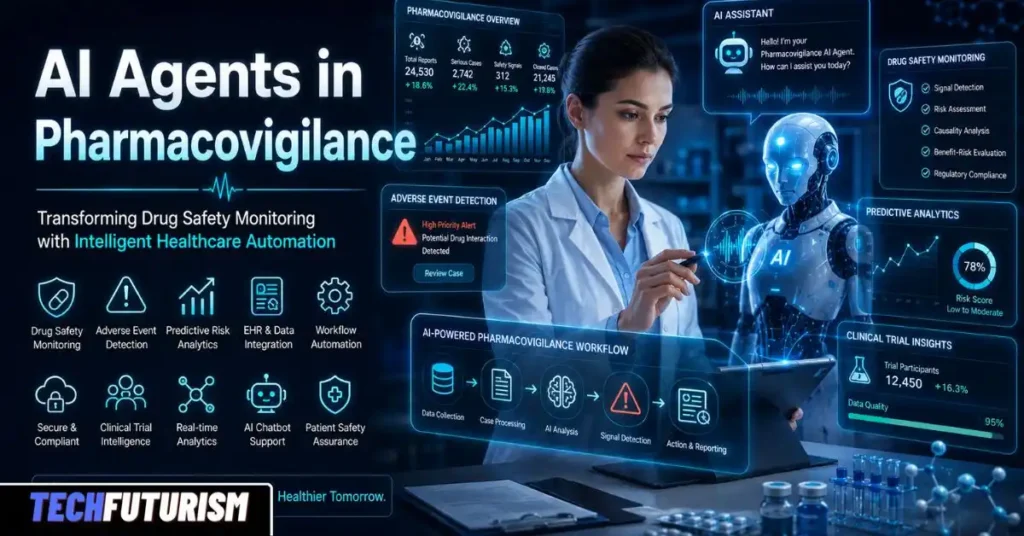
Every year, adverse drug reactions send millions of people to the hospital and cause hundreds of thousands of preventable deaths worldwide. The pharmaceutical industry has always worked hard to catch these problems — but for decades, the tools were slow, manual, and overwhelmed. Now, pharmacovigilance is undergoing a quiet revolution, powered by AI agents.
This guide covers everything: from types and tools to research, regulation, and machine learning — so you can act with confidence.
- Key Statistics at a Glance
- What Is Pharmacovigilance — and Why Does It Matter?
- Types of AI Agents in Pharmacovigilance
- AI in Drug Safety: Key Applications Transforming the Field
- Machine Learning in Pharmacovigilance: Going Beyond Rules
- Artificial Intelligence and Big Data for Pharmacovigilance and Patient Safety
- CIOMS Artificial Intelligence in Pharmacovigilance: The Global Regulatory Framework
- The Use of Artificial Intelligence in Pharmacovigilance: A Systematic Review of the Evidence
- Step-by-Step: How to Implement AI Agents in Your Pharmacovigilance System
- AI in Pharmacovigilance Course: How to Build Your Team's Expertise
- AI Agents in Pharmacovigilance: PDF Resources and Further Reading
- The Future — and the Case for Acting Now
- Frequently Asked Questions
Key Statistics at a Glance
| Metric | Figure |
| Adverse events reported to the FDA annually | 2M+ |
| Estimated global under-reporting rate | 90% |
| Time savings AI delivers on case processing | Up to 80% |
| Global pharmacovigilance AI market by 2027 | $1.6 billion |
What Is Pharmacovigilance — and Why Does It Matter?
Pharmacovigilance is the science of detecting, assessing, understanding, and preventing the harmful effects of medicines. Every time a patient takes a drug, there is a possibility — however small — that something unexpected happens. Perhaps a routine headache worsens into a seizure. Perhaps a common antibiotic triggers a rare heart arrhythmia. Catching these signals early saves lives.
Traditionally, drug safety professionals collected reports from doctors, nurses, patients, and clinical trials, then manually reviewed thousands of documents to identify patterns. It was — and still is — enormously important work. But the volume of incoming data has exploded, and human teams simply cannot keep up on their own. That gap is exactly what AI agents in pharmacovigilance are built to close.
Real-World Story: When COVID-19 vaccines rolled out globally, regulators received millions of Individual Case Safety Reports (ICSRs) within months. A traditional team of 50 reviewers could spend weeks on what an AI agent now handles in hours — spotting a rare cluster of myocarditis cases in young males, flagging it for immediate investigation, and helping regulators update clinical guidance before the problem could grow further.
Types of AI Agents in Pharmacovigilance
Not all AI agents and pharmacovigilance are alike. Understanding the distinct types helps organisations choose the right tool for each task and build a coordinated, intelligent safety ecosystem. Broadly, they fall into six categories.
NLP Extraction Agents parse free-text reports, medical records, and scientific literature to extract structured safety data using natural language processing (NLP). They are the entry point for almost every AI pharmacovigilance pipeline — converting unstructured human language into machine-readable clinical data.
Signal Detection Agents continuously monitor multi-source data streams and flag disproportionate reporting patterns that may indicate a new or emerging safety risk. They operate across spontaneous reporting systems, EHRs, and social media simultaneously.
Process Automation Agents handle end-to-end case intake, triage, medical coding, and database entry — reducing manual workload by up to 80% and freeing safety scientists for high-value clinical analysis.
Regulatory Submission Agents compile, format, and validate PSURs, Risk Management Plans (RMPs), and ICSRs for submission to the EMA, FDA, and other regulatory authorities around the world.
Patient-Reporting Agents guide patients through structured side-effect reporting via conversational interfaces, encoding responses into MedDRA terminology automatically — making patient-reported outcomes both richer in detail and more actionable for safety teams.
Literature Monitoring Agents scan thousands of scientific publications each week, extract relevant safety findings, and prioritise articles requiring human review — turning a weeks-long manual process into an overnight automated scan.
Crucially, these agent types rarely operate in isolation. The most effective deployments combine multiple agents in a coordinated pharmacovigilance workflow automation pipeline — where, for example, an NLP extraction agent feeds cleaned data directly into a signal detection agent, which then routes confirmed signals to a regulatory submission agent for escalation. Together, they form an intelligent system that never tires, never misses a report, and continuously improves with use.
AI in Drug Safety: Key Applications Transforming the Field
AI in drug safety has moved well beyond proof-of-concept. Across the pharmaceutical industry, real systems are delivering measurable impact today. Here are the most consequential applications.
Automated Adverse Event Case Processing
One of the most time-consuming tasks in drug safety is processing adverse event reports. AI agents read incoming reports — whether structured forms or unstructured free-text narratives — extract key fields such as patient demographics, suspect drugs, reactions, and outcomes, and populate a safety database automatically. This cuts case processing time by up to 80%, freeing human experts for the complex clinical judgements that only they can make.
Real-Time Signal Detection and Signal Management
Finding a safety signal is like looking for a needle in a haystack — except the haystack contains millions of reports and grows every single day. Statistical algorithms such as the Proportional Reporting Ratio (PRR) and the Bayesian Confidence Propagation Neural Network (BCPNN) have long been part of the toolkit. AI agents extend these further — monitoring spontaneous reporting systems, social media, and electronic health records (EHRs) simultaneously, and flagging emerging patterns in near real-time.
Story in Practice: A large European pharmaceutical company deployed an AI agent to monitor patient forums and health communities online. Within three weeks of a new pain medication’s launch, the system detected an unusual cluster of reports describing extreme drowsiness and confusion in elderly patients — a pattern that never appeared in the clinical trial data. The company escalated the finding to regulators, updated its prescribing label, and avoided what could have become a wave of preventable hospital admissions. Humans would eventually have spotted it. The AI spotted it first.
Medical Literature Monitoring
Medical literature monitoring is a regulatory requirement: companies must scan thousands of scientific publications each week for any mention of their medicines causing harm. AI agents equipped with NLP read abstracts and full-text papers, extract relevant safety information, and flag publications requiring human review — turning a weeks-long manual process into an overnight automated scan.
Regulatory Submission Support
Submitting a Periodic Safety Update Report (PSUR) requires aggregating enormous data volumes into a structured, compliant document. AI agents automate data aggregation, draft narrative sections, and cross-check submissions against ICH E2C guidelines — dramatically reducing the risk of errors and costly delays.
While AI Agents in Pharmacovigilance help track and analyze drug safety data, AI Voice Agents in Healthcare improve patient communication by collecting important information and reporting potential side effects more quickly.
Patient-Centric Pharmacovigilance
AI agents are also reshaping how patients report side effects directly. Conversational AI tools integrated into patient-facing apps guide users through structured adverse event reporting, ask clarifying follow-up questions in plain language, and automatically encode responses into MedDRA terminology — making patient-reported outcomes both richer in detail and more actionable for safety teams.
Machine Learning in Pharmacovigilance: Going Beyond Rules
Machine learning in pharmacovigilance represents a step-change from traditional rule-based systems. Where older tools applied fixed thresholds — flag any report where the reporting ratio exceeds a defined value — machine learning models learn patterns from millions of historical cases and continuously refine their predictions as new data arrives.
In practice, this means three important things. First, supervised learning models trained on labelled safety data can classify incoming reports by seriousness, causality, and urgency with accuracy that rivals experienced reviewers. Second, unsupervised clustering algorithms can detect novel patterns — groupings of symptoms, drugs, and patient profiles — that no human analyst had thought to search for. Third, transformer-based language models (the same architecture underpinning modern AI assistants) now read clinical narratives with near-human comprehension, extracting structured safety data from sources as varied as hospital discharge summaries, social media posts, and regulatory submissions.
The result is a system that becomes more accurate with every report processed — one that actively reduces the pharmacovigilance blind spots that have historically led to delayed safety actions and patient harm.
Key Distinction: Not all machine learning is the same. Deep learning models excel at unstructured data — free text, images, audio. Classical ML approaches such as random forests and gradient boosting often outperform them on structured tabular safety data. Choose the right model for the data type, not the most fashionable algorithm.
Artificial Intelligence and Big Data for Pharmacovigilance and Patient Safety
The marriage of artificial intelligence and big data for pharmacovigilance is perhaps the most consequential development in patient safety since the introduction of spontaneous reporting itself. For the first time, safety teams can interrogate datasets of a scale and variety that were previously impossible to analyse.
Big data in this context draws from multiple streams. FDA FAERS and WHO VigiBase together contain tens of millions of spontaneous reports. Electronic health record (EHR) networks hold longitudinal patient histories for hundreds of millions of individuals. Real-world evidence (RWE) platforms aggregate insurance claims data, genomic information, wearable sensor readings, and social media self-reports into unified analytical environments.
When AI agents operate across these data lakes, they can identify safety signals that no single source would reveal. A signal buried in five spontaneous reports might be confirmed by a pattern across 50,000 EHR records — and that confirmation can happen in hours rather than years. This is the core promise of combining AI and big data for patient safety: compressed timelines, richer evidence, and earlier protective action.
The most valuable big-data assets for AI-driven pharmacovigilance include FDA Sentinel, WHO VigiBase, EudraVigilance, national EHR networks, insurance claims databases, and emerging real-world evidence platforms. Connecting these sources is the most strategically important infrastructure investment a drug safety team can make today.
CIOMS Artificial Intelligence in Pharmacovigilance: The Global Regulatory Framework
For organisations navigating the regulatory landscape, the CIOMS Working Group on Artificial Intelligence in Pharmacovigilance provides the most authoritative global framework available. Published with input from regulators, industry experts, and academic researchers across more than 30 countries, the CIOMS guidance addresses questions that no single national regulator has yet answered definitively.
Its central recommendations are worth understanding clearly. First, AI systems used in pharmacovigilance decision-support must be transparent: the basis for every automated decision must be explainable to a qualified human reviewer. Second, performance must be validated not once at deployment, but continuously — systems must be monitored for model drift over time. Third, human oversight — a qualified person capable of overriding automated outputs — must remain embedded in every workflow.
Together with the EMA’s reflection paper on AI in the medicine lifecycle and the FDA’s AI/ML action plan, the CIOMS framework forms a tripartite foundation for compliant AI pharmacovigilance globally. Organisations that build their systems against all three are well-positioned for regulatory inspection anywhere in the world.
The Use of Artificial Intelligence in Pharmacovigilance: A Systematic Review of the Evidence
The academic evidence base for the use of artificial intelligence in pharmacovigilance has grown rapidly. A landmark systematic review of the literature examining AI applications across the pharmacovigilance lifecycle found consistent, reproducible benefits across multiple independent studies.
Key findings from the peer-reviewed literature include: NLP-based systems detect adverse drug reactions from electronic health records with sensitivity exceeding 85% in controlled evaluations; machine learning signal detection algorithms outperform classical disproportionality analysis in identifying true safety signals while reducing false-positive burden; and deep learning models applied to social media data capture patient-reported adverse events that never appear in spontaneous reporting systems — providing a meaningful supplement to traditional data sources.
Importantly, the literature also identifies consistent limitations. Most validated systems perform well within the data environment they were trained on, but generalise imperfectly to new geographies, languages, or drug classes. This finding reinforces the CIOMS recommendation for continuous performance monitoring — and underscores why ICH-aligned validation frameworks must accompany any deployment.
Recommended Reading: For a rigorous entry point into the evidence base, start with the PubMed systematic review corpus on AI in pharmacovigilance, the CIOMS working group publications, and the EMA reflection paper. Together, these three sources cover technical methodology, regulatory expectation, and international consensus.
Step-by-Step: How to Implement AI Agents in Your Pharmacovigilance System
Whether you are a drug safety professional, a technology leader at a pharmaceutical company, or an independent consultant, the following roadmap gives you a practical path toward implementing AI-powered pharmacovigilance in your organisation.
Step 1 — Audit your current workflow. Map every step from report intake to regulatory submission. Identify the highest-volume, most repetitive tasks — these are your priority targets for intelligent process automation. Document current cycle times and error rates so you have a clear baseline against which to measure AI impact.
Step 2 — Define data sources and integration points. AI agents depend on structured, accessible data. Identify all inbound streams: FDA FAERS, WHO VigiBase, EudraVigilance, literature feeds, and social media. Confirm that your safety database — whether Oracle Argus or Veeva Vault Safety — exposes APIs that an AI layer can connect to cleanly.
Step 3 — Choose your AI platform or vendor. Evaluate purpose-built pharmacovigilance AI solutions — such as Saama, Arriello, or Cognizant Life Sciences — against general-purpose AI platforms. Key criteria include 21 CFR Part 11 compliance, audit-trail completeness, and the explainability of AI outputs to regulatory inspectors.
Step 4 — Validate before you deploy. Run parallel processing — allow the AI to handle cases alongside your human team, compare outputs systematically, and document every discrepancy. Under Good Pharmacovigilance Practices (GVP), formal validation is not optional. It is the foundation of regulatory trust in your system.
Step 5 — Train your team on human-AI collaboration. Safety professionals must learn to interpret AI outputs critically, override incorrect findings, and provide structured feedback that improves the system over time. Human-in-the-loop design is essential for both quality assurance and regulatory acceptance. Frame AI as a tool that eliminates tedious tasks — freeing experts for the complex judgements only humans can make.
Step 6 — Monitor, audit, and continuously improve. After deployment, track key performance indicators: case processing speed, signal detection false-positive rates, literature review coverage, and model drift. Schedule regular system audits. The strongest AI pharmacovigilance systems improve with every cycle — but only if actively and deliberately managed.
Editor’s Tip: Start with one high-volume, low-risk task — such as narrative writing automation for routine ICSRs — and prove value before scaling. This approach builds internal confidence, satisfies regulators through incremental validation, and gives your team the time they need to develop genuine trust in the technology.
AI in Pharmacovigilance Course: How to Build Your Team’s Expertise
Technology alone does not transform drug safety operations — people do. As pharmacovigilance AI agents become standard infrastructure, the demand for professionals who can configure, validate, interpret, and govern these systems has surged. Fortunately, a growing number of high-quality training pathways now exist.
| Course / Programme | Provider | Focus | Level |
| AI in drug safety and pharmacovigilance | DIA Global | Regulatory, signal detection, AI governance | Intermediate |
| Applied machine learning in life sciences | Coursera | ML fundamentals, NLP, real-world evidence | Foundational |
| Pharmacovigilance and AI masterclass | PSI | Statistical methods, signal management, big data | Advanced |
| WHO pharmacovigilance training programme | WHO Uppsala Monitoring Centre | Global PV systems, data quality, reporting standards | Foundational |
| CIOMS AI in pharmacovigilance workshop | CIOMS | Governance, ethics, international regulatory alignment | Advanced |
Beyond formal courses, internal learning programmes — structured around real case studies from your own safety database — often produce faster capability gains than external training alone. Pairing a qualified data scientist with a senior pharmacovigilance scientist in a joint project delivers both technical build and domain contextualisation at the same time. This is the human-AI collaboration model in its most productive form.
AI Agents in Pharmacovigilance: PDF Resources and Further Reading
For professionals who prefer to study in depth — or who need to brief stakeholders with authoritative reference material — the following AI agents pharmacovigilance PDF resources represent the highest-quality freely available literature in the field. Each has been selected for rigour, practical relevance, and regulatory authority.
The CIOMS Working Group report on AI in pharmacovigilance is the single most comprehensive document available — covering technical methodology, governance frameworks, validation requirements, and international regulatory alignment in one downloadable reference. It is essential reading for any organisation building an AI pharmacovigilance strategy.
The EMA reflection paper on AI in the medicinal product lifecycle offers a European regulatory perspective on explainability, bias, data governance, and post-market monitoring — all directly applicable to pharmacovigilance deployments. The FDA’s AI/ML action plan provides the equivalent US regulatory counterpart.
For academic depth, the PubMed library hosts the full corpus of peer-reviewed literature on AI in pharmacovigilance — including systematic reviews, signal detection algorithm comparisons, and NLP benchmarking studies that form the evidence base for current best practice. Filtering by publication year (2022 onwards) surfaces the most clinically current findings.
The Future — and the Case for Acting Now
The next generation of AI agents in pharmacovigilance will combine large language models (LLMs), real-world evidence from wearables and electronic health records, and multimodal data inputs to detect safety signals long before they appear in spontaneous reporting systems. We are moving toward a world of continuous, proactive drug safety monitoring — where the system never sleeps, never misses a report, and surfaces the most critical signals for human decision-making within hours, not months.
Looking Ahead: Imagine a patient in rural Indonesia reporting a side effect through a mobile app. An AI agent encodes and routes the report in seconds. A signal detection algorithm flags it as part of a growing global pattern. A regulatory alert is issued before a single preventable death occurs. This is not science fiction. Pilots of exactly this kind of system are already running. The technology is ready. The question is whether your organisation is, too.
The pharmaceutical industry carries a profound responsibility: to ensure that the medicines it brings to market are as safe as science allows. Pharmacovigilance AI agents do not replace that responsibility — they amplify it. By automating the high-volume, repetitive tasks that once consumed safety teams, these systems free human experts to do what they do best: apply clinical judgement, investigate emerging anomalies, and protect patients.
The technology is mature. The regulatory frameworks are coming into focus. The business case is clear. And the patient safety case is undeniable. The only meaningful question remaining is how quickly your organisation is willing to act.
Frequently Asked Questions
Q1. What exactly do AI agents do in pharmacovigilance, and how are they different from regular software?
This is one of the most common questions people ask — and it is a great one, because the difference really matters.
Regular software follows fixed rules. You tell it: “If a report contains the word ‘death,’ mark it as serious.” It does that one thing, every time, without any flexibility. It cannot learn, adapt, or handle anything it was not explicitly programmed for. If a report describes a fatal outcome unusually — say, using medical shorthand or a different language — the old software might miss it entirely.
AI agents work completely differently. They can read a report the way a trained human would — understanding context, picking up on subtle clues, and making judgements based on patterns learned from millions of previous cases. They can handle messy, inconsistent, real-world data. They can work across multiple tasks at once. And crucially, they get smarter over time as they process more information.
In pharmacovigilance specifically, an AI agent might receive a handwritten patient complaint, extract the drug name, the side effect, and the patient’s age, cross-reference that combination against a global safety database, assign a severity score, flag it for human review if needed, and file it in the correct regulatory format — all within a few minutes, without any human touching it at each step.
Think of it this way. Traditional software is like a vending machine: it only gives you what you programme it to give, and nothing else. An AI agent is more like a trained assistant: it understands what you need, uses judgement to figure out the best way to get it done, and improves with experience.
That combination of speed, flexibility, and learning ability is why pharmacovigilance AI agents are such a transformative development for patient safety.
Q2. Is AI in pharmacovigilance safe and approved by regulators like the FDA and EMA?
This question comes up constantly — and it deserves a direct, honest answer: yes, but with important conditions attached.
Neither the FDA nor the EMA has banned AI in pharmacovigilance. In fact, both agencies actively encourage the responsible use of AI to improve drug safety. The FDA has published a detailed AI/ML action plan. The EMA has released a reflection paper on using AI across the medicine lifecycle. The CIOMS — the global body that sets international pharmacovigilance standards — has an entire working group dedicated to AI, and has produced comprehensive guidance that organisations around the world are already following.
What regulators insist on, however, is that AI systems used in pharmacovigilance meet the same standards of rigour that apply to any other regulated process. That means three things in practice.
First, the system must be properly validated. You cannot simply plug an AI tool into your safety workflow and assume it works correctly. You have to test it thoroughly, compare its outputs against expert human reviewers, document every discrepancy, and demonstrate that it performs consistently and accurately before you rely on it for anything that affects patient safety or regulatory submissions.
Second, the AI must be explainable. A black-box system that produces answers nobody can explain is not acceptable in a regulated environment. If an AI agent flags a safety signal or classifies a case as serious, a qualified human reviewer must be able to understand why — and must have the authority to override that decision if they disagree.
Third, human oversight must remain in place. Under Good Pharmacovigilance Practices (GVP), a qualified person must remain accountable for every pharmacovigilance decision. AI can inform and support that decision — it cannot replace the human who is ultimately responsible for it.
So the short answer is: AI in pharmacovigilance is not just permitted — it is actively supported by regulators. The conditions are clear, achievable, and entirely reasonable. Companies that meet them can use AI with full confidence and regulatory backing.
Q3. How does machine learning actually detect safety signals — and can it really do it better than a human expert?
This is a fascinating question, and the answer genuinely surprises most people when they hear the detail.
A human expert reviewing adverse event reports relies on experience, pattern recognition, and clinical knowledge. They are very good at spotting signals that match patterns they have seen before. But they have real limitations: they can only review so many reports per day, they can only hold so much information in their heads at once, and they are subject to all the cognitive biases that affect every human being — confirmation bias, fatigue, anchoring on the most recent case they reviewed.
Machine learning works differently, and those differences are significant. A machine learning model trained on millions of historical adverse event reports can hold every one of those patterns in memory simultaneously. It does not get tiring. It does not anchor on the last case it saw. It applies the same level of attention to report number one million as it does to report number one.
Practically, here is how signal detection works with machine learning. The model analyses the incoming stream of adverse event reports and looks for cases where a particular drug-reaction combination appears more often than you would expect by chance — a concept called disproportionality analysis. Classical statistical methods like the Proportional Reporting Ratio do this with a relatively simple formula. Machine learning models do the same thing, but they can simultaneously account for dozens of confounding factors — patient age, co-medications, geography, reporting source, time since drug launch — that classical methods struggle to handle.
Beyond disproportionality, more advanced machine learning models can identify signals that have no obvious statistical footprint yet. By recognising subtle patterns in the language of reports — the specific combination of symptoms, the sequence in which they appeared, the demographic profile of affected patients — these models can flag a potential issue weeks or even months before it would appear in any statistical analysis.
Can machine learning do this better than a human expert? For high-volume screening and pattern recognition across enormous datasets — yes, it outperforms humans consistently and measurably. For the complex clinical judgement that follows — deciding whether a signal is real, what it means for patients, and what regulatory action to take — experienced human experts remain essential. The best pharmacovigilance systems combine both: machine learning for scale and speed, human expertise for judgement and accountability. Neither one alone is as powerful as both working together.
Q4. How much does implementing AI in pharmacovigilance cost, and is it worth it for smaller companies?
Cost is always the practical question that follows the exciting ones — and it is entirely fair to ask it.
The honest answer is that implementation costs vary widely depending on the approach you take. At the high end, a fully custom AI pharmacovigilance platform built from scratch and integrated into a large enterprise safety system can run into several million dollars when you factor in software development, data infrastructure, validation, and ongoing maintenance. Large pharmaceutical companies with global safety operations are already investing at this level, and the return is clear: reducing case processing time by 70-80% across tens of thousands of reports per year generates substantial savings in both cost and regulatory risk.
For smaller companies — including mid-size biotechs, specialty pharma organisations, and CROs — the picture is more accessible than many people assume. Several purpose-built AI pharmacovigilance platforms now offer subscription or modular pricing, putting sophisticated AI capabilities within reach of organisations without enterprise-scale budgets. Rather than building everything from scratch, these companies can connect their existing safety database — such as Oracle Argus or Veeva Vault Safety — to an AI layer that handles specific high-value tasks: automated case intake, narrative generation, or literature monitoring.
Starting small is not just a cost strategy — it is actually the recommended approach even for larger organisations. Picking one well-defined, high-volume process and deploying AI there first lets you prove value quickly, build internal confidence, satisfy regulatory validation requirements incrementally, and develop the in-house expertise you need before scaling further. The first successful deployment almost always pays for itself within the first year through time savings alone.
The deeper question, though, is not whether smaller companies can afford AI in pharmacovigilance. It is whether they can afford not to have it. As the volume of adverse event reports grows, as regulatory expectations rise, and as submission timelines tighten, the manual-only approach becomes increasingly unsustainable — regardless of company size. AI does not have to be an all-or-nothing investment. For most companies, the right starting point is a single, well-chosen use case that delivers fast, measurable, and defensible value. From there, the path forward tends to become obvious.