
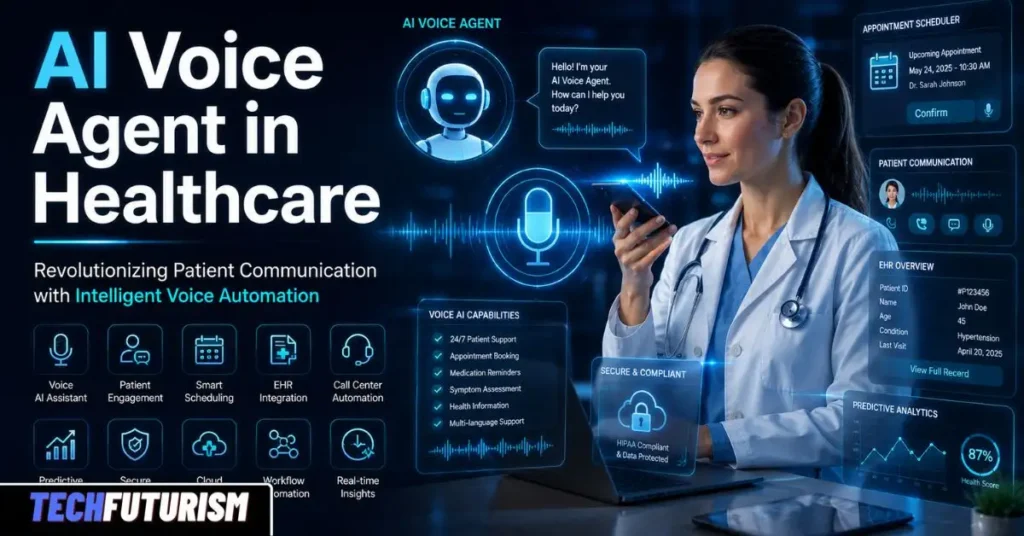
Imagine calling your doctor’s office at 2 a.m. because you are worried about a strange symptom. Instead of reaching voicemail, a calm and intelligent voice answers immediately. It listens to your concern, checks your medical history, books an urgent appointment, and sends you follow-up instructions — all within two minutes. No hold music. No frustration. Just help when you need it most.
This is not science fiction. The AI voice agent in healthcare is making this kind of experience possible today — at scale, across thousands of clinics, hospitals, and telehealth platforms worldwide.
In this article, we walk you through everything you need to know: what these tools actually are, which platforms lead the market, what careers they are creating, and how you can implement one in your own practice — or benefit from one as a patient.
- What Is an AI Voice Agent in Healthcare?
- Why Healthcare Needs Voice AI Now
- How AI Voice Agents Actually Work
- Key Benefits for Patients and Providers
- Step-by-Step Guide: Implementing an AI Voice Agent Healthcare
- Healthcare AI Agents: Real-World Use Cases Across Specialties
- Healthcare AI Call Center: Automating the Front Door of Care
- Assort Health: Specialty-Trained Voice AI at Scale
- Assort AI vs. Infinitus AI: Two Platforms, Two Strengths
- Health AI Agents for Doctors: Reducing the Documentation Burden
- AI Voice Agent in Healthcare Jobs: The Emerging Career Landscape
- Common Challenges and How to Overcome Them
- The Future of AI Voice Agents in Healthcare
- How to Choose the Right AI Voice Agent Solution
- Final Thoughts
- Frequently Asked Questions (FAQ)
What Is an AI Voice Agent in Healthcare?
A healthcare AI voice agent is a software system that uses natural language processing (NLP) and speech recognition to hold real, meaningful conversations with patients and healthcare staff — using voice alone.
Unlike old-fashioned interactive voice response (IVR) systems that force callers to press “1 for appointments” and “2 for billing,” a conversational AI agent understands context. It listens, interprets intent, and responds like a trained clinical assistant. Tasks range from simple appointment scheduling to advanced clinical decision support and real-time patient triage.
These systems sit at the intersection of artificial intelligence in medicine and patient communication — and they are rapidly becoming one of the most consequential tools in modern healthcare delivery.
Key statistics at a glance:
- 60% of patients prefer digital-first communication
- $150B saved annually through AI automation in healthcare
- 40% fewer missed appointments with AI-powered reminders
- 24/7 patient availability vs. 9–5 human staff coverage
AI Voice Agents are one of the most useful types of AI Agents in Healthcare, helping hospitals and clinics automate patient calls, answer questions, schedule appointments, and improve patient support.
Why Healthcare Needs Voice AI Now
Healthcare systems worldwide are under enormous pressure. Staff shortages, growing patient loads, and the rising complexity of chronic disease management have pushed traditional care models to their limits. Meanwhile, patients expect faster, more personalized, and more convenient service than ever before.
Consider this: administrative tasks consume up to 30–40% of a physician’s working day. Doctors spend hours on paperwork, phone follow-ups, and routine patient queries — time that would be far better spent on direct patient care. This is precisely the gap that AI-powered automation is designed to close.
Real-world story: Dr. Sarah Mitchell runs a busy family practice in Austin, Texas. Every morning, her front desk team spent the first two hours returning calls left overnight. After deploying an AI voice agent for patient engagement, those calls are handled automatically — after hours, on weekends, even on public holidays. “It felt like hiring five extra people,” she says. “But the AI never calls in sick.”
Beyond staffing relief, there is a deeper reason to act. Patient safety improves when communication improves. Missed medication reminders, forgotten appointment details, and delayed triage responses all contribute to preventable harm. A voice AI system that reaches patients proactively can close those gaps — at a fraction of the cost of additional headcount.
How AI Voice Agents Actually Work
Understanding the technology helps you trust it. Here is a plain-English breakdown of how a healthcare voice AI platform functions.
When a patient speaks, the system captures their voice and converts it to text using automatic speech recognition (ASR). A large language model (LLM) then analyses the meaning behind those words — not just the literal text — using NLP techniques. The system identifies intent (for example, “book an appointment for next Tuesday”) and connects to the provider’s electronic health record (EHR) to complete the action.
Finally, it responds via text-to-speech (TTS) synthesis, generating a natural-sounding reply in real time. The full cycle takes milliseconds.
Advanced systems also incorporate sentiment analysis to detect emotional distress in a caller’s tone. When distress is detected, the system escalates the call to a human clinician rather than handling it alone — an important patient safety safeguard that separates responsible platforms from reckless ones.
Key Benefits for Patients and Providers
Whether you are a healthcare administrator, a busy clinician, or a patient trying to access timely care, AI voice agents deliver real, measurable value:
- 24/7 availability — Patients get support at any hour, reducing unnecessary ER visits for non-urgent concerns
- Automated scheduling — Books, cancels, and reschedules appointments without requiring human staff involvement
- Medication reminders — Deliver intelligent, personalized voice reminders for prescriptions and refill requests
- Multilingual support — Communicates in patients’ preferred languages, directly improving health equity
- Reduced administrative burden — Frees clinical staff from repetitive tasks so they can focus on higher-value care
- HIPAA compliance — Leading platforms are built with data security and regulatory compliance at their core
Furthermore, providers report measurable improvements in patient satisfaction scores (CAHPS) after deploying voice AI — largely because patients feel attended to even outside business hours, which builds lasting confidence in the care relationship.
Step-by-Step Guide: Implementing an AI Voice Agent Healthcare
Implementing a healthcare voice AI solution does not have to be complicated. Follow this seven-step roadmap to get started with confidence:
Step 1 — Identify your biggest pain points. Before evaluating any platform, map where your team loses the most time. Is it after-hours call volume? High no-show rates? Prescription refill backlogs? A clear problem definition shapes a far better solution.
Step 2 — Audit your existing technology stack. Confirm which EHR system you use — Epic, Cerner, Athenahealth, or another — and verify that candidate platforms integrate via HL7 FHIR APIs. Interoperability is non-negotiable.
Step 3 — Evaluate vendors for HIPAA compliance. Any platform handling protected health information (PHI) must be fully HIPAA-compliant. Always request a signed Business Associate Agreement (BAA) before moving forward with any vendor.
Step 4 — Start with a focused pilot. Rather than a full rollout, begin with a single use case — outbound appointment reminders are a low-risk starting point. Measure carefully over 60 days before expanding scope.
Step 5 — Train your staff alongside the system. Your team needs to understand how the AI handles calls, when it escalates to a human, and how to read analytics dashboards. Structured training before go-live prevents gaps in patient experience.
Step 6 — Collect patient feedback continuously. Automate a brief post-call survey after each AI-handled interaction. Use that data to refine conversation scripts, adjust voice tone settings, and prioritize the next use cases to build out.
Step 7 — Scale deliberately. Once your pilot delivers results, expand methodically — to billing inquiries, post-discharge follow-up, chronic disease check-ins, and preventive care outreach.
Healthcare AI Agents: Real-World Use Cases Across Specialties
Healthcare AI agents are no longer limited to answering basic scheduling calls. They are now embedded across the full continuum of care — transforming every patient touchpoint from first contact to post-discharge follow-up. Across the full spectrum of healthcare settings, these tools consistently deliver measurable results.
Primary Care and General Practice
Automated appointment reminders have cut no-show rates by up to 40% at practices using leading platforms. Patients receive a personalized call the day before, can confirm or reschedule by voice, and the system updates the calendar in real time — no receptionist required.
Patient story: James, a 67-year-old patient managing type 2 diabetes in Chicago, used to miss quarterly check-ups simply because he forgot. His clinic’s AI health assistant now calls him three days before every appointment, reminds him to fast for blood work, and asks whether he needs a transportation arrangement. He has not missed a single visit in 18 months.
Hospital Systems and Emergency Triage
Some hospital networks deploy AI-driven triage agents to screen patients before they arrive at the emergency department. The agent asks structured clinical questions, assesses urgency using established triage protocols, and directs patients to the appropriate level of care — reducing overcrowding and improving patient flow without adding staff.
Mental Health and Behavioral Care
Health AI agents play a distinctive role in behavioral health support. Between therapy sessions, patients can check in with a voice agent that monitors mood, flags crisis indicators, and notifies the treating clinician if something seems off. This creates a continuous safety net that no human team can sustain at scale.
Chronic Disease Management
For patients managing diabetes, hypertension, or heart failure, consistency is everything. A voice agent can call daily, log reported symptoms, and alert the clinical team to warning signs — without a nurse picking up the phone. That kind of regular touchpoint meaningfully improves treatment adherence outcomes.
Post-Discharge Follow-Up
Hospital readmission rates fall significantly when patients receive structured follow-up after discharge. A voice AI agent conducting daily recovery check-ins, answering medication questions, and escalating concerns to a clinician directly addresses one of the costliest problems in acute care.
Healthcare AI Call Center: Automating the Front Door of Care
The healthcare AI call center is one of the fastest-growing application areas for voice AI — and for very good reason. Traditional call centers are extraordinarily expensive to operate. The average annual labor cost for a 100-person healthcare call center exceeds $4 million, with agent turnover running at 25–45% annually. That churn costs organizations roughly 20% of each agent’s annual salary every time someone leaves.
AI call center agents change this equation entirely. Well-deployed healthcare AI call center solutions automatically resolve or deflect between 65% and 85% of all inbound calls — without a human agent touching them. Routine scheduling, prescription refill requests, insurance eligibility inquiries, and appointment confirmations are handled entirely by the AI. Human agents are freed to focus only on cases that genuinely require judgment, empathy, and clinical expertise.
The operational results are striking. One orthopedic network reduced average patient hold times from over 11 minutes to just over one minute within 30 days of deployment — while simultaneously growing appointment volume and reducing labor costs. AI call center agents do not eliminate jobs. They eliminate the most frustrating parts of jobs. Staff who previously spent entire shifts answering the same three questions can now focus on complex cases, improve patient relationships, and build more meaningful careers in healthcare.
Pro tip: When evaluating a healthcare AI call center platform, ask vendors specifically about their call deflection rate, average handle time, and escalation accuracy. Platforms like Hyro and Assort Health publish verified performance benchmarks. If a vendor cannot produce them, that tells you everything you need to know.
Assort Health: Specialty-Trained Voice AI at Scale
When it comes to specialty-specific voice AI, Assort Health has emerged as one of the most capable and fastest-growing platforms in the market. Founded in 2023 by Jon Wang and Jeff Liu — veterans of Apple, Stanford, Meta, and Commure — Assort was purpose-built to handle the operational complexity of specialty care, not just general scheduling queries.
What distinguishes Assort Health is the depth of its training data. The platform runs on a compounding dataset of over 125 million patient interactions across 22 clinical specialties — including orthopedics, cardiology, dermatology, pediatrics, behavioral health, and primary care. That specialty-specific training means the AI understands the difference between a post-operative global period constraint in orthopedic scheduling and a routine follow-up booking, and it applies the right rules automatically — without manual configuration.
The results are concrete. Michigan Orthopedic Surgeons captured $2.3 million in additional revenue and grew total appointment volume by 5% after deploying Assort across 10 locations. Another early customer reduced call abandonment rates from 41% to 8% within 30 days — cutting average hold time from 11 minutes to just over one minute.
Beyond inbound voice, Assort Health’s platform — AssortOS — has since expanded to encompass the full patient access journey: intake, referral management, outbound engagement campaigns, billing coordination, and care gap closure. Having raised $102 million in total funding in under four months, including a $76 million Series B led by Lightspeed Venture Partners, Assort is among the most well-resourced and technically advanced startups reshaping the AI voice agent in the healthcare landscape today.
Assort AI vs. Infinitus AI: Two Platforms, Two Strengths
While Assort AI focuses primarily on patient access — scheduling, intake, and front-desk automation for specialty practices — Infinitus AI has carved out a distinct position by automating the deeply complex, multi-step administrative and clinical phone calls that happen between providers, payors, pharmacies, and patients throughout an entire care journey.
Infinitus AI has powered more than 100 million minutes of healthcare conversations, accelerating care for over one million patients. The platform serves 44% of Fortune 50 companies and handles workflows most voice AI systems cannot touch — including specialty pharmacy benefit verification, prior authorization follow-up, copay card coordination, and provider data verification.
A core differentiator of Infinitus is its hallucination-free architecture. The company builds a “discrete action space” — a curated knowledge graph — in partnership with each customer. This graph defines exactly what the AI can and cannot discuss with patients, creating a compliance boundary that prevents the kind of AI errors that are simply unacceptable in clinical settings. Every call achieves a reported 98% success rate and collects data an average of 10% more accurately than human agents.
One specialty pharmacy customer reported that Infinitus enabled their team to support 50% more patients at current staff levels, freeing tens of thousands of hours per week for high-value clinical work. Together, Assort AI and Infinitus AI represent the two dominant models in healthcare voice automation: one optimized for the front door of care, the other for the complex administrative fabric behind it. Understanding which model fits your organization’s needs is the first and most important decision you will make when investing in this technology.
Health AI Agents for Doctors: Reducing the Documentation Burden
Health AI agents for doctors address a different but equally urgent problem — the documentation crisis. Physicians today spend, on average, nearly two hours on clinical documentation for every one hour of direct patient care. That ratio is clinically and humanly unsustainable, and it is a primary driver of physician burnout across every specialty.
AI agents for doctors are changing this through two primary mechanisms. First, ambient clinical intelligence tools — such as Nuance DAX and Suki AI — listen passively during patient encounters and automatically generate structured SOAP notes, referral letters, and after-visit summaries. Physicians review and approve the draft rather than dictating or typing it from scratch. Early adopters report documentation time reductions of up to 70%.
Second, AI agents for doctors now support real-time clinical decision support during consultations — surfacing relevant evidence-based guidelines, flagging potential drug interactions, and suggesting diagnostic pathways based on the patient’s presenting symptoms and history. These are not passive search tools. They are active agents operating within the clinical workflow, augmenting physician judgment rather than replacing it.
Anecdote: Dr. Priya Nair, a hospitalist in Seattle, used to spend the last 90 minutes of every shift catching up on notes. After her hospital deployed an ambient AI documentation tool, she finished her notes before leaving the ward. “I go home and actually have dinner with my kids,” she says. “That is not a small thing.”
The net effect for physicians is transformative. A doctor using well-designed health AI agents can see more patients, document more accurately, make fewer errors of omission, and end the day with far less cognitive fatigue. That is a meaningful improvement in both quality of care and quality of professional life.
AI Voice Agent in Healthcare Jobs: The Emerging Career Landscape
The rapid adoption of the healthcare AI voice agent is not just transforming patient care — it is generating an entirely new category of AI voice agent healthcare jobs. As health systems invest billions in intelligent automation, the demand for professionals who can design, deploy, and manage these systems is growing faster than the talent supply.
The most in-demand roles in this emerging field include the following:
Healthcare voice agent engineer. These professionals design the conversation flows, prompts, and escalation logic that govern how AI agents behave with patients. They work at the intersection of prompt engineering, NLP, and clinical workflow design. Typical requirements include 3–5 years of experience with LLMs and voice AI platforms, familiarity with HIPAA-regulated environments, and strong API integration skills.
AI agent engineer in healthcare. Roles like this — pioneered by companies such as Ellipsis Health — involve building and refining the prompt libraries, evaluation frameworks, and safety guardrails that keep AI agents clinically sound. Strong writing skills, an understanding of health literacy, and hands-on experience with large language models are core requirements.
Clinical informatics specialist (AI focus). As AI agents are integrated into EHR systems and care workflows, health systems need professionals who can bridge the gap between clinical staff and AI engineering teams — translating care protocols into structured agent behaviors and vice versa.
Healthcare AI prompt engineer. A fast-growing specialty, these roles focus on designing and iterating the prompts that guide LLM behavior in clinical contexts — ensuring outputs are accurate, empathetic, culturally sensitive, and fully compliant with regulatory standards. Salaries range from $52,000 to over $195,000 depending on seniority and organization.
For clinicians, the rise of AI voice agents in healthcare jobs also creates a powerful new hybrid role: the physician or nurse informaticist who shapes how AI systems interact with patients — contributing clinical expertise to the design of agents they will ultimately use themselves. This convergence of clinical and technical skill is where some of the most interesting and well-compensated careers in modern healthcare are being built right now.
Common Challenges and How to Overcome Them
Like any technology, AI voice agents come with real implementation challenges. Knowing them in advance makes the transition significantly smoother.
Patient Trust and Adoption
Some patients — particularly older adults — may initially resist AI-handled calls. The remedy is transparency: always identify the agent as AI at the start of every call, and provide a frictionless path to reach a human at any point. Trust builds quickly once patients experience consistent reliability. Over time, the convenience of instant answers typically outweighs any initial skepticism.
Accuracy with Clinical Language
General-purpose voice AI often struggles with complex medical terminology. Prioritize platforms trained specifically on clinical datasets — like Assort Health or Infinitus — and schedule regular log reviews to catch and correct misinterpretations before they affect patient experience.
Integration with Legacy Systems
Connecting modern AI platforms to older EHR infrastructure can be technically demanding. Favor vendors who offer dedicated integration engineering support and pre-built connectors for widely used systems. Always request a technical architecture review before committing to any contract.
Data Privacy and Regulatory Compliance
Healthcare is among the most heavily regulated sectors in the world. Beyond HIPAA, providers serving international patients must also comply with GDPR and applicable data sovereignty laws. Partner only with vendors who treat compliance as a product-level commitment — not a checkbox — and who can produce a signed BAA on day one.
The Future of AI Voice Agents in Healthcare
The pace of innovation in this space is remarkable. Within the next five years, we will see capabilities that make today’s deployments look basic by comparison.
Early implementations of multimodal AI already combine voice, vision, and real-time data analysis — enabling an agent to not only hear reported symptoms but also analyze a photo of a skin lesion, cross-reference lab results, and produce a structured clinical summary for the treating physician. That kind of synthesis was unimaginable just three years ago.
Meanwhile, ambient clinical intelligence — AI that listens passively during appointments and automatically generates clinical documentation — is rapidly becoming mainstream. Early adopters report up to a 70% reduction in documentation burden, giving clinicians the freedom to be fully present with their patients rather than facing their screens.
As generative AI matures, voice agents will also become more emotionally sophisticated — capable of supporting behavioral health conversations, palliative care discussions, and post-diagnosis counseling with genuine sensitivity. The shift from transactional automation to empathetic assistance is already underway. The healthcare organizations that invest in this transition now will be the ones best positioned to lead patient experience in the decade ahead.
How to Choose the Right AI Voice Agent Solution
Not all platforms are equal. When evaluating vendors, look for these five non-negotiable qualities in a healthcare AI agent partner:
EHR integration. The platform must connect cleanly to your existing systems via HL7 FHIR. Verify pre-built connectors for your specific EHR — Epic, Cerner, Athenahealth — before entering any commercial discussion.
Clinical-grade NLP. Ensure the AI has been trained on real medical language and can reliably handle drug names, diagnoses, insurance terminology, and clinical workflows — not just general conversation.
Configurable workflows. Your practice has unique protocols. Choose a platform that lets operational staff build and adjust conversation flows without depending on a developer for every change.
Transparent analytics. You need real-time visibility into call volumes, task completion rates, patient satisfaction data, and escalation patterns. If a vendor cannot demonstrate a clear analytics dashboard in the demo, look elsewhere.
Proven clinical outcomes. Ask for published case studies, peer-reviewed validation, and references from organizations comparable to yours in size and specialty. Vendors with genuine results share them readily — and proudly.
Pro tip: Before signing any contract, run a live demo using your own realistic patient scenarios. Test edge cases: strong accents, ambiguous symptom descriptions, urgent escalation paths. How a vendor handles the unexpected reveals far more about platform maturity than any polished sales deck ever will.
The right healthcare AI voice agent should feel like an invisible, tireless member of your care team — one that consistently puts the patient first, never compromises on safety, and makes your staff’s work measurably easier every single day.
Final Thoughts
Healthcare stands at a remarkable turning point. The AI voice agent in healthcare is no longer a futuristic concept — it is a practical, proven, and accessible tool that practices of every size can deploy right now.
Platforms like Assort Health and Infinitus AI are demonstrating what is possible at scale, while a new generation of AI voice agents in healthcare jobs is creating careers at the frontier of clinical technology. Healthcare AI agents are transforming every layer of care — from the healthcare AI call center to the physician’s exam room. Health AI agents for doctors are giving clinicians their time back, and the broader category of health AI agents is closing gaps in access, adherence, and follow-up that the healthcare system has struggled with for decades.
From patient engagement and intelligent scheduling to post-discharge monitoring and chronic disease management, the applications are broad, the return on investment is clear, and the impact on patient outcomes is real and measurable.
If your practice still relies entirely on human staff for routine patient communication, the question is not whether to adopt this technology. It is how quickly you can do so without leaving patients behind in the process. Start with one clear problem. Measure obsessively. Scale with purpose.
Because in healthcare, every improvement in communication is ultimately an improvement in care.
Frequently Asked Questions (FAQ)
Q1. Will an AI voice agent replace my doctor or nurse?
This is the number one concern most people have — and it is completely understandable. The short answer is no. An AI voice agent is not designed to replace your doctor or nurse. It is built to handle the repetitive, time-consuming tasks that keep doctors and nurses away from what they do best: taking care of you.
Think about everything that happens before you even sit down with your doctor. Someone had to answer your call, find an open slot, check your insurance, send you a reminder, and log your details into the system. None of that requires a medical degree. But it does consume enormous amounts of time — time that trained clinicians could be spending with patients instead.
What AI voice agents actually replace is the grind. They take over the scheduling calls, the medication reminders, the after-hours inquiries, and the routine follow-ups. This frees up nurses to focus on clinical judgment and frees doctors to spend more time listening to you, not typing into a computer.
That said, the conversation around AI in healthcare is not black and white. The United States is facing a serious healthcare workforce shortage, and some experts honestly acknowledge that AI will eventually take on a broader role as that shortage deepens. Nursing unions have already raised concerns about how AI tools are being introduced into hospitals without enough input from frontline staff — and those concerns deserve to be taken seriously.
The honest picture is this: today, AI voice agents are assistants, not replacements. They make human caregivers more effective. Whether that remains true as the technology advances is a conversation the entire healthcare industry needs to keep having — openly, and with clinical staff at the table.
Q2. Is my personal health information safe with an AI voice agent?
This is a smart and important question. Your health information is among the most sensitive data you have, and you are right to ask exactly how it is protected before trusting any AI system with it.
Here is the good news: reputable healthcare AI voice agent platforms are built from the ground up to comply with HIPAA — the federal law that sets strict rules for how patient health information must be handled, stored, and shared. In practice, this means several layers of protection are in place every time the system touches your data.
First, all data transmitted between the AI and the healthcare provider’s systems is encrypted — meaning it is scrambled in a way that makes it unreadable to anyone who should not have access. Second, access to your information is restricted to only the people and systems that genuinely need it for your care. If an AI is scheduling an appointment, for example, it should not be pulling up your full medical history — only the details required to complete that specific task. Third, every interaction is logged in an audit trail, so there is always a record of what data was accessed, by whom, and when.
There is also a legal requirement called a Business Associate Agreement (BAA). Any vendor handling patient data on behalf of a healthcare provider must sign one. If a vendor hesitates or refuses to sign a BAA, that is a major red flag and a clear signal to walk away.
One important thing to watch out for: not all AI tools that call themselves “healthcare AI” are actually built for healthcare compliance. Many general-purpose AI platforms simply are not equipped to handle protected health information safely. The average cost of a healthcare data breach in the United States reached $9.77 million in 2024 — so the stakes for getting this wrong are very real. Always ask your provider which AI system they use and whether it is fully HIPAA-compliant. You have every right to know.
Q3. How much does an AI voice agent cost for a healthcare practice?
Cost is one of the most common barriers holding smaller practices back — and it should not be, because the numbers are more accessible than most people realize.
For most healthcare practices in the United States, a subscription to a healthcare AI voice agent platform runs between $500 and $3,000 per month, depending on call volume, the number of features included, and how deeply the system integrates with your existing EHR and practice management software. Some vendors charge by the minute instead, with rates typically ranging from $0.05 to $2.00 per minute of call time. Larger enterprise platforms custom-built for health systems can run higher, but the standard SaaS models are designed to be accessible for practices of all sizes.
Now here is where the numbers get really interesting: the return on investment. Most healthcare practices that deploy an AI voice agent see positive ROI within three to six months. Here is why.
Running a traditional healthcare call center is expensive. A single full-time front desk employee handling calls costs roughly $40,000–$55,000 per year in salary alone, before you add benefits, training, and the cost of turnover — which in healthcare administrative roles runs at 30–45% annually. Every time an employee leaves and needs to be replaced, it costs the practice roughly 20% of that person’s annual salary. An AI voice agent, by contrast, runs around the clock without overtime, sick days, or turnover costs.
On top of labor savings, practices consistently report that AI agents reduce no-show rates by up to 40%, capture after-hours appointment requests that would otherwise be lost, and improve insurance collection rates by reducing errors in intake information. One industry analysis estimated that a mid-size practice with six providers can generate net savings of roughly $138,000 per year, representing a return on investment of over 400%.
For a solo practitioner or a small clinic, even conservative estimates suggest net annual savings well above $50,000 — often several times the annual cost of the platform itself. The cost of doing nothing is actually higher than the cost of getting started.
Q4. What can an AI voice agent’s healthcare actually do — and what can it not do?
This is the most practical question of all, and it deserves a straight, honest answer — because overpromising is a real problem in the AI industry.
Here is what a good AI voice agent can genuinely do today:
It can answer patient calls 24 hours a day, seven days a week, in multiple languages — without putting anyone on hold. It can schedule, reschedule, and cancel appointments directly inside your EHR system. It can send proactive outbound reminders for upcoming visits, medication refills, and preventive screenings. It can collect basic intake information, verify insurance eligibility, and handle prescription refill routing. It can conduct post-discharge check-in calls, ask standardized questions about a patient’s recovery, and flag concerning answers for a nurse or doctor to review. In emergency triage applications, it can ask structured clinical questions and direct patients to the appropriate level of care — whether that is a same-day appointment, an urgent care visit, or a 911 call.
For doctors specifically, ambient AI tools can listen during appointments and automatically draft clinical notes — giving physicians back 1–3 hours of documentation time every single day.
Here is what an AI voice agent cannot do — and should never try to do:
It cannot diagnose a medical condition. It cannot replace the judgment of a clinician who has examined you, reviewed your full history, and considered the nuances of your individual situation. It cannot provide mental health therapy or crisis counseling on its own — the best systems recognize distress in a caller’s voice and immediately connect them to a human. It cannot handle highly complex or emotionally charged conversations the way a trained human can, and it should never attempt to.
The clearest way to think about it is this: an AI voice agent handles the predictable, repeatable parts of patient communication with speed and consistency that no human team can match at scale. A human clinician handles everything that requires empathy, judgment, and the irreplaceable experience of one person truly listening to another. The best healthcare organizations in America right now are learning to let each do what it does best — and the patients in their care are better off for it.