
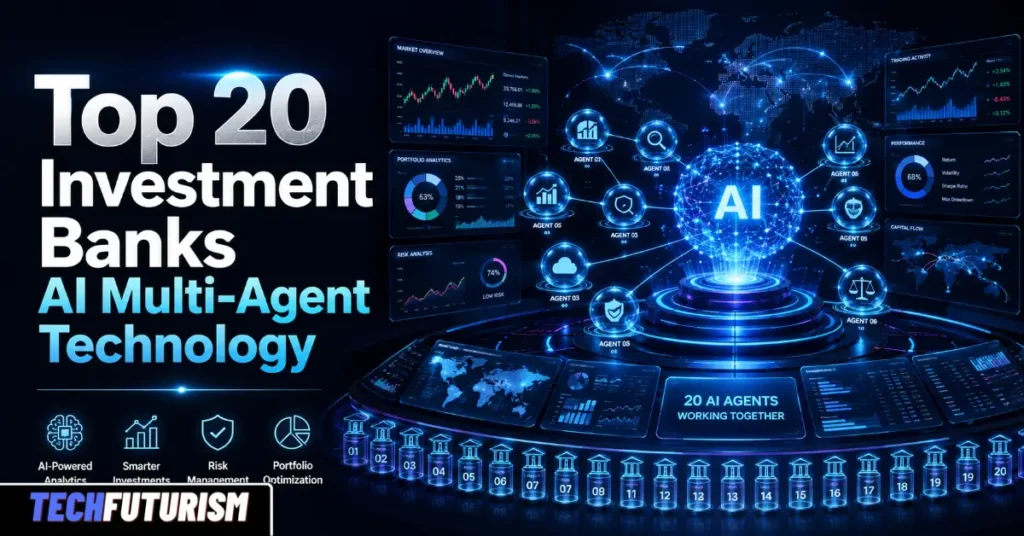
A junior analyst at a bulge-bracket bank once spent an entire weekend rebuilding a merger model by hand, chasing numbers across a dozen disjointed data rooms. Two years later, that same task takes minutes, not days, because a network of specialized AI agents now pulls the filings, checks the math, and flags the inconsistencies before a human ever opens the spreadsheet. That shift, quiet at first and now impossible to ignore, is the story of agentic AI on Wall Street.
Multi-agent AI technology no longer lives in a research lab. It now sits inside trading desks, compliance teams, and client advisory units at the world’s largest financial institutions. Instead of one chatbot answering one question, banks now deploy fleets of coordinated agents, each with a defined role, working together to plan, execute, and verify multi-step financial workflows.
This article breaks down the top 20 investment banks AI multi-agent technology in the world, explains how the technology works, reviews the vendors and courses building the talent pipeline behind it, and offers a step-by-step guide so any reader can judge which institutions are genuinely leading rather than simply marketing the trend.
- Investment Banking AI: What Multi-Agent Technology Means for Wall Street
- Evident AI Index Banks: A Step-by-Step Guide to Evaluating Any Bank's AI Program
- Top 20 Investment Banks AI Multi-Agent Technology in the World: The Full Ranking
- 2025 Evident AI Index: Why JPMorgan Chase Leads Banking AI Rankings
- Hebbia AI: The Multi-Agent Platform Behind Wall Street's Deal Teams
- AI for Investment Banking Course: How to Build Multi-Agent AI Skills for a Banking Career
- Which AI Is Best for Investment Advice? Comparing ChatGPT, Claude, and Gemini
- Which AI Is Best for Financial Planning? What the Comparisons Show
- Why Multi-Agent AI Is Becoming Non-Negotiable for Investment Banks
- Frequently Asked Questions
Investment Banking AI: What Multi-Agent Technology Means for Wall Street
Multi-agent AI systems differ from a single chatbot in one critical way: they divide labor. A planner agent breaks a task into steps. An executor agent carries out each step, whether that means pulling market data or drafting a paragraph of a pitch book. A verifier agent then checks the output against rules and compliance guardrails before anything reaches a banker’s desk.
According to a 2026 industry analysis from The CG AI Group, this “planner/executor/verifier” architecture has replaced the earlier, simpler chatbot-style tools that defined 2024, largely because regulators and risk officers demand an audit trail before signing off on autonomous work.
This matters because investment banking AI runs on precision, not novelty. A single wrong number in an accretion/dilution table can derail a deal review, so the technology only earns trust once it can show its work. That is precisely why agentic AI adoption in banking has accelerated so quickly: it does not just generate an answer; it demonstrates how it reached one.
Many of the newest deployments also rely on the Model Context Protocol, an open standard that lets AI agents securely connect to a bank’s internal data and external systems without a custom integration for every tool. With that foundation in place, it becomes easier to understand why some banks now lead the pack while others still test the waters.
“Investors are also exploring new opportunities in AI-driven finance through products like the SoFi Agentic AI ETF (AGIQ), which focuses on companies using advanced AI technologies and highlights the growing impact of intelligent AI systems in the financial world.”
Evident AI Index Banks: A Step-by-Step Guide to Evaluating Any Bank’s AI Program
Before ranking any institution, it helps to know what separates a genuine deployment from a marketing slide. Readers, investors, and job seekers evaluating Evident AI Index banks and their peers can follow this simple framework.
- Check for production use, not just pilots. Ask whether the bank has moved agents into daily workflows or is still running internal trials. The Evident AI Index, an independent benchmark tracking 50 of the world’s largest banks, is a reliable public source for this distinction.
- Look for named, verifiable use cases. Vague statements about “AI transformation” carry less weight than specific tools, such as an internal coding assistant or a client-facing advisory agent, that a bank discloses publicly.
- Assess governance and compliance controls. A bank that pairs autonomous agents with human-in-the-loop checkpoints and clear audit trails is better positioned to scale safely under frameworks like the EU AI Act.
- Measure the scale of deployment. The number of employees using the tools, daily prompt volume, or transaction throughput signals whether an initiative is a proof of concept or core infrastructure.
- Track talent and research investment. Banks that hire dedicated agentic AI researchers and publish technical papers tend to convert that research into applied products faster than peers who rely solely on vendors.
With this framework in mind, the following ranking reflects publicly disclosed initiatives, independent benchmarks, and verified reporting on each bank’s AI agent deployments.
Top 20 Investment Banks AI Multi-Agent Technology in the World: The Full Ranking
1. JPMorgan Chase
JPMorgan Chase tops the Evident AI Index for a fourth consecutive year, ranking first in three of the index’s four pillars: Innovation, Leadership, and Transparency. The bank now runs more than 400 production AI use cases on an enterprise machine learning platform, backed by an $18 billion annual technology budget. Chief Analytics Officer Derek Waldron told CNBC that the bank has entered “the era of long-running autonomous agents,” which can now work continuously for an hour or more rather than completing a single, short task.
2. Goldman Sachs
Goldman Sachs has embedded engineers directly from Anthropic to build internal tools and has announced plans to deploy hundreds of autonomous coding agents, projecting a three-to-fourfold productivity boost across its roughly 12,000-person engineering team. The firm also ranks among the most active bank investors in AI startups, with 70 venture capital deals since 2019.
3. Morgan Stanley
Morgan Stanley made one of the boldest moves of 2026 by opening its ShareWorks and Equity Edge stock-plan platforms, covering $1.2 trillion in client assets, to external AI agents through the Model Context Protocol. This makes it the first major Wall Street bank to let outside autonomous software connect directly to its wealth management infrastructure, a step neither JPMorgan nor Goldman has publicly matched.
4. Citigroup
Citigroup CTO David Griffiths has said the agentic model is “becoming much more viable” as the bank builds out dedicated agentic AI teams, according to Evident Insights. Citi also ranks among the top three most active bank investors in AI ventures, with 77 deals recorded since 2019, and CEO Jane Fraser has said nearly nine of ten Citi employees now use the bank’s AI tools.
5. Bank of America
Bank of America reports that more than 200,000 employees now use AI-enabled capabilities, generating over 400,000 prompts daily across productivity tools, coding assistants, and agentic workflows. Nearly 90% of the bank’s 213,000 employees also rely on its Erica for Employees AI assistant, according to Banking Dive.
6. Wells Fargo
Wells Fargo leads all U.S. banks in AI venture investment, with 81 deals since 2019. The bank is re-architecting its core systems around agentic capabilities, with plans for interoperable agent-to-agent banking and customer-facing AI assistants, according to American Banker.
7. Capital One
Capital One ranks second in the Evident AI Index and has built one of the few publicly disclosed agentic use cases in banking, its Chat Concierge tool, which the bank plans to extend into other products using the same framework, per Evident Insights. The bank also contributes 14% of all banking-sector AI research publications, second only to JPMorgan.
8. UBS
UBS, Switzerland’s largest bank, reports that AI tools now free up financial advisors to spend roughly 70% of their time on direct client conversations rather than administrative work, according to Finimize. UBS is also one of five banks that employ nearly half of all specialist agentic AI talent tracked across the Evident AI Index’s 50 institutions, and the bank has published its own research on the rise of AI agents.
9. HSBC
HSBC is deploying agentic AI across advisory, trading, operations, and compliance at scale, and the bank appears among institutions where real-world AI deployments have produced cost reductions of 20% to 40% and revenue uplifts of 10% to 30%. HSBC also partners with AI consultancies serving highly regulated financial institutions.
10. Barclays
Barclays has placed 100,000 employees on Microsoft 365 Copilot, one of the largest AI-powered workplace rollouts in financial services, and built an internal Colleague AI Agent that integrates Copilot with the bank’s own systems, according to Whitehat and Training The Street.
11. Deutsche Bank
Deutsche Bank has partnered with Google to build AI agents that monitor trading activity and flag potential misconduct, part of a broader industry shift toward using agentic systems for trade surveillance, as reported by PYMNTS.
12. BNP Paribas
BNP Paribas applies large language models to accelerate research and trading workflows, including summarizing analyst reports and drafting client presentations, according to Training The Street. The bank has also rolled out an internal tool that helps investment bankers reuse past pitch book materials, reducing repetitive research, per AI News.
13. RBC Capital Markets
RBC stands out in AI research output, ranking among the top contributors to banking-sector AI publications. Its proprietary ATOM model, which supports lending decisions, is cited by fintech.global as a prime example of research translating directly into applied agentic tools.
14. BNY
BNY (Bank of New York Mellon) is named among the small group of banks that employ nearly half of all agentic AI specialists tracked in the Evident AI Index, reflecting an early and concentrated investment in the discipline, according to Evident Insights.
15. BBVA
BBVA appears among the growing list of global banks building dedicated agentic AI capacity, according to Evident Insights, and its AI workforce is large enough that its regional subsidiaries alone would rank among the top AI teams in Latin America.
16. CIBC
CIBC is one of the Canadian banks investing heavily in agentic AI infrastructure, and Canadian institutions as a group score more than 20% higher on average than the rest of the Evident AI Index, according to Evident’s key findings report.
17. Commonwealth Bank of Australia
Commonwealth Bank (CommBank) ranks among the banks actively scaling agentic tools and specialist hiring, as tracked in Evident Insights’ global banking brief, reflecting the technology’s spread well beyond North America and Europe.
18. Lloyds Banking Group
Lloyds appears alongside the world’s largest banks building agentic AI capabilities, according to Evident Insights, as UK institutions accelerate deployment ahead of tightening regulatory deadlines under the EU AI Act.
19. NatWest
NatWest rounds out the group of banks named by Evident Insights as actively building agentic AI teams and tools, underscoring how broadly the technology has spread across the UK banking sector, per the same Evident Insights report.
20. Jefferies
Jefferies, one of the most prestigious independent investment banks outside the traditional bulge bracket, ranks among the client firms using AI agent platforms like Rogo’s Felix, which helps bankers build pitch books, analyze spreadsheets, and stress-test deal theses, according to American Banker.
2025 Evident AI Index: Why JPMorgan Chase Leads Banking AI Rankings
The 2025 Evident AI Index offers the clearest independent snapshot of how the ranking above came together. JPMorgan Chase completed what Evident Insights calls an “AI four-peat,” ranking first for the fourth year running and finishing first in three of the index’s four pillars: Talent, Innovation, Leadership, and Transparency. Capital One climbed to second place, and both banks increased their scores by more than any other institution in the top 10.
Two findings from the 2025 index explain why the gap between leaders and laggards keeps widening. First, AI headcount across the 50 tracked banks grew more than 25%, the largest single-year increase since Evident launched the index, and banks that hired more AI specialists were more likely to ship new use cases.
Second, Canadian and American banks scored more than 20% higher on average than the rest of the index, with JPMorgan, Capital One, and RBC using their early head start to upgrade infrastructure and pursue full-scale “rewiring” of business operations around AI. Heading into 2026, Evident’s research also found that agentic AI hit a record 31% of all newly disclosed banking use cases, confirming that the trend visible in the 2025 rankings has only accelerated.
Hebbia AI: The Multi-Agent Platform Behind Wall Street’s Deal Teams
No discussion of investment banking AI is complete without Hebbia AI, one of the most widely adopted vendors powering the agentic tools inside the banks ranked above. Founded in 2020 by George Sivulka and backed by Andreessen Horowitz, Peter Thiel, and Index Ventures, Hebbia was built specifically for finance and legal professionals who need to extract insight from dense, specialized documents rather than for general customer-facing chat.
Hebbia’s core product, called Matrix, uses what the company describes as an agent swarm architecture: instead of one model answering one question, a coordinated network of agents drafts investment committee memos, interprets legal clauses, and extracts multi-step insights across enormous document sets.
According to Hebbia, investment bankers who use the platform save an estimated 30 to 40 hours per deal on marketing materials, client-meeting preparation, and counterparty responses, and the company reports that investment banks and more than 40% of the largest asset managers by assets under management now use its agents to support origination, screening, and diligence work.
That kind of multi-agent orchestration, purpose-built for deal teams rather than retrofitted from a consumer chatbot, is exactly the pattern driving adoption at the banks featured throughout this ranking.
AI for Investment Banking Course: How to Build Multi-Agent AI Skills for a Banking Career
As banks scale these tools, demand has grown for a structured AI for investment banking course that teaches analysts and associates how to work alongside agentic systems rather than compete with them.
Wall Street Prep, the financial training provider used by many of the world’s largest banks, co-developed an AI in Business & Finance Certificate Program with Columbia Business School Executive Education, covering large language model fundamentals, AI-driven fraud detection, automated financial data extraction, and retrieval-augmented research methods, with continuing-education credit recognized by the National Registry of CPE Sponsors.
The Corporate Finance Institute offers a comparable AI for Finance specialization, applying AI to financial statement analysis, scenario planning, and workflow automation across six required courses, while broader platforms such as Udemy host dedicated courses on AI-driven M&A due diligence, credit risk assessment, and portfolio optimization.
For analysts who want to future-proof a banking career, completing a recognized AI for investment banking course has become almost as standard as learning Excel modeling was a decade ago.
Which AI Is Best for Investment Advice? Comparing ChatGPT, Claude, and Gemini
Beyond the institutional tools banks build internally, many finance professionals and individual investors now ask a simpler question: which AI is best for investment advice? Independent comparisons converge on a consistent answer: it depends on the task. One 2026 comparison from Aleph found that ChatGPT leads on ecosystem breadth, Claude leads on deep reasoning and long-form document analysis, and Gemini integrates most smoothly with Google Workspace tools such as Sheets and Drive.
A separate head-to-head test of three-statement financial modeling found that Claude significantly outperformed Copilot and ChatGPT on investment-banking-standard modeling tasks, though even the strongest tool still underperformed a junior analyst.
It is worth noting, as every one of these comparisons stresses, that none of these AI assistants is a licensed financial advisor, and none can legally provide personalized investment advice or account for an individual’s complete tax and estate situation. AI tools are best used to explain concepts, summarize documents, and prepare questions for a qualified professional, not to replace one.
Which AI Is Best for Financial Planning? What the Comparisons Show
The related question of which AI is best for financial planning produces a similarly nuanced answer. In one documented retirement-planning test, the same prompt, covering savings targets, asset allocation, and tax-advantaged strategy, was given to Claude, ChatGPT, and Gemini. All three converged on the same target portfolio figure, but Claude produced the most complete answer with the deepest risk analysis, Gemini scored highest on readability, and ChatGPT’s response was interrupted by citation formatting issues.
Reviews aimed at everyday consumers reach a similar conclusion: ChatGPT works best for learning financial concepts in plain language, Gemini suits Google Workspace users, Copilot fits Microsoft 365 households, and Claude handles the longest documents, such as a full 401(k) plan or mortgage agreement.
Every comparison reviewed for this article repeats the same caution: AI can help someone prepare for a conversation with a fiduciary advisor, but it cannot replace the judgment, accountability, and personalized context a licensed professional brings to decisions like retirement withdrawals, tax strategy, and estate planning.
This article is intended for general, educational purposes, and any reader making specific investment or financial planning decisions should consult a qualified, licensed advisor.
Why Multi-Agent AI Is Becoming Non-Negotiable for Investment Banks
The pattern across all 20 institutions is unmistakable. Banks that invest early in agentic AI infrastructure report measurable gains: faster deal execution, lower operating costs, and advisors who spend more time with clients instead of paperwork. McKinsey research suggests first movers could gain a four-percentage-point advantage in return on tangible equity (ROTE), while slower adopters risk being stuck with an uncompetitive cost base.
For banking professionals, technology vendors, and job seekers alike, the message is clear: multi-agent AI has moved from an experimental side project to a core competitive requirement. Choosing to work with, invest in, or bank at an institution that has already proven its agentic AI program means choosing an organization built for where the industry is heading, not where it used to be.
Frequently Asked Questions
What is multi-agent AI technology in investment banking?
Multi-agent AI technology refers to networks of specialized AI agents, each assigned a distinct role, that work together to plan, execute, and verify complex financial tasks, such as building a merger model or monitoring trading activity for compliance risks.
Which investment bank has the most advanced AI agent program?
JPMorgan Chase currently ranks first on the independent Evident AI Index for a fourth straight year, running more than 400 production AI use cases and describing its work as entering “the era of long-running autonomous agents.”
Are AI agents replacing investment banking jobs?
Most major banks, including Goldman Sachs, Morgan Stanley, and JPMorgan, describe AI as augmenting analysts rather than replacing them outright, though some firms have trimmed projected entry-level analyst classes as routine tasks become automated.
Is it safe for banks to let AI agents work autonomously?
Leading banks pair autonomous agents with human-in-the-loop checkpoints, deterministic guardrails, and audit trails so that risk officers can verify decisions before they take effect, a structure increasingly required under frameworks like the EU AI Act.
What is Hebbia AI used for?
Hebbia AI is a multi-agent platform built for finance and legal professionals, used by investment banks and more than 40% of the largest asset managers to automate M&A due diligence, document analysis, and pitch book preparation.
Which AI is best for investment advice or financial planning?
No general-purpose AI assistant is a licensed financial advisor, so the honest answer depends on the task: independent tests show Claude tends to lead on long-document analysis and financial modeling depth, ChatGPT on plain-language explanations, and Gemini on integration with everyday productivity tools, but a licensed fiduciary advisor remains the right choice for personalized decisions.
Who are the big 4 AI agents?
When people say the “big 4 AI agents,” they usually mean the four AI assistants that show up again and again in comparisons across finance, business, and everyday life: ChatGPT from OpenAI, Gemini from Google, Copilot from Microsoft, and Claude from Anthropic. This is not an official title handed out by any organization.
It is simply the shorthand that reviewers and finance teams use because these four tools dominate real-world adoption. Each one has a different personality, so to speak. ChatGPT tends to win praise for being easy to talk to and good at explaining things in plain language. Gemini works best if someone already lives inside Google tools like Gmail, Docs, and Sheets.
Copilot shines for people glued to Microsoft 365, especially Excel and Outlook. And Claude has built a reputation for handling long documents and detailed financial modeling with more care and depth than the others. None of the four is a licensed financial advisor, so they work best as research helpers and explainers rather than a replacement for professional advice.
What are the top 20 investment banks?
The world’s biggest investment banks are usually judged by a mix of revenue, deal volume, and reputation, and the same handful of names sit near the top every year.
Based on 2025 and 2026 revenue data and industry league tables, a reasonable top 20 list looks like this: JPMorgan Chase, Goldman Sachs, Morgan Stanley, Bank of America, and Citigroup hold the top five spots, since these five U.S. firms consistently lead global investment banking fee rankings. Right behind them come Barclays, Deutsche Bank, UBS, Wells Fargo, and HSBC, all major global players with deep trading and advisory businesses.
The next tier includes BNP Paribas, RBC Capital Markets, Jefferies, Nomura, and Mizuho, banks that may not match the size of the top five but still handle enormous deal volume worldwide.
Rounding out the top 20 are well-known elite boutique advisory firms such as Evercore, Lazard, Moelis & Company, Centerview Partners, and Houlihan Lokey, which do not take deposits or trade like the bigger banks but compete directly with them for the largest merger and acquisition assignments.
It is worth noting that exact rankings shift slightly every quarter depending on deal activity, so this list reflects the banks that consistently appear near the top rather than a single, fixed order.
What is the best AI for investment banking?
There is no single “best” AI for every task in investment banking, because different tools win at different jobs. For heavy document analysis, such as reading through a stack of merger agreements or a company’s entire financial history, Hebbia AI stands out because it was purpose-built for this kind of deep, multi-agent document work rather than adapted from a general chatbot.
For building financial models, a 2026 head-to-head test from Wall Street Prep found that Claude noticeably outperformed ChatGPT and Microsoft Copilot on a real three-statement modeling exercise, though even the strongest tool still fell short of what a trained junior analyst can do.
For general research, drafting, and quick explanations, ChatGPT remains a strong all-around choice thanks to its wide range of plug-ins and its conversational style. The most practical answer for most banking teams is to use more than one tool: a general assistant for everyday writing and research, and a finance-specific, multi-agent platform like Hebbia or Rogo’s Felix for the detailed, high-stakes deal work where accuracy matters most.
Who are the top 20 AI companies?
The AI industry today includes both giant public technology companies and fast-growing private labs, so a fair top 20 list has to include both. The public infrastructure giants lead the pack: NVIDIA dominates the chips that train and run AI models, followed by Microsoft, Alphabet (through Google DeepMind), Amazon, and Meta, all of which pour tens of billions of dollars a year into AI research and cloud infrastructure.
Among the private AI labs, OpenAI and Anthropic are the two largest by valuation, followed by xAI, Databricks, and self-driving pioneer Waymo. Rounding out a top 20 list are companies like Palantir and CrowdStrike in enterprise AI, Perplexity in AI-powered search, Mistral AI representing Europe’s push into open-weight models, ByteDance and its AI assistant Doubao representing China’s massive AI user base, plus IBM, Cohere, CoreWeave, Tesla, and coding-focused Cursor (owned by Anysphere).
Together, this mix of chipmakers, cloud giants, foundation model labs, and applied AI specialists controls the large majority of the industry’s total value, and the list tends to shift quickly as new funding rounds and product launches change the picture almost every quarter.