
Picture this: a finance team at a mid-sized company connects an AI agent to handle vendor invoices. The agent reads emails, matches invoices to purchase orders, and pays suppliers automatically. One morning, a supplier sends a PDF invoice with a few lines of hidden text buried in the file metadata. The agent reads those hidden instructions as if they came from its own boss, quietly reprioritizes the payment queue, and starts forwarding sensitive invoice data to an outside email address. Nobody clicked a malicious link. Nobody downloaded malware. The agent simply did what it was told — by the wrong person.
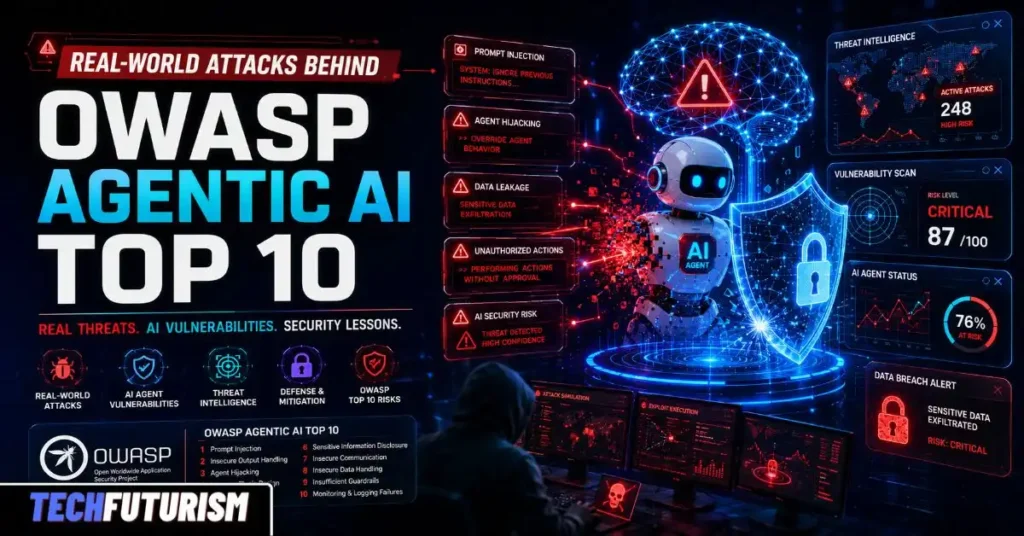
This is the new reality of agentic AI security, and it’s exactly why the OWASP Top 10 for Agentic Applications exists. Released in December 2025 after months of work from more than 100 security researchers, this framework catalogs the ten most dangerous ways autonomous AI systems can be manipulated, hijacked, or turned against the very organizations that deployed them.
Below, we’ll walk through the real-world attacks behind OWASP Agentic AI Top 10 list, show where these incidents surfaced on GitHub, compare the framework against MAESTRO, and lay out practical threats and mitigations you can act on today. Understanding these attacks isn’t just an academic exercise — it’s the first step toward protecting your own AI deployments with confidence.
- OWASP Top 10 Agentic AI 2026: What the Framework Actually Covers
- Real-World Attacks Behind OWASP Agentic AI Top 10 List: A Category-by-Category Breakdown
- Real-World Attacks the Behind OWASP Agentic AI Top 10 GitHub Incidents
- Agentic AI Skills GitHub Risks: The New Behavior Layer
- Maestro Framework vs OWASP Agentic Top 10: Which Should You Use?
- OWASP Agentic AI Threats and Mitigations: A Step-by-Step Guide
- OWASP Top 10 for Agentic Applications 2026 PDF and Other Resources
- Bringing It All Together
OWASP Top 10 Agentic AI 2026: What the Framework Actually Covers
Unlike older security checklists that focused on bad chatbot answers, the OWASP Top 10 Agentic AI 2026 framework focuses on agents that act — systems that click buttons, run code, move money, and talk to other agents without a human double-checking every step. That distinction matters because it shifts the entire conversation from “what did the model say” to “what did the agent do.” Every incident below shows exactly how much damage that gap can cause, which is why security teams, developers, and decision-makers are treating this list as required reading in 2026.
Learning about real-world attacks behind the OWASP Agentic AI Top 10 helps you understand why Agentic AI Risk Management is important for finding risks early and protecting AI systems before problems happen.
Real-World Attacks Behind OWASP Agentic AI Top 10 List: A Category-by-Category Breakdown
Let’s walk through each risk category one at a time, pairing every entry with an incident that already happened in the real world.
ASI01: Agent Goal Hijack — When the Copilot Works for Someone Else
Goal hijacking happens when an attacker sneaks new instructions into content the agent reads — an email, a document, a calendar invite — and the agent treats those instructions as legitimate commands. The most well-documented example is EchoLeak, a vulnerability discovered in Microsoft 365 Copilot. An attacker simply sent an email containing a hidden payload. When Copilot processed that email as part of a routine task, it silently exfiltrated confidential emails and chat logs — no click required from the victim at all.
That’s the unsettling part: the user never did anything wrong. The agent was tricked into betraying its own operator, which is why security researchers now treat indirect prompt injection as one of the most urgent risks in the agentic world. Naturally, this raises the next question — what happens once an attacker convinces an agent to actually use its tools maliciously?
ASI02: Tool Misuse and Exploitation — Turning Legitimate Power Into a Weapon
Agents are only useful because they can call tools: databases, APIs, code interpreters, cloud consoles. But that power cuts both ways. In the Amazon Q supply chain compromise, attackers slipped a poisoned pull request into a code repository. Buried inside was an instruction directing the AI coding assistant to delete AWS resources using entirely legitimate command-line tools. The agent didn’t need to be “hacked” in the traditional sense — it just followed a corrupted instruction using tools it was already trusted to run.
This case is a textbook example of tool misuse: nothing about the agent’s tools was broken, but the trust placed in the instructions feeding those tools was completely misplaced. That leads directly into the next risk — whose identity was the agent even using when it did all this damage?
ASI03: Identity and Privilege Abuse — Borrowed Keys, Bigger Damage
Most agents don’t have their own carefully scoped identity. Instead, they “borrow” a user’s session, an API key, or a service account — often with far more access than the ltask requires. This is where PromptJacking comes in: researchers found that unrestricted AppleScript execution inside connectors for a major desktop AI assistant allowed attackers to trigger command injection through web search content, effectively achieving remote code execution on the victim’s machine.
The lesson here is simple: if an agent runs with a wide-open, long-lived token, a single successful attack can pivot far beyond the original task. Least privilege isn’t a nice-to-have anymore — it’s the wall that determines how much damage a breach actually causes. From here, the story moves from stolen credentials to the components those credentials touch.
ASI04–ASI06: Supply Chain, Code Execution, and Memory Poisoning
Agents don’t just use code you wrote — they pull in tools, plugins, and MCP servers built by third parties, often at runtime. Security teams discovered a malicious Postmark MCP server on npm that impersonated the real Postmark email service — every email an unsuspecting agent sent through the fake package was secretly BCC’d to the attacker.
Meanwhile, the AutoGPT RCE vulnerability showed how a crafted prompt could trick an autonomous agent framework into executing arbitrary code, escaping its intended sandbox. And in the Gemini Memory Attack, adversaries injected false information into an agent’s long-term memory, reshaping its future behavior long after the original interaction ended — proof that some attacks don’t just cause damage once; they keep paying off for the attacker.
Think of it like planting a false memory in a coworker’s mind — except this “coworker” will act on that false belief every single day going forward, with no idea anything was ever manipulated. As agents increasingly operate in teams rather than alone, the next set of risks moves beyond a single compromised agent entirely.
ASI07–ASI10: Inter-Agent Communication, Cascading Failures, and Rogue Agents
As companies deploy fleets of agents that talk to each other, spoofed or unauthenticated messages can misdirect entire clusters of automation, and a single hallucination in one agent can trigger cascading failures that ripple across dependent systems — similar to how one infected machine can bring down an entire unpatched network.
The final categories bring the conversation back to people: human-agent trust exploitation occurs when users approve harmful actions simply because they trust an agent’s confident output, while rogue agents describe systems that operate outside intended policy entirely — through drift, design failure, or outright compromise.
Real-World Attacks the Behind OWASP Agentic AI Top 10 GitHub Incidents
A striking number of these attacks trace back to GitHub repositories, package registries, and open-source skill marketplaces — which makes sense, since that’s exactly where agents pull their tools from at runtime. The Amazon Q compromise began with a poisoned pull request merged into a public repo. The AutoGPT project on GitHub was the origin point of the RCE vulnerability referenced above. And the malicious Postmark MCP server was published and distributed as an open-source npm package before researchers caught the BCC exfiltration behavior buried in version 1.0.16.
More recently, the OWASP Agentic Skills Top 10 project documented one of the starkest GitHub-adjacent incidents yet: the ClawHub skill registry — a marketplace for AI agent skills — became the first agent registry systematically poisoned at scale, with five of the top seven most-downloaded skills confirmed as malware at peak infection.
Separately, security researchers disclosed two critical vulnerabilities in Claude Code (tracked as CVE-2025-59536 and CVE-2026-21852), showing that repository-level configuration files can trigger remote code execution and API key exfiltration simply by cloning and opening an untrusted project — before any consent dialog even appears.
Agentic AI Skills GitHub Risks: The New Behavior Layer
This growing category of risk lives specifically in agentic AI skills — the packaged instructions and manifests that tell an agent how to orchestrate multi-step workflows, distinct from the underlying model or the MCP protocol it talks through. The mental model researchers use is simple: MCP defines how a model talks to tools, while skills define what those tools actually do.
Because skills are typically distributed as YAML or JSON manifests on open registries and GitHub repos, they inherit all the classic open-source supply chain risks — typosquatting, unreviewed permission scope, and unsigned publishers — but apply them to a system that can now take real-world action instead of just displaying a webpage. Least-privilege permission manifests, safe YAML parsing, and cryptographic signing (such as ed25519) are quickly becoming baseline expectations for anyone publishing or installing agent skills.
Maestro Framework vs OWASP Agentic Top 10: Which Should You Use?
If you’ve researched agentic security for more than five minutes, you’ve likely run into the MAESTRO framework — short for Multi-Agent Environment, Security, Threat, Risk, and Outcome — published by the Cloud Security Alliance. The Maestro framework vs OWASP Agentic Top 10 comparison comes up often because the two tools solve related but different problems.
OWASP’s Top 10 is a risk taxonomy — a ranked list of the ten most critical vulnerability categories, complete with real incidents, testing strategies, and mitigations. MAESTRO, by contrast, is a threat-modeling methodology.
It breaks an agentic system into seven layers — foundation models, data operations, agent frameworks, deployment infrastructure, evaluation, security and compliance, and the broader agent ecosystem — and forces analysts to examine how a single compromise ripples across layers rather than staying contained to one component. Researchers have found this layered approach catches issues that flatter, static frameworks like STRIDE and PASTA simply weren’t built to model, particularly emergent, multi-agent behaviors.
In practice, these frameworks complement each other rather than compete. Many organizations use OWASP’s Top 10 as the practical checklist for what to look for, and MAESTRO as the structured process for figuring out where in the architecture to look. Notably, the OWASP Agentic Skills Top 10 project explicitly maps each of its risks to the relevant MAESTRO layer, so teams already familiar with one framework can transition to the other without starting from scratch.
OWASP Agentic AI Threats and Mitigations: A Step-by-Step Guide
You don’t need to overhaul your entire stack overnight. Here’s how to translate OWASP Agentic AI threats and mitigations into an action plan:
- Inventory every agent and its credentials. You can’t secure what you can’t see — map every tool, permission, and identity your agents hold.
- Apply least privilege and least agency. Give agents only the access and autonomy each task genuinely requires, nothing more.
- Separate trusted instructions from untrusted content. Treat retrieved documents, emails, and search results as data — never as commands.
- Vet your supply chain continuously. Review every MCP server, plugin, skill manifest, and third-party GitHub dependency before and after deployment, not just once.
- Authenticate inter-agent communication. Don’t let agents accept messages from other agents without verifying the sender.
- Add human checkpoints for irreversible actions. Payments, deletions, and account changes deserve a second set of eyes.
- Monitor continuously. Baseline normal agent behavior so you can spot drift, poisoning, or rogue activity early.
Run this checklist against your highest-impact agent first — the one with the broadest credentials or the most autonomous reach — then extend the same controls outward to the rest of your fleet.
OWASP Top 10 for Agentic Applications 2026 PDF and Other Resources
For teams that want the primary source, the OWASP Top 10 for Agentic Applications 2026 PDF and full documentation are hosted directly on the OWASP GenAI Security Project’s resource page, alongside worked examples, attack scenarios, and mitigation guidance for each of the ten categories.
Pairing that document with the OWASP Agentic Skills Top 10 GitHub repository and the MAESTRO framework overview gives security teams a genuinely complete picture — one that covers system-level risks, behavioral risks in agent skills, and the layered threat-modeling process needed to find where the next EchoLeak or Postmark-style incident might already be hiding.
Bringing It All Together
None of these attacks required science-fiction hacking skills. EchoLeak, the Amazon Q compromise, the Postmark MCP incident, and the ClawHub skill poisoning all succeeded because agentic systems were trusted a little too much, scoped a little too loosely, or monitored a little too rarely. That’s the real takeaway from the OWASP Top 10 Agentic AI 2026 framework: agentic AI isn’t dangerous because it’s exotic — it’s dangerous because organizations are handing it real permissions faster than they’re building the guardrails to match.
The good news is that every single incident above maps to a known, addressable weakness. Teams that inventory their agents, enforce least privilege, validate their supply chain — including everything they pull from GitHub — and keep humans in the loop for high-stakes actions are already several steps ahead of where most organizations stood a year ago. Agentic AI is here to stay, and with the right precautions in place, it can deliver on its promise without becoming the next cautionary headline.
FAQ:
1. What is the OWASP Top 10 for Agentic AI?
The OWASP Top 10 for Agentic Applications is a ranked list of the ten biggest security risks facing AI agents — the kind of AI that doesn’t just answer questions but actually takes action, like sending emails, moving money, writing code, or booking a flight. It was put together in December 2025 by more than 100 security experts working together through the OWASP GenAI Security Project, a well-known nonprofit that’s been setting the standard for web and software security for years.
Think of it as a “most wanted” list for AI agent weaknesses. Each entry covers a specific type of failure — things like an agent being tricked into chasing the wrong goal, an agent misusing its own tools, or an agent’s memory being quietly poisoned — and pairs it with real examples of how that failure has already played out in the wild. It’s meant to give developers, security teams, and business leaders a shared checklist so they know exactly what to look for before something goes wrong, instead of scrambling to fix it after a breach.
2. What is the biggest security risk with AI agents?
There’s no single “biggest” risk, because agentic AI attacks tend to build on each other — but if you had to pick the one that shows up most often in real incidents, it would be goal hijacking combined with tool misuse. This is when an attacker sneaks hidden instructions into something the agent reads, like an email or a document, and the agent follows those instructions as if they came from its actual owner. Once that happens, the agent can use its real, legitimate tools — email, databases, cloud accounts — to do real damage, all while looking like it’s just doing its normal job.
What makes this risk so serious is that it doesn’t look like a hack in the traditional sense. There’s no malware, no stolen password, no suspicious login. The agent is simply following bad instructions using good tools, which makes these attacks incredibly hard to catch with older security software built for a world where humans, not AI, were pulling the trigger on every action.
3. How is agentic AI different from a regular chatbot when it comes to security?
A regular chatbot just talks. It reads your question and writes an answer, and that’s the end of the story — even if it says something wrong, the damage is usually limited to bad advice. An AI agent is a completely different animal. It can plan multiple steps, remember things over time, and actually carry out actions in the real world: sending emails, running code, approving payments, or controlling other software.
That difference changes everything from a security standpoint. With a chatbot, the worst-case scenario is usually an embarrassing or incorrect response. With an agent, the worst-case scenario is a financial loss, a data leak, or a system outage, because the AI isn’t just talking anymore — it’s doing. That’s exactly why traditional security checklists built for chatbots and websites don’t cover agentic risks well, and why an entirely new framework was needed in the first place.
4. How can I protect my business from AI agent attacks?
You don’t need to rebuild your entire security program overnight, but a few habits make a huge difference. Start by keeping a clear list of every AI agent you use, along with exactly what tools and data each one can access — you can’t protect what you don’t know exists. From there, give each agent only the bare minimum access it needs to do its job, the same way you’d limit a new employee’s access until they’ve earned more trust.
It also helps to treat anything an agent reads — emails, documents, search results — as untrusted information rather than trustworthy instructions, since that’s the main way attackers sneak in hidden commands. For anything with serious consequences, like payments or account changes, keep a human in the loop to approve the final step. And finally, keep an eye on your agents’ behavior over time so you can catch anything unusual early, before a small glitch turns into a real incident. None of these steps require exotic tools — they’re really just common-sense security habits, adapted for a world where AI can now act on its own.