
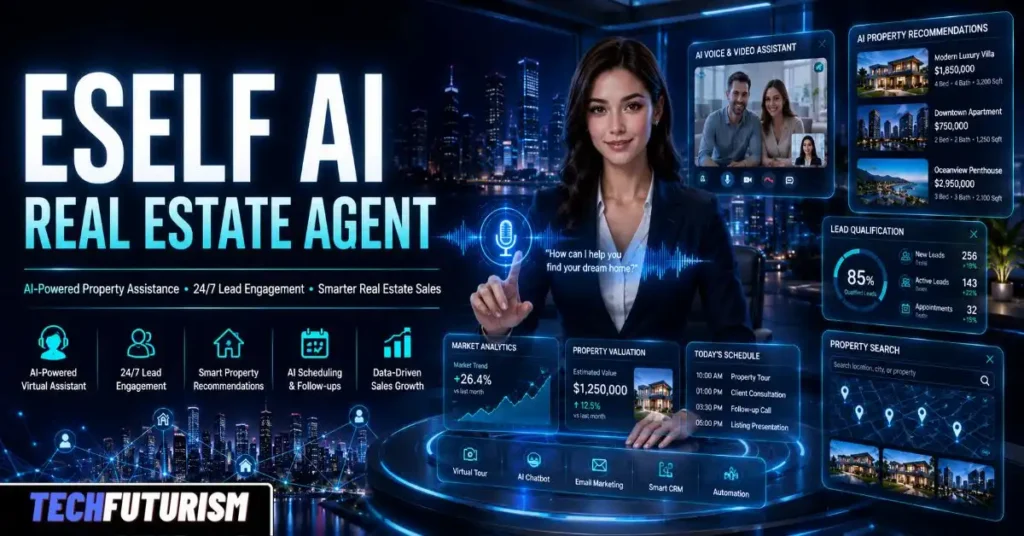
The world’s first AI-powered real estate agent has already closed $100 million in deals. Here’s what it means for buyers, sellers, investors, and every agent in between.
Imagine it’s 2:47 in the morning. You can’t sleep. You’ve been scrolling through property listings for weeks, and you finally found one that looks perfect — ocean views, the right number of bedrooms, and just within your budget. But your real estate agent is, understandably, fast asleep.
In the old world, you’d save the link and wait until morning. In the new world? You click a button, and a friendly, lifelike agent appears on your screen. She greets you by name, pulls up the listing, walks you through a virtual tour, and answers every question you throw at her — about the neighborhood, the price history, nearby schools. She even books you a showing for the next day. All of this at 2:47 AM, without a single human being on the other end.
This isn’t science fiction. This is eSelf AI real estate agent, and it’s already happening.
- What is the eSelf AI Real Estate Agent?
- eSelf AI Real Estate Agent Review: What the Numbers Say
- How to Use AI as a Real Estate Agent: A Step-by-Step Walkthrough
- AI Agent for Real Estate Investors: A Competitive Edge in Every Market
- AI for Real Estate Listings: Making Every Property Work Harder
- Will AI Replace Real Estate Agents? The Honest Answer
- AI Real Estate Automation: How eSelf AI Runs Your Pipeline on Autopilot
- AI Real Estate Search: Finding the Right Property, Faster
- AI CRM for Real Estate Agents: Never Lose a Lead Again
- What Makes eSelf AI Different from Every Other Real Estate Tech Tool?
- How to Get Started with the eSelf AI Agent for Real Estate
- The Bottom Line
- Frequently Asked Questions
What is the eSelf AI Real Estate Agent?
eSelf AI is an Israeli technology startup that has built one of the most advanced AI-powered virtual agent platforms in the world. Founded in 2023 and recognized by Fast Company as one of the Next Big Things in Tech for 2025, eSelf AI creates hyper-realistic, conversational AI avatars that speak, respond, and interact with customers in real time — across more than 30 languages.
The company’s co-founder and CEO, Alan Bekker — a Forbes 30 Under 30 honoree with prior experience at Snap — describes the technology this way: it turns large language models (LLMs) into a visual, conversational experience, much like what movies did for books. Instead of reading a text response from a chatbot, you’re having a face-to-face video conversation with an AI that looks, sounds, and reacts like a real person.
For real estate, the impact has been nothing short of extraordinary. But before we get into the mechanics, here’s the proof that it actually works.
An eSelf AI Real Estate Agent becomes even more powerful when combined with an AI Voice Agent for Real Estate, allowing it to talk with buyers, answer questions, and book property viewings 24/7.
eSelf AI Real Estate Agent Review: What the Numbers Say
Here’s a story that stops real estate professionals in their tracks.
Portugal-based brokerage Porta da Frente Christie’s — managing a portfolio of over 5,000 properties — faced a challenge familiar to every large agency: how do you give every potential buyer the full attention they deserve, at any hour, across every listing?
They deployed an real estate agent eSelf AI on their platform. The results, as reported on Fox Business, were staggering: the AI agent generated over $100 million in sales through the leads it created — making it the world’s first AI real estate agent to reach that milestone.
CEO João Cília put it plainly: with more than 5,000 properties in their portfolio, no team of human consultants could realistically provide comprehensive, on-demand information about every single one. The eSelf AI agent fills that gap effortlessly — and in some ways, surpasses what a human consultant can offer.
“If we can use it at large scale,” Cília told Fox Business, “it can replace a lot of the physical commercial consultants — and in this sense, make the operation of selling these properties much cheaper.”
Beyond the headline number, real-world users consistently highlight three things: the speed of setup, the quality of conversations, and a measurable lift in qualified lead volume. No other proptech tool currently combines all three at this level — and that alone makes it the most compelling platform in its category right now.
How to Use AI as a Real Estate Agent: A Step-by-Step Walkthrough
So what does the experience look like from a buyer’s perspective? It’s surprisingly intuitive. And for agents, the setup is even simpler. Here’s exactly how it all unfolds — step by step.
Step 1: Integrate eSelf AI into Your Website
A visitor lands on a real estate website integrated with eSelf AI. Instead of a static page or a cold contact form, they’re greeted by a lifelike AI agent — a fully animated, speaking avatar — ready to help. Integration takes minutes with a simple embed code, and no technical background is required.
Step 2: The AI Agent Gathers Buyer Preferences
The agent opens with simple, conversational questions: Which city are you looking in? What’s your budget? How many bedrooms do you need? House or apartment? This is natural language processing (NLP) at work — the agent understands plain-speech responses and uses that information to filter thousands of listings in real time.
Step 3: Deliver a Personalized Property Tour
Rather than handing the buyer a flat list of links, the agent shows properties dynamically within the conversation. It shares images, plays video walkthroughs, and narrates key details — square footage, amenities, price history, neighborhood highlights — all in natural, engaging dialogue. As Bekker himself noted, “We are not only a face that is moving and speaking while the agent responds to the user, but we also have sharing video and image capabilities.” It’s a genuinely multimedia, immersive experience that no static listing page can match.
Step 4: Answer Every Question Instantly
Can a human agent memorize every detail of 5,000 properties? Realistically, no. But an AI real estate agent can. Buyers ask granular questions — “What’s the HOA fee?” “How old is the roof?” “Are pets allowed?” — and get accurate, instant answers pulled directly from the property’s full data profile.
Step 5: Capture the Lead and Book a Showing
When a buyer is ready to move forward, the AI agent schedules a physical showing or connects them to a human agent. It handles the logistics seamlessly, capturing the lead and passing it to the sales team fully qualified — and ready to close.
This end-to-end flow works the same at noon as it does at midnight, on weekdays as it does on weekends. That reliability is precisely where the business value lives.
AI Agent for Real Estate Investors: A Competitive Edge in Every Market
Individual buyers aren’t the only ones who benefit from eSelf AI’s real estate agent. In fact, real estate investors — particularly those managing multiple properties or operating across different markets — have some of the most compelling use cases.
Consider a portfolio investor holding 40 rental properties across three states. Fielding inquiries from prospective tenants, answering questions about lease terms, screening interest, and scheduling viewings is a full-time job on its own. With an eSelf AI agent embedded on their property management site, every inquiry gets an immediate, intelligent response — 24 hours a day, seven days a week — without hiring a single additional staff member.
For investors working in fix-and-flip or new-development markets, the AI agent becomes a powerful pre-sales tool. It fields buyer interest before a property is even listed, gathers preferences, builds a waitlist, and delivers personalized updates automatically. By the time the property hits the MLS, a qualified pipeline of interested buyers is already waiting.
The ROI case is straightforward: faster lead response, lower staffing overhead, and higher conversion rates — across residential, commercial, and mixed-use portfolios alike. For investors who measure every decision against returns, that equation is hard to argue with.
AI for Real Estate Listings: Making Every Property Work Harder
A listing that sits quietly on a portal is a missed opportunity. AI for real estate listings changes that equation entirely — and eSelf AI is the clearest example of how.
With eSelf AI embedded directly on a listing page, every visitor — whether they arrive at 9 AM on a Tuesday or 11 PM on a Sunday — is met with an intelligent, engaging experience. The AI agent doesn’t just display static information. It actively presents the property, walks the visitor through its highlights, anticipates common questions, and creates a two-way dialogue that mimics the best version of a live showing.
This matters because online attention spans are short. A visitor who bounces from a listing page without engaging is a lost lead. A visitor who spends five minutes in conversation with an AI agent — getting real answers and feeling genuinely helped — is a warm prospect ready for follow-up.
eSelf AI also supports dynamic media sharing during live conversations: videos, photos, floor plans, and virtual tour links appear naturally within the dialogue, dramatically reducing the friction between interest and action. For sellers, this means more engagement per listing. For agents, it means less time doing preliminary Q&As and more time on the work that actually closes deals.
Will AI Replace Real Estate Agents? The Honest Answer
This is the question everyone is asking — and it deserves a straight, honest answer.
Short answer: no. But the nuance matters, and it’s worth understanding why.
Real estate is, at its core, a relationship-driven industry. Buyers and sellers make some of the biggest financial decisions of their lives, and they want to work with someone they trust. The empathy, intuition, and negotiation skill that a great agent brings to a complex deal cannot be replicated by any algorithm — at least not today.
What AI does brilliantly is handle the top of the funnel. Think about it this way: a surgeon doesn’t spend their day scheduling appointments, answering routine patient questions, or managing billing. Those tasks are handled by systems and support staff, so the surgeon can focus on what only a surgeon can do. AI does the same thing for real estate agents. It handles the predictable, repeatable work so the agent’s irreplaceable human skills are deployed where they matter most.
As eSelf AI itself puts it, the goal is not to replace agents but to give them superpowers — freeing them from repetitive, time-consuming work so they can focus on high-value interactions. The agents who thrive in the coming decade will be those who embrace this technology early. The ones who resist it risk being outcompeted — not by AI itself, but by other agents who are using AI.
AI Real Estate Automation: How eSelf AI Runs Your Pipeline on Autopilot
One of the biggest time drains in real estate is the work that happens before the deal — the follow-ups, the scheduling, the repetitive Q&As, the lead qualification. AI real estate automation tackles all of it, and eSelf AI is built specifically for this workflow.
Here’s what the automation layer looks like in practice:
Instant lead capture — every visitor who interacts with the AI agent becomes a tracked, tagged lead with conversation history, property interests, and intent signals logged automatically. No manual entry, no missed contacts.
Automated follow-up — the agent sends follow-up messages, schedules check-ins, and re-engages leads who went quiet, all without any manual effort from the human agent.
Showing coordination — the AI books appointments directly into the agent’s calendar, eliminating the back-and-forth that typically eats hours each week.
Agentic workflows — for larger brokerages, eSelf AI connects to listing databases, CRM platforms, and scheduling tools, creating an end-to-end sales pipeline that runs largely on autopilot.
The result is that real estate professionals spend less time on administration and more time on the high-value human work that actually closes deals. For a solo agent, this feels like having a full-time assistant. For a brokerage, it means scaling operations without scaling headcount — a genuinely rare thing in this industry.
AI Real Estate Search: Finding the Right Property, Faster
Traditional property search is a frustrating experience. You filter by price, bedrooms, and location, and you still end up scrolling through dozens of listings that don’t really fit what you’re looking for.
AI real estate search works differently — and it’s one of the features that buyers immediately notice.
Instead of clicking through filter menus, buyers describe what they want in natural language: “I’m looking for a three-bedroom house near a good school, with a yard, under $600,000, and ideally move-in ready.” The eSelf AI agent interprets that intent, matches it against the full listing inventory, and presents a curated shortlist with explanations for why each property fits.
This is semantic search applied to real estate — not just matching keywords, but understanding context, priorities, and trade-offs. If nothing in the inventory perfectly matches the buyer’s criteria, the agent says so honestly and suggests the closest alternatives, just as a knowledgeable human agent would.
For international buyers, the advantage compounds further. eSelf AI’s multilingual capabilities cover more than 30 languages natively, meaning a buyer in Tokyo searching for a Miami condo can have the entire experience — search, tour, Q&A, and booking — in Japanese, with zero translation lag or loss of nuance.
AI CRM for Real Estate Agents: Never Lose a Lead Again
Every agent has a story about a lead that slipped through the cracks. A promising inquiry on a Friday afternoon that didn’t get a follow-up until Monday, by which time the buyer had already signed with someone else. An AI CRM for real estate agents — powered by eSelf AI — makes that story obsolete.
When the eSelf AI agent connects to your CRM, every conversation automatically generates a structured record: who the buyer is, what they’re looking for, which properties they engaged with, what questions they asked, and how warm their intent appears. None of this requires manual data entry. It happens in the background, in real time.
From there, the CRM layer enables intelligent follow-up. The AI agent reaches back out to leads who haven’t responded, surfaces new listings that match saved preferences, and flags high-intent prospects for immediate human follow-up. The result is a sales pipeline that is always current, always organized, and always working — even when the agent is not.
For brokerages managing hundreds of agents and thousands of leads, this kind of automated lead management is transformative. It removes the leakage from the pipeline and ensures that every single lead gets a response, every time. That alone can be the difference between a good quarter and a great one.
What Makes eSelf AI Different from Every Other Real Estate Tech Tool?
The proptech market is crowded. So why is eSelf AI the one generating this level of attention? The answer comes down to a set of differentiators that, taken together, no other platform can currently match.
Photorealistic AI avatars — most AI tools for real estate are text-based chatbots or simple voice assistants. eSelf AI’s agents are visually present. They make eye contact, use natural facial expressions, and speak in a warm, human tone. This dramatically reduces the friction buyers feel when interacting with automated systems. The uncanny valley, for once, has been crossed.
30+ languages, zero extra cost — a single eSelf AI deployment can serve an international clientele without any additional staffing, making it the only platform that truly removes the language barrier from global real estate.
Dynamic media sharing — unlike text chatbots, eSelf AI agents actively share videos, photos, and virtual tour links during the conversation, keeping buyers engaged and dramatically improving the quality of each interaction.
The Digital Twin feature — an agent records themselves for a few minutes. eSelf AI’s platform uses that footage to create a photorealistic AI clone that captures the agent’s voice, expressions, and communication style. That digital twin then works independently — greeting visitors, booking showings, answering questions — while the real agent is busy elsewhere. It’s the closest thing the industry has ever had to being in two places at once.
Enterprise-grade agentic workflows — for larger brokerages, automated processes connect the AI agent to CRM systems, scheduling tools, and listing databases, creating an end-to-end pipeline that runs on autopilot.
Taken together, these features represent a complete rethinking of what a real estate agent — human or AI — can deliver.
How to Get Started with the eSelf AI Agent for Real Estate
If you’re a real estate professional, brokerage owner, or proptech developer, getting started is far more straightforward than you might expect. Here is the complete path from sign-up to a live, revenue-generating AI agent:
- Visit eself.ai and explore the platform’s core products — the AI Agent, Digital Twin, and AI Video Chat tools.
- Book a demo to see a live walkthrough of the real estate use case in action.
- Review the pricing page to find the right tier — options scale from individual agents all the way to large brokerages.
- Create your Digital Twin in minutes using the no-code studio — no technical experience required.
- Embed the AI agent on your website or listings portal and watch it begin engaging visitors immediately.
- Connect it to your CRM to automatically capture and manage every AI-generated lead.
- Monitor your analytics — eSelf AI tracks conversations, lead quality, and conversion rates so you can iterate and improve continuously over time.
Each step builds on the last. Most agents are fully live within a single business day.
The Bottom Line
The real estate industry has been ripe for disruption for decades. Now, the disruption is here — and it arrives not as a threat, but as a remarkable opportunity.
The eSelf AI real estate agent has proven, with $100 million in real sales, that AI can do far more than answer basic questions. It drives meaningful revenue, serves global clients in their native languages, automates the entire lead pipeline, and delivers property experiences that feel genuinely personal.
Whether you’re a buyer searching for your dream home at 3 AM, an investor managing a multi-state portfolio, a seller wanting maximum exposure for every listing, or an agent trying to scale without burning out — eSelf AI offers something the industry has genuinely never had before: a smarter, always-on, deeply human way to do real estate.
The future of property sales isn’t coming. It’s already closed a deal while you were reading this.
Frequently Asked Questions
How Does eSelf AI Work?
At its core, eSelf AI combines three powerful technologies to create something that feels genuinely new: a large language model (LLM) for intelligence, a text-to-speech engine for natural-sounding voice, and a real-time video rendering system for the lifelike avatar. Together, they produce a face on your screen that listens, thinks, and responds — all within a fraction of a second.
Here’s how the process works from start to finish. When a visitor lands on a website powered by eSelf AI, the AI avatar activates and greets them in natural, conversational language. The visitor asks a question — by typing or speaking — and eSelf AI’s natural language processing (NLP) layer interprets the meaning behind the words, not just the words themselves. It understands context, intent, and follow-up questions the same way a knowledgeable human would.
The AI then pulls the relevant answer from a connected knowledge base — which, in real estate, means a live database of property listings, pricing, floor plans, neighborhood data, and more — and delivers it through the animated avatar in real time. The avatar maintains eye contact, uses natural facial expressions, and speaks in a warm, human tone. If the visitor wants to see a property, the agent shares images, videos, and virtual tour links right inside the conversation window.
Behind the scenes, eSelf AI integrates with your existing tools. It connects to your CRM to log every interaction, your scheduling system to book showings, and your listing databases to stay current on available inventory. Every conversation is tracked and stored, giving your human sales team full visibility into what was discussed and where each lead stands in the buying journey.
The Digital Twin feature adds another dimension. An agent records themselves speaking for a few minutes, and eSelf AI’s platform generates a photorealistic AI clone — complete with the agent’s voice, facial expressions, and mannerisms. That digital twin can then be deployed across any web page or platform, representing the agent in real time even when they’re physically unavailable.
In short, eSelf AI works by turning a static website into a living, breathing, intelligent conversation — one that never sleeps, never gets tired, and never misses a lead.
How Much Does a Real Estate Agent Make on a $300,000 Sale?
This is one of the most common questions in real estate, and the answer depends on a few moving parts. But let’s walk through the typical structure so the numbers make sense.
In the United States, the standard real estate commission on a home sale has historically been around 5% to 6% of the sale price. On a $300,000 home, that means the total commission pool is between $15,000 and $18,000. However, that full amount almost never goes to a single agent.
Here’s why: that commission is typically split between the listing agent (who represents the seller) and the buyer’s agent (who represents the buyer). So each side starts with roughly $7,500 to $9,000.
But the split doesn’t stop there. Each agent also splits their portion with their brokerage — the firm they work under. A typical broker-agent split ranges from 50/50 for newer agents to 70/30 or even 80/20 in favor of more experienced agents. Some top producers at certain brokerages operate at a 90/10 or even 100% commission structure, though they often pay a flat desk fee instead.
So, working through the math on a $300,000 sale at a 6% total commission with a 50/50 agent-broker split:
Total commission: $18,000
Buyer’s agent side: $9,000
After a 50/50 broker split: $4,500 in the agent’s pocket
An agent with a better 70/30 split takes home $6,300 from that same transaction. A senior agent at 90/10 walks away with $8,100.
It’s also worth noting that since the NAR settlement in 2024, commission structures in the U.S. have been shifting. Buyers and sellers now have more room to negotiate commissions directly, which means rates can vary more widely than they used to.
Beyond the commission itself, agents also carry business expenses — MLS fees, marketing costs, licensing renewals, transportation, and technology subscriptions. These can run anywhere from a few hundred to several thousand dollars a month, which further reduces net take-home pay.
This is precisely why tools like the eSelf AI agent real estate matter so much to individual agents. When a single AI platform handles lead generation, qualification, and initial follow-up automatically, agents close more deals per month without proportionally increasing their expenses — directly improving what they actually take home.
What’s the Best AI for Real Estate Agents?
The honest answer is: it depends on what you need. The AI tools for the real estate market have grown quickly, and different platforms solve different problems. Here’s how the landscape breaks down, and where eSelf AI fits within it.
For lead engagement and 24/7 client interaction, eSelf AI stands in a category of its own. No other platform currently combines a photorealistic, conversational AI avatar with real-time property data, multilingual support, and dynamic media sharing in a single product. If your primary goal is to engage more website visitors, qualify leads around the clock, and give every potential buyer a personalized experience regardless of what time they show up — eSelf AI is the clear front-runner. Its $100 million sales milestone at Porta da Frente Christie’s is the strongest real-world proof point any AI real estate tool has produced to date.
For writing property descriptions and marketing copy, tools like ChatGPT and Copy.ai are widely used. Agents feed in a few property details and get a polished listing description in seconds. These are useful for content production but don’t interact with buyers or generate leads on their own.
ForCRM automation and pipeline management, platforms like Follow Up Boss, LionDesk, and Sierra Interactive use AI to help agents prioritize leads, automate follow-up sequences, and track deal stages. These are strong operational tools, but they work with leads you’ve already captured — they don’t generate new ones the way eSelf AI does.
Forpredictive analytics and market intelligence, tools like HouseCanary and Likely.AI use machine learning to identify which homeowners are likely to sell soon, giving agents a prospecting edge. These are powerful for outbound strategy but don’t help with the inbound buyer experience.
The bottom line? The best AI for a real estate agent isn’t one tool — it’s a smart combination. But if you could only choose one platform that delivers the most visible, immediate impact on revenue, eSelf AI makes the strongest case. It works at the exact moment that matters most: when a potential buyer is on your website, right now, and deciding whether to stay or leave.
Who Is the Founder of eSelf AI?
eSelf AI was co-founded by Alan Bekker, who serves as the company’s CEO. Bekker was named to the prestigious Forbes 30 Under 30 list, a recognition given annually to the most innovative young entrepreneurs and leaders across industries. Before founding eSelf AI, he gained experience at Snap Inc. — the company behind Snapchat — which gave him a strong foundation in consumer-facing technology, visual media, and user experience at scale.
Bekker’s vision for eSelf AI came from a clear observation: as large language models became more capable, the way people interacted with them — reading text on a screen — hadn’t kept pace with what the technology could actually deliver. He wanted to give AI a face, a voice, and a personality. Not to mimic humans for its own sake, but to make AI interactions feel natural enough that people would genuinely trust them with important decisions — like buying a home.
That insight drove the development of eSelf AI’s core product: a real-time AI video agent that looks and sounds like a real person, responds intelligently to complex questions, and can be deployed at scale across any website or platform.
The company was founded in 2023 and moved quickly. Within its first two years, it earned recognition from Fast Company as one of the Next Big Things in Tech for 2025, secured real-world deployments with major proptech and real estate clients, and produced the world’s first AI real estate agent to generate over $100 million in sales.
Bekker has described the company’s mission in simple terms: make AI feel as natural as a face-to-face conversation. In real estate — an industry built entirely on trust, relationships, and communication — that mission couldn’t be more relevant.