
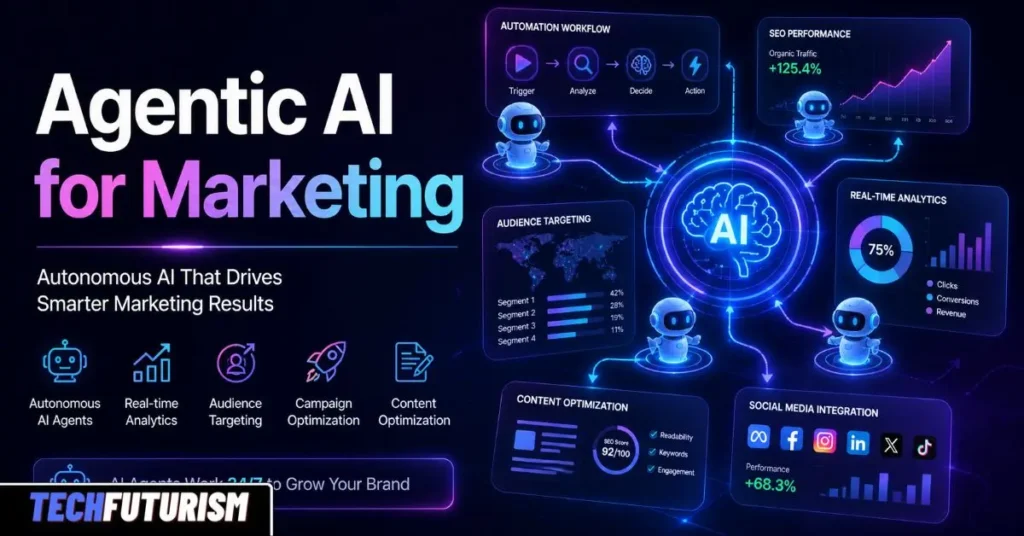
A practical, no-jargon guide for marketers, founders, and growth teams — covering use cases, real-world examples, top tools, Braze, Google AI, a step-by-step implementation guide, and course recommendations.
Picture this: it is Monday morning. Your marketing team has not touched a keyboard yet, but overnight your AI agent has already segmented your email list, drafted five personalized campaign variants, A/B-tested subject lines, and flagged which leads are most likely to convert this week. You walk in, review the summary, approve the best-performing version, and hit send — all before your first coffee goes cold.
That is not science fiction. That is agentic AI for marketing in action — and it is changing how smart businesses compete. In this guide, you will learn exactly what agentic marketing means, why it outperforms the tools you have already tried, and how to deploy it for your brand right now.
- What is agentic AI for marketing?
- How agentic AI differs from traditional marketing automation
- Agentic AI marketing use cases: what it actually does
- AI for marketing examples: real-world wins from leading brands
- Agentic AI tools for marketing: a curated overview
- Braze agentic AI: what it means for customer engagement
- Google marketing AI tools: search, ads, and beyond
- Agentic market landscape: where this industry is heading
- Agentic AI marketing course: how to build your skills
- Step-by-step guide: implementing agentic AI in your marketing stack
- Common concerns — answered honestly
- Frequently asked questions
What is agentic AI for marketing?
Most people have already used generative AI tools that answer a question or produce a paragraph of text. You prompt, it responds. Simple. Useful. But limited.
Agentic AI works differently. Instead of waiting for your next instruction, an AI agent sets a goal, breaks it into tasks, takes action, learns from the result, and loops back to improve. It behaves less like a tool and more like a highly capable team member who never sleeps, never forgets a data point, and never has a bad day.
For marketers, this distinction matters enormously. Traditional automation handles repetitive tasks. Agentic marketing handles complex, judgment-based workflows — the kind that used to require a senior strategist, a data analyst, and a copywriter all working together. Consequently, teams that adopt it are not just getting faster. They are getting smarter at scale — something no amount of hiring alone can replicate.
“We used to spend two full weeks every quarter pulling together campaign performance data, writing up insights, and briefing the creative team. After deploying an agentic AI system, that whole cycle dropped to about four hours. Our strategists now spend their time on actual strategy — not data wrangling.”
— Director of Marketing, SaaS company (200+ employees)
How agentic AI differs from traditional marketing automation
Before going deeper, it is worth being precise about the difference — because a lot of vendors use “AI” loosely, and you deserve to know what you are actually buying.
Traditional marketing automation follows a script. It says: “If a user clicks this email, wait two days, then send this follow-up.” Every path is pre-defined by a human. It is powerful, but it cannot think outside its rules.
Agentic AI, by contrast, operates with genuine autonomous decision-making. It can:
- Discover new audience segments you have not yet defined
- Rewrite ad copy in real time based on live performance signals
- Coordinate across email, social, paid, and SEO simultaneously
- Trigger multi-step campaigns based on nuanced behavioral patterns
- Learn from outcomes and adjust strategy without being re-programmed
In short, traditional automation is a conveyor belt. Agentic AI is a thinking collaborator.
Agentic AI marketing use cases: what it actually does
Understanding the theory is one thing. Seeing agentic AI marketing use cases in practice is what converts skeptics into adopters. Here are the highest-impact areas where AI agents are delivering measurable results for marketing teams right now.
Personalized content at scale
Personalization has been the marketing holy grail for years — but scaling it manually is nearly impossible. Agentic AI dynamically generates content tailored to individual users based on behavior, preferences, location, and buying stage. Whether it is an email subject line, a homepage banner, or a product recommendation, the right message reaches the right person automatically.
Intelligent lead scoring and nurturing
Agentic systems track hundreds of behavioral signals — page visits, email opens, content downloads, social interactions — and build a predictive lead scoring model in real time. They then trigger the most relevant nurture sequence, adjusting cadence based on how each lead responds. No more one-size-fits-all drip campaigns.
Multi-channel campaign orchestration
Keeping messaging consistent across email, paid social, search, and content — while making each channel feel native — is one of the hardest things in modern marketing. Agentic AI acts as a central coordinator, ensuring every touchpoint fits the overall customer journey without creating channel silos.
Real-time competitive intelligence
AI agents continuously monitor competitor websites, ad libraries, pricing pages, and press releases — surfacing insights your team can act on immediately. Furthermore, they flag shifts in SEO rankings and market positioning before you even notice them yourself.
Autonomous ad optimization
An agent connected to your Google Ads or Meta Ads accounts can test creative variations, pause underperforming ad sets, reallocate budget to winning audiences, and generate new copy — without waiting for a weekly review meeting. This shrinks the optimization feedback loop from weeks to hours.
AI for marketing examples: real-world wins from leading brands
The best way to understand the potential of AI for marketing examples is to see how forward-thinking companies are deploying these systems today. The following cases illustrate what becomes possible when agentic AI is embedded into a marketing operation.
E-commerce: dynamic email personalization
A mid-sized e-commerce brand connected an agentic AI to their CRM and product catalog. The agent generated individually tailored email content for each subscriber segment — updating subject lines, product recommendations, and offer messaging in real time based on browsing and purchase history. Within 90 days, the brand reported a 34% increase in revenue per campaign without adding a single person to its marketing team.
“The agent noticed a segment of high-intent users who had abandoned checkout twice in the same week. It triggered a personalized re-engagement sequence we had never thought to build manually — and converted 22% of them.”
— Head of CRM, mid-market e-commerce brand
B2B SaaS: autonomous pipeline nurturing
A B2B software company deployed an agentic AI to manage the middle of their sales funnel. The agent scored inbound leads, routed high-intent prospects to sales, and enrolled lower-intent contacts into tailored educational sequences — all without manual intervention. The result was a 40% reduction in average deal cycle length and a significant lift in conversion rate from trial to paid.
Retail: cross-channel loyalty campaigns
A national retail chain used agentic AI to orchestrate its loyalty program across email, SMS, and push notifications. Rather than sending uniform promotional blasts, the agent timed and personalized each message based on individual purchase patterns and local store inventory — producing a measurable uplift in repeat purchase frequency and a reduction in cost-per-acquisition.
34%
Revenue lift per campaign (e-commerce pilot)
40%
Reduction in B2B deal cycle length
10–20%
Marketing ROI lift from AI personalization (McKinsey)
60%
B2B orgs using AI agents by 2026 (Gartner)
Agentic AI tools for marketing: a curated overview
Choosing the right agentic AI tools for marketing is one of the most important decisions you will make in this space. The market is expanding rapidly, and not every platform that claims to be “agentic” actually delivers autonomous, goal-directed behavior. Below is a curated overview of the most capable and widely adopted options available today.
Content & copy
Agentic content workflows for brand-consistent copy across email, ads, and long-form. Strong campaign orchestration and brand voice controls.
Content & copy
Multi-step agentic pipelines for GTM teams. Automates content creation, data enrichment, and outreach sequences at scale.
CRM & automation
Enterprise-grade AI-powered journey orchestration with deep CRM integration and Einstein AI for predictive segmentation.
Customer engagement
Leading customer engagement platform with native agentic AI (Sage AI) for real-time, cross-channel personalization at enterprise scale.
Search & ads
Performance Max and Smart Bidding use autonomous AI to optimize budget, creative, and targeting across all Google properties.
Analytics
Agentic AI surfaces anomalies, predictive audiences, and churn-risk signals automatically — without waiting for a manual analysis.
Custom agents
Build custom marketing agents with nuanced reasoning and brand-safe output. Ideal for complex, multi-step campaign workflows via API.
Custom agents
Powerful API-based agent framework for teams building bespoke marketing automation on top of GPT models.
When evaluating any platform, prioritize transparent AI decision logs, native integrations with your existing martech stack, real-time analytics tied to revenue outcomes, and verifiable data privacy controls. Also look for active product roadmaps — this space evolves quickly, and you want a partner shipping meaningful updates every quarter.
“Agentic AI for marketing becomes even more powerful when combined with proven AI agents in marketing, as they can plan, run, and improve campaigns automatically to get better results.”
Braze agentic AI: what it means for customer engagement
Braze agentic AI represents one of the most mature implementations of autonomous marketing intelligence available to brands today. Braze has embedded agentic capabilities directly into its customer engagement platform, enabling marketers to move far beyond static campaign templates and manual audience rules.
With Braze, AI agents monitor real-time behavioral signals — app sessions, purchase events, support interactions — and autonomously trigger the most contextually relevant message at exactly the right moment, on the right channel. The platform’s Sage AI layer handles intelligent timing, channel selection, A/B testing, and content personalization without requiring manual campaign configuration for every possible user scenario.
For enterprise brands managing millions of customers across email, push, SMS, and in-app messaging, this kind of agentic orchestration is not a luxury — it is rapidly becoming the operational baseline. Braze’s approach also prioritizes GDPR compliance and first-party data governance, making it a strong choice for regulated industries and global brands operating across multiple markets.
“Braze’s Sage AI essentially eliminated our manual segmentation work. Instead of building 30 audience rules by hand, the agent identifies the right cohort in real time and personalizes the message automatically. It’s the closest thing to having an always-on CRM strategist.”
— VP of Lifecycle Marketing, consumer technology company
Google marketing AI tools: search, ads, and beyond
Google marketing AI tools form one of the most powerful — and most widely used — agentic ecosystems in digital advertising. Google has systematically embedded autonomous AI across its entire advertising and analytics stack, making it the default agentic infrastructure for millions of marketers worldwide at every budget level.
Performance Max
Performance Max is Google’s fully autonomous campaign type. Marketers provide creative assets, budget parameters, and conversion goals — and the AI agent takes over entirely. It allocates spend across Search, Display, YouTube, Gmail, and Maps; tests creative combinations in real time; and continuously refines audience targeting based on conversion signals. It is one of the clearest examples of agentic marketing at massive scale.
Smart Bidding
Smart Bidding uses machine learning to set bids at auction time, factoring in dozens of contextual signals — device, location, time of day, search query intent — to maximize conversions within your target CPA or ROAS. It is one of the most battle-tested forms of agentic AI in marketing, operating at a scale no human bidding strategy can match.
Google Analytics 4 and AI-powered insights
Google Analytics 4 uses agentic AI to surface anomalies, predictive audiences, and churn-risk signals automatically. Rather than waiting for a data analyst to spot a trend, the AI flags it proactively — enabling marketing teams to act on data in near real time.
Gemini for Google Workspace and Ads
Gemini is Google’s latest integration of agentic AI across its product suite. Inside Google Ads, it assists with creative generation, audience suggestions, and campaign briefs. Inside Workspace, it drafts briefs, summarizes analytics reports, and surfaces campaign recommendations directly within the tools your team already uses daily.
Agentic market landscape: where this industry is heading
The agentic market for marketing technology is one of the fastest-growing segments in enterprise software. According to McKinsey, AI-powered personalization can lift marketing ROI by 10–20%. Gartner predicts that by 2026, over 60% of B2B marketing organizations will deploy AI agents for campaign management. And that window is still open — but it is narrowing fast.
Several converging forces are accelerating adoption. First, the cost of deploying agentic AI has dropped sharply as platforms mature and API ecosystems expand. Second, first-party data infrastructure is becoming essential in a post-cookie world, making AI-driven personalization not just desirable but necessary for competitive brands. Third, the pressure from early adopters is already showing up in market share data — brands using agentic AI are measurably outpacing those that are not.
The brands that invest now — in the right platforms, data foundations, and internal capabilities — will be structurally advantaged for the next five to ten years.
Agentic AI marketing course: how to build your skills
Understanding agentic AI conceptually is valuable. But to lead this transformation inside your organization, you need hands-on skills. Fortunately, the range of Its course options has expanded significantly across 2024 and 2025, spanning free introductory modules to deep technical programs.
Here is where to invest your learning time:
- Coursera: AI for Marketing — structured programs from leading universities covering AI fundamentals, predictive analytics, and marketing automation. Ideal for marketers seeking a rigorous, credential-bearing track.
- HubSpot Academy: AI for Marketers — a free, practitioner-focused course covering AI tools inside the HubSpot ecosystem and beyond. Excellent starting point for beginners and intermediate marketers.
- Google Digital Garage — covers Google’s AI-powered tools including Performance Max, Smart Bidding, and GA4 AI insights. Best for paid media practitioners.
- LinkedIn Learning: Agentic AI — short, role-specific modules on deploying AI agents in marketing workflows. Well-suited for professionals learning on a tight schedule.
- Anthropic learning resources — for teams building custom agentic marketing workflows using Claude’s API, including prompt engineering, agent architecture, and responsible AI deployment.
Pro tip: Beyond formal courses, the fastest way to build fluency is to run a real experiment. Pick one workflow — a weekly campaign report, a lead scoring model, an email subject line test — deploy an agent, measure the result, and iterate. Experiential learning compounds faster than any curriculum.
Step-by-step guide: implementing agentic AI in your marketing stack
Ready to move from theory to practice? Here is a clear, actionable roadmap for getting agentic AI marketing into your workflow — even if you are not a technical expert.
- Step 1
Audit your current marketing workflows
Before adding any new technology, map out where your team spends the most time on repetitive or data-heavy tasks. Common candidates include campaign reporting, email sequencing, social scheduling, and lead follow-up. These are your highest-ROI targets for agentic AI. Use a simple time-tracking exercise over one week to quantify where hours are going. - Step 2
Select your agentic AI tools for marketing
Match the platform to the use case. Use Jasper or Copy.ai for content workflows, Braze for cross-channel customer engagement, Google Ads AI for paid channels, and Claude by Anthropic for custom multi-step agent workflows that require nuanced reasoning. - Step 3
Connect your data sources
Agentic AI is only as smart as the data it can access. Connect your CRM, email platform, analytics tools, and ad accounts through APIs or native integrations. The richer your data environment, the more autonomous and accurate your agent’s decisions become over time. - Step 4
Define goals and guardrails
Tell your agent what success looks like — increasing qualified lead volume, lowering cost-per-acquisition, improving email open rates — and set clear boundaries for autonomous action. For instance, you might allow the agent to auto-optimize ad bids but require human approval before launching a brand-new campaign. - Step 5
Run a 30–60 day pilot on one channel
Do not try to automate everything at once. Start with a single high-volume, data-rich channel — email marketing is usually ideal. Let the agent run for 30–60 days, measure performance against your pre-AI baseline, and document what is working before expanding to other channels. - Step 6
Scale and iterate systematically
Once your pilot proves ROI, expand the agent’s scope systematically. Add social, then paid, then content. At each stage, review the agent’s decision logs, refine its goals, and update your data feeds. The more feedback loops you create, the more powerful and accurate your system becomes.
Common concerns — answered honestly
Will AI replace my marketing team?
No — and this point is important. Agentic AI handles the execution layer: data processing, testing, optimization, and personalization at scale. Your team handles the vision, brand voice, creative direction, and strategic judgment. The best marketing organizations use AI to free their people for higher-order thinking, not to eliminate them. Think of it as raising the floor for what every team member can accomplish, not lowering the headcount.
Is my data safe?
That depends entirely on your vendor. Always choose platforms that are transparent about GDPR compliance, offer data residency options, and can clearly explain how your personally identifiable information (PII) is stored and used. Never feed sensitive customer data into any tool without first reviewing its data processing agreement.
How long before I see results?
In most cases, you will see measurable improvements within the first 60–90 days on your pilot channel. Full-stack deployment with compounding machine learning effects typically takes 6–12 months to reach peak performance. The key is starting early, measuring rigorously, and treating the first deployment as a learning investment as much as a production system.
What about brand safety and tone of voice?
This is a valid concern, and the best agentic platforms address it directly. Tools like Jasper allow you to encode detailed brand guidelines that the AI agent applies consistently across every piece of output. For more nuanced requirements — regulated industries, sensitive topics, complex tone rules — Claude offers some of the most reliable and controllable outputs available.
Frequently asked questions
Q1 What exactly is agentic AI, and how is it different from the AI tools I already use?
This is the most common starting point — and it is a great question, because the word “AI” gets attached to a lot of very different things. Most of the AI tools marketers already use today are what experts call generative AI. You type a prompt, the tool produces something — a blog post, an image, a subject line — and then it stops. It does exactly what you asked and nothing more. Every single output requires a human to start it.
Agentic AI is a fundamental step beyond that. The word “agentic” comes from the idea of having agency — the ability to make decisions and take action independently to reach a goal. Instead of waiting for your next instruction, an AI agent can:
Set its own sub-goals — break a big objective (like “increase this quarter’s qualified leads by 20%”) into individual tasks and execute them one by one
Use tools on its own — browse the web, pull data from your CRM, run A/B tests, write and send emails, update ad bids — all without you clicking a button
Learn from results — if a campaign variant underperforms, the agent notices, adjusts, and tries something different the next time around
Keep running — a generative AI tool stops when you stop. An AI agent keeps working in the background, 24 hours a day, even when your team is offline
Think of the difference this way. A generative AI tool is like a very talented freelancer you hire per task — fast, skilled, but idle until you call. An agentic AI is like a full-time marketing coordinator who shows up every morning with a plan, executes it, tells you what happened, and has already started improving for tomorrow before you have even read the summary.
According to MIT Sloan Management Review, companies that have adopted agentic AI architectures are 4.5 times more likely to be posting strong financial performance and operational efficiency gains compared to those still in the early experimentation stage. That gap is only going to widen as the technology matures.
Answer last reviewed: May 2025. Sources: IBM Think, MIT Sloan Management Review, Wikipedia.
Q2 Will agentic AI replace my marketing team and their jobs?
This is, understandably, the question most marketers ask with a knot in their stomach. The short answer is: no, it will not replace your team. But it will change what your team spends its time doing — and that change is actually a good one for most people.
Here is the honest breakdown of what agentic AI handles well versus where humans are genuinely irreplaceable.
What AI agents do exceptionally well:
Processing large volumes of data and spotting patterns humans would miss
Running hundreds of simultaneous A/B tests across email, ads, and landing pages
Personalizing messages at a scale no human team could physically manage
Optimizing budgets and bids in real time, around the clock
Generating first drafts of copy, reports, and briefs at high speed
Monitoring competitors and flagging market shifts automatically
What humans do that AI cannot replicate:
Brand vision and creative strategy — knowing why your brand matters and what story it needs to tell
Emotional intelligence — reading cultural moments, sensing when a campaign might feel tone-deaf, understanding nuance that data cannot capture
Stakeholder relationships — building trust with agency partners, media buyers, and internal leadership
Ethical judgment — deciding what your brand should and should not say, even when an AI agent would have no objection
Big-picture thinking — connecting marketing to business strategy, company culture, and long-term brand equity
McKinsey’s research puts it clearly: nearly 90% of CMOs are experimenting with AI use cases, but the conclusion is consistent — the future of marketing is not AI replacing humans. It is humans and AI working together, with AI handling execution and humans focusing on meaning, creativity, and judgment.
A useful way to think about it: today’s marketing team spends roughly 60% of its time on execution tasks — pulling reports, scheduling posts, writing variations, updating spreadsheets. Agentic AI takes over most of that 60%. What remains is the 40% that actually defines a great marketing organization: strategy, storytelling, relationship-building, and big creative ideas. Most marketers find this shift genuinely energizing once they experience it firsthand. According to one industry survey cited by Landbase, 74% of marketers say using AI helps them meet or exceed their campaign targets — and enjoy their jobs more.
Answer last reviewed: May 2025. Sources: McKinsey, Landbase, Aprimo.
Q3 How much does agentic AI marketing actually cost — and is it worth it for smaller businesses?
Cost is one of the biggest practical questions, and the honest answer is: it varies enormously depending on what you are trying to do. But the good news is that agentic AI is no longer just for enterprise brands with seven-figure tech budgets. Meaningful tools are accessible at almost every price point in 2025.
Here is a realistic breakdown of what to expect across different tiers, based on current market data from Nextiva and other industry sources:
Tier 1 — Entry level / single use case ($0–$500/month):
This covers SaaS tools with built-in agentic features — platforms like Jasper, Copy.ai, or Mailchimp’s AI features. You are not building a custom agent — you are using pre-built agentic workflows for content creation, email personalization, or ad copy. Ideal for freelancers, small businesses, and teams just getting started. ROI tends to show up quickly in time saved.
Tier 2 — Mid-market / integrated workflows ($500–$5,000/month):
At this level, you are connecting agentic AI to your CRM, email platform, and ad accounts. Platforms like Braze, Salesforce Marketing Cloud, or HubSpot’s AI suite sit in this range. You get multi-step automation, predictive lead scoring, and cross-channel orchestration. This is where most growing SMBs and mid-market companies operate. Expect to see measurable improvements in cost-per-acquisition and conversion rates within 60–90 days.
Tier 3 — Enterprise / custom-built systems ($10,000–$250,000+ implementation):
This is where organizations build proprietary multi-agent systems using APIs from providers like Claude by Anthropic or OpenAI Assistants. These deployments coordinate multiple specialized agents across departments — one agent for media buying, one for content generation, one for analytics — all working together. Implementation costs range from $50,000 to $250,000+, with annual maintenance running roughly 15–20% of that figure. For large enterprises, the ROI calculation is straightforward: replacing even one full-time data analyst role ($80,000/year) more than justifies a $50,000 build.
For smaller businesses, the smartest move is to start with a SaaS tool in Tier 1 or 2, run a focused 30-day pilot on one workflow, and let the results determine whether to invest further. Many businesses discover that a $200/month tool, properly deployed, does the work of a part-time hire. That math tends to make the decision easy.
One important note: the ROI from agentic AI compounds over time. The first month is mostly learning. By month three, the agent knows your audience well. By month six, it is outperforming anything a manual approach could achieve. So the cost question is not just “what does it cost today?” — it is “what is the cost of waiting?”
Answer last reviewed: May 2025. Sources: Nextiva, Aprimo, Landbase, Rightpoint.
Q4 How do I get started with agentic AI if I have no technical background?
This might be the most important question of all — because the biggest barrier to adoption for most marketers is not cost. It is the fear that you need to be a developer or a data scientist to make this work. You do not. In fact, the best agentic AI deployments in marketing today are led by non-technical marketers who understand their goals clearly and know their customers well.
Here is the most practical starting framework, drawn from the “crawl, walk, run” model recommended by Google’s Think with Google and validated by real-world deployments across hundreds of companies.
Start by crawling — pick one small, painful task:
Do not try to transform your entire marketing operation on day one. Instead, identify the single most time-consuming, repetitive task your team does every week. Common starting points include writing weekly performance report summaries, generating email subject line variations, or building audience segments based on CRM filters. Use a tool with a simple interface — Jasper, Copy.ai, or even Claude with a clear prompt — to hand that task off to an AI agent. Set it up, run it for two weeks, measure the time saved and output quality.
Then walk — connect your data and automate a workflow:
Once you are comfortable with a single task, expand to a connected workflow. For example, link your email platform to an agentic AI that can automatically segment new subscribers, assign them to the right nurture sequence, and adjust messaging based on how they engage. Tools like HubSpot and Braze make this possible without writing a single line of code. The key is to have clean, connected data going in — because as the saying goes in this field, better data in means better decisions out.
Finally, run — build a governed, multi-channel system:
As your confidence grows, you can start linking agents together. A trendspotting agent monitors market signals. An insights agent turns those signals into campaign ideas. A content agent writes the assets. A distribution agent schedules and sends them. A reporting agent tells you what worked. Each agent is doing one thing well, and together they form a system that would have required a team of five people to run manually.
You do not need technical skills to orchestrate this — you need clarity about your goals, a willingness to experiment, and the discipline to measure results honestly. If you want to deepen your knowledge along the way, free resources like HubSpot Academy’s AI for Marketers course and Google’s Digital Garage will give you a strong foundation without requiring any prior technical knowledge.
The most important thing is simply to start. Every week you spend running marketing entirely manually is a week your competitors who have adopted agentic AI are pulling further ahead. The good news is that starting is genuinely easier than most people expect.