
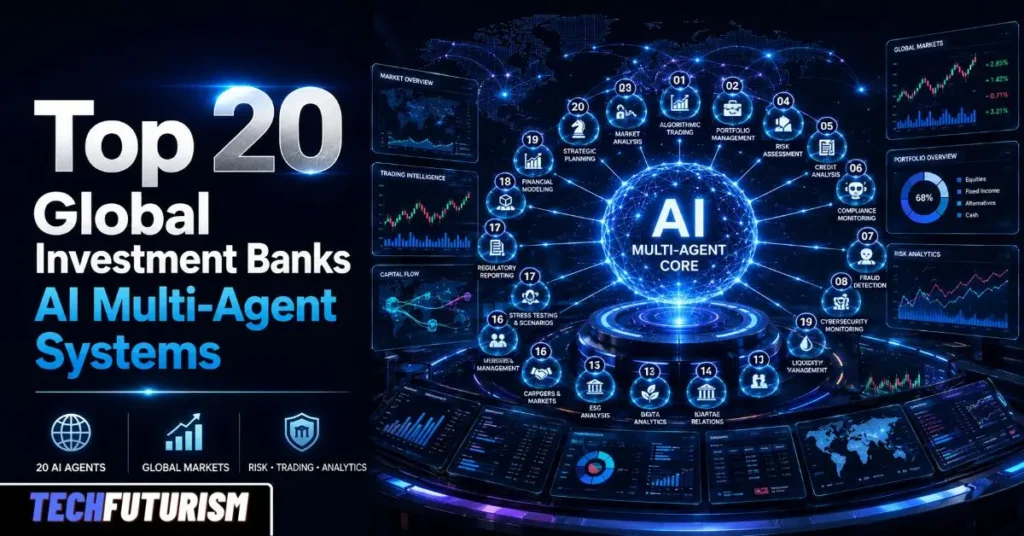
A junior analyst at JPMorgan used to spend an entire evening building a single investment banking pitch deck. Pull the comps, format the charts, proofread the footnotes, repeat until 2 a.m. Today, the bank’s chief analytics officer has demonstrated a system that builds a comparable deck in roughly 30 seconds. That is not a chatbot answering a question. That is an AI multi-agent system — a team of specialized software agents that plan, research, draft, and check each other’s work, much like a real deal team would.
This shift is happening across nearly every major bank on Wall Street and beyond. So, let’s walk through the top 20 global investment banks using AI multi-agent systems to work, the top AI companies building the technology behind them, and how you can evaluate them with confidence.
- Top 20 Investment Banks AI Multi-Agent Systems: What the Technology Actually Is
- Top 20 Investment Banks AI Multi-Agent Systems in the World: Why the Race Is Accelerating
- The Top 20 Global Investment Banks Using AI Multi-Agent Systems
- Top AI Companies to Invest In: The Vendors Powering Bank Agent Fleets
- Evident AI Index | Banks: Ranking Multi-Agent Maturity
- A Real-World Anecdote: The 30-Second Pitch Deck
- How to Evaluate a Bank's Multi-Agent AI Program: A Step-by-Step Guide
- The Regulatory Backdrop Banks Can't Ignore
- Final Thoughts
- Frequently Asked Questions
Top 20 Investment Banks AI Multi-Agent Systems: What the Technology Actually Is
Before naming names, it helps to define the term. A single AI chatbot answers one prompt at a time. An agentic AI system goes further: it breaks a big job into smaller tasks and assigns each one to a specialized “agent.” One agent might pull market data, another might build the financial model, a third might check the output for compliance, and a fourth might draft the client-ready summary. The agents talk to each other, hand off work, and — in the more advanced setups — even debate conflicting conclusions before a human signs off.
This “specialist agents plus oversight” pattern is often called the TradingAgents approach, and it has become the most widely cited blueprint for how banks structure their agent teams. According to that research, roughly 44% of finance teams are now deploying agentic AI in 2026, a jump of more than 600% compared to 2025. That is a staggering pace of adoption, and it is worth understanding why banks are moving so fast.
Top 20 Investment Banks AI Multi-Agent Systems in the World: Why the Race Is Accelerating
Investment banking runs on deadlines, and deadlines run on data. Analysts historically lost hours manually reviewing PDFs, rebuilding models, and hunting for transaction details buried in disorganized virtual data rooms. As a result, deal sourcing and due diligence work became the industry’s biggest bottleneck.
Multi-agent platforms solve this by automating the grunt work so people can focus on judgment calls. Consequently, banks deploying agentic AI in relationship management have reported up to 15% higher revenues and up to 40% lower cost to serve, according to McKinsey research cited across the industry. That kind of return explains why boards are no longer asking “should we pilot this?” — they are asking “how fast can we scale it?”
With that context in mind, here is the list.
“To learn more about how leading financial institutions are adopting advanced AI solutions, explore our guide on Top 20 Investment Banks AI Multi-Agent Technology and see how multi-agent systems are changing the future of banking.”
The Top 20 Global Investment Banks Using AI Multi-Agent Systems
1. JPMorgan Chase
JPMorgan Chase runs the most mature agentic AI program on Wall Street. Its OmniAI platform now powers more than 400 production use cases, and its internal LLM Suite reaches roughly 250,000 employees, with about half using it every day. The bank’s ambition is bold: every employee gets a personalized AI assistant, and every back-office process eventually runs through agents.
2. Goldman Sachs
Goldman Sachs has moved past simple copilots into full agentic AI fleets. The firm is partnering with Anthropic to build agents for trading, transaction accounting, and client onboarding, and it pairs roughly 12,000 engineers with coding agents to handle accounting, compliance, and operational finance tasks.
3. Morgan Stanley
Morgan Stanley treats AI as an “efficiency-enhancing interaction layer” that sits between employees and the dozens of systems they touch daily. Its Debrief tool already auto-logs meeting notes and action items directly into CRM software. This summer, the firm plans to test AI assistants that interact directly with wealth management clients around the clock, pushing reminders and recommendations to human advisors.
4. Bank of America
Bank of America has folded AI into the daily rhythm of its operations, using virtual-assistant technology to support both employees and retail-facing teams while extending similar capabilities into its capital markets business.
5. Citigroup
Citigroup is preparing an AI-powered virtual wealth management “team member” that supports human advisors around the clock. The bank has also required roughly 175,000 employees to complete AI training, signaling how deeply the technology is meant to spread across the organization.
6. UBS
UBS built an internal AI marketplace called Eliza, hosting approved models and tools employees can use for everything from policy questions to workflow automation. Its agents now alert financial advisors to opportunities like maturing annuities and, once approved, can execute trades and transfers directly — freeing advisors to spend roughly 70% of their time with clients instead of paperwork.
7. HSBC
HSBC is among the banks showing measurable payoff from agentic deployments, with reported cost reductions in the 20–40% range and revenue gains between 10–30% from real-world agent rollouts.
8. Barclays
As one of the eight global bulge-bracket banks, Barclays continues to expand generative and agentic tools across research, compliance, and deal-support workflows, aligning with the broader bulge-bracket push toward automated diligence.
9. Deutsche Bank
Deutsche Bank aims to expand AI capabilities across every division, with a strong emphasis on efficiency and regulatory compliance. The bank is scaling generative AI carefully while preparing for more advanced, autonomous agentic use cases in the years ahead.
10. BNY (Bank of New York Mellon)
BNY takes an unusually literal approach: it assigns its AI “digital employees” login credentials, nicknames, and even human managers responsible for training and quality control — treating the agents as genuine teammates rather than background scripts.
11. State Street
State Street continues to invest in AI-driven operations and analytics infrastructure to support its asset-servicing and capital markets clients, part of the same industry-wide shift toward machine-assisted workflows.
12. Wells Fargo
Wells Fargo has expanded its AI programs alongside its capital markets business, with analysts at the bank tracking how AI-driven trading revenue is reshaping the broader sector’s earnings.
13. BNP Paribas
BNP Paribas, one of Europe’s largest investment banks, continues to build out AI-supported research and risk management workflows as part of the wider European push toward agentic AI adoption ahead of the EU AI Act’s high-risk system requirements.
14. Société Générale
Société Générale is part of the same European wave of banks investing in automation for trading support, compliance monitoring, and client servicing.
15. Crédit Agricole CIB
Crédit Agricole CIB’s corporate and investment banking arm is expanding its use of AI-assisted analytics and workflow automation across its global markets operations.
16. Nomura
As Asia’s largest investment bank by global reach, Nomura continues to invest in AI-enabled research and trading-support tools, part of the wider Asia-Pacific momentum toward agentic systems.
17. Mitsubishi UFJ (MUFG)
MUFG is scaling AI-supported operations across its global investment banking business, aligning with Japan’s broader financial-sector push into automation.
18. Mizuho
Mizuho, which acquired boutique advisor Greenhill in 2023, continues to expand its capital markets AI tooling as competition among Japanese banks intensifies.
19. RBC Capital Markets
RBC Capital Markets has been expanding AI-supported research and deal-support tools as part of parent RBC’s broader technology investment strategy.
20. Jefferies
Rounding out the list, Jefferies — one of the most active independent investment banks in M&A advisory — continues to invest in AI-driven research and deal-sourcing tools to keep pace with the bulge-bracket firms above.
Top AI Companies to Invest In: The Vendors Powering Bank Agent Fleets
None of the 20 banks above built their agents alone. Behind every bank’s agentic AI rollout sits a small group of top AI companies supplying the models, chips, and cloud infrastructure.
For investors, this is where the picture gets interesting — the banks are customers of the AI boom, but the vendors behind them are arguably the more direct play on the trend. Nvidia, Microsoft, and Alphabet are widely projected to remain the top publicly traded AI stocks in 2026, thanks to their dominance in AI chips and cloud infrastructure — the same infrastructure that banking multi-agent platforms run on.
Top 5 AI Companies in the World Building Agentic Infrastructure
Rankings vary by methodology, but the five names that show up consistently across 2026 industry lists are Nvidia, Microsoft, Alphabet (Google), OpenAI, and Anthropic — the last two both privately held but valued in the hundreds of billions of dollars.
OpenAI closed a $122 billion financing round in March 2026 at an approximate $852 billion valuation, while Anthropic’s enterprise coding and agent tools are the ones Goldman Sachs pairs with its own engineers, as noted earlier in this article.
Top 10 AI Companies and Top 20 AI Companies in the World
Expand the list past the top five and the top 10 AI companies typically add Meta, Amazon, Databricks, xAI, and CoreWeave — infrastructure and applied-AI names that banks lean on for data platforms and compute.
Push further to the top 20 AI companies, or even the top 50 AI companies in the world, and the field broadens into specialized players like Perplexity, Mistral AI, Cursor-maker Anysphere, and legal-AI firm Harvey — companies that rarely appear in banking headlines directly but often power the tools banking vendors build on top of.
Fastest Growing AI Companies in the Multi-Agent Banking Race
Growth in this sector is unusually fast even by tech standards. Anysphere, the maker of the Cursor code editor, grew from $100 million to $2 billion in annualized revenue in about thirteen months — reportedly the fastest climb to $1 billion ARR ever recorded in B2B software.
Alongside it, fastest-growing AI companies like Anthropic, OpenAI, Databricks, CoreWeave, Perplexity, and Harvey have all posted outsized 2026 revenue or funding growth. That velocity matters for banks: the vendor a bank picks today may look very different from the market leader eighteen months from now.
Top 10 AI Companies to Invest In (and Top 10 AI Companies in the USA)
For investors specifically hunting top 10 AI companies to invest in through public markets, the accessible names are dominated by the familiar mega-caps — Nvidia, Microsoft, Alphabet, Meta, and Amazon — since OpenAI and Anthropic remain privately held.
Nearly every name mentioned in this section also happens to double as one of the top 10 AI companies in the USA, since the overwhelming majority of frontier model labs and AI infrastructure providers are headquartered in the United States, from Nvidia’s Santa Clara campus to Anthropic and OpenAI’s San Francisco offices.
Evident AI Index | Banks: Ranking Multi-Agent Maturity
If the vendor side of this story is about who builds the technology, the Evident AI Index is about who actually uses it well. Now in its fourth edition, the Index benchmarks 50 of the world’s largest banks across North America, Europe, and Asia, scoring each one against more than 70 indicators grouped into four pillars: Talent, Innovation, Leadership, and Transparency.
It’s the closest thing the banking industry has to an independent report card on agentic AI maturity, and it draws entirely on publicly available data rather than self-reported claims.
The Index has also expanded regionally — Evident published dedicated rankings for Latin America and the Middle East & Africa in 2026, and its research tracker separately catalogs more than 1,000 AI research papers published by major financial institutions. Across every region it covers, one trend stands out: agentic AI now accounts for roughly a third of new use cases banks report, and Anthropic has emerged as a leading vendor partner across the sector.
For anyone deciding which bank to trust with an AI-driven relationship, checking where that bank sits on the Evident AI Index is a faster gut-check than reading a press release.
A Real-World Anecdote: The 30-Second Pitch Deck
It’s worth pausing on the JPMorgan example from earlier, because it captures the entire story in miniature. A junior analyst’s job used to include hours of repetitive deck-building. Now, an agent pulls the data, another formats the slides, and a third checks the numbers against the source material — and the draft appears in about half a minute.
The human banker still reviews it, refines the narrative, and owns the client relationship. The agents didn’t replace the analyst’s judgment; they replaced the parts of the job that never required judgment in the first place. That distinction is exactly what separates a well-designed multi-agent system from a risky one.
How to Evaluate a Bank’s Multi-Agent AI Program: A Step-by-Step Guide
If you’re assessing an investment bank’s AI capability — whether as a client, an investor, or a prospective employee — walk through these steps:
- Check for human oversight, not just automation. The strongest programs, like BNY’s “digital employee” model, keep a named human accountable for every agent’s output.
- Look for domain-specific agents, not general chatbots. A single generic assistant rarely handles regulated financial workflows well; specialist agents built for research, risk, and compliance perform better.
- Ask how the system handles compliance. Under the EU AI Act, systems that influence credit decisions, insurance pricing, or investment advice are likely to be classified as high-risk, which brings strict transparency and documentation obligations.
- Review data integration. Agents are only as good as the data they can reach — core banking systems, CRMs, and compliance databases all need to connect cleanly.
- Check the vendor stack. Ask which of the top AI companies power the bank’s agents, and how quickly that bank could switch vendors if a faster-growing challenger overtakes today’s leader.
- Measure the outcome, not the hype. Look for concrete numbers, like the 20–40% cost reductions and 10–30% revenue gains reported at banks including HSBC and UBS, rather than vague promises of “transformation.”
Following this checklist gives you a grounded way to separate genuine agentic AI infrastructure from marketing gloss.
The Regulatory Backdrop Banks Can’t Ignore
None of this growth is happening in a vacuum. The Bank of England has noted that multi-agent systems present novel challenges for model validation and governance that existing risk frameworks weren’t built to handle.
Meanwhile, Singapore’s Monetary Authority issued sweeping AI risk management guidelines in late 2025, and the EU AI Act’s high-risk provisions apply from August 2026 onward. Any bank on this list that wants to keep scaling its agents will need to build compliance into the architecture from day one, not bolt it on afterward.
Final Thoughts
The banks on this list are not experimenting on the sidelines anymore — they are competing to build the most reliable, well-governed AI multi-agent systems in the industry, and the top AI companies supplying them are growing just as fast.
If you’re choosing a banking partner, a technology vendor, or even a career path, the institutions moving fastest and most responsibly on agentic AI — and ranking highest on independent benchmarks like the Evident AI Index — are the ones best positioned for what comes next. The 30-second pitch deck is just the beginning.
Frequently Asked Questions
What is the difference between generative AI and agentic AI in banking?
Generative AI produces content — a summary, an email, a chart — when a person asks for it. Agentic AI goes a step further by planning and executing multi-step tasks on its own, often coordinating several specialized agents before handing a finished result back to a human.
Which investment bank has the most advanced multi-agent AI system?
Based on publicly reported deployments, JPMorgan Chase and Goldman Sachs currently run the most extensive production-scale agentic systems, each covering hundreds of internal use cases.
Which AI companies build the technology banks are using?
The most frequently cited vendors are Anthropic, OpenAI, Microsoft, Nvidia, and Alphabet — with Anthropic in particular named as a direct partner to both Goldman Sachs and JPMorgan.
Is agentic AI safe for regulated financial workflows?
It can be, provided the bank keeps a human accountable for every agent’s decisions and builds in the transparency and documentation that regulators like the EU AI Act and the Bank of England now require.
Will AI replace investment bankers? Or will AI agents replace investment bankers?
This is probably the question people worry about most, and the honest answer is: not based on how banks are actually using the technology today. Every major deployment we’ve seen — at JPMorgan, Goldman Sachs, Morgan Stanley, and the rest — follows the same pattern. The AI takes over the repetitive, time-consuming grunt work: formatting slides, gathering data, drafting first-pass summaries. The human banker still reviews everything, makes the judgment calls, negotiates with clients, and takes responsibility for what goes out the door.
It’s a bit like how a calculator didn’t replace accountants — it just took over the part of the job that never needed a human brain in the first place. What’s actually shifting is where junior bankers spend their time. Instead of building a deck from scratch overnight, they’re reviewing what an agent already built and adding the judgment and relationship skills that AI can’t replicate. So the job is changing, but the people aren’t going away.
Not based on current deployments. Banks are using agents to remove repetitive, low-judgment work — like formatting decks or gathering data — while keeping humans in charge of client relationships, negotiation, and final decisions.
What is an AI agent in investment banking?
Think of an AI agent as a digital coworker with a job to do, not just a chatbot that answers one question and stops. A regular chatbot waits for you to ask something and gives you an answer. An AI agent works more like an intern with initiative: you give it a goal, like “pull together the financial history for this company and flag anything that looks off,” and it figures out the steps on its own — searching documents, pulling numbers, cross-checking sources, and putting together a finished result without someone walking it through every move.
In investment banking specifically, these agents handle the unglamorous but critical work: building pitch decks, running comparable company analysis, checking data rooms for red flags, and drafting first versions of financial models. A multi-agent system takes this a step further by using several of these AI coworkers together, each with its own specialty, so the work gets checked and cross-checked before a human ever sees it.
How do banks use AI multi-agent systems in real deals?How do banks use AI multi-agent systems in real deals?
In practice, it looks like a relay race. One agent might scan hundreds of pages in a data room to pull out contract terms, interest rates, or ownership details that used to take a junior analyst days to find by hand. A second agent takes that raw information and builds it into a financial model. A third checks the numbers against the source documents to catch mistakes before they turn into an embarrassing error in front of a client. A fourth might draft the actual slides, matching the bank’s branding and formatting rules automatically.
Because each agent focuses on one narrow task instead of trying to do everything at once, the whole process runs faster and with fewer errors than a single all-purpose AI trying to juggle everything at once. The result is that a task like building an investment banking pitch deck, which used to take a team of analysts several hours, can now come together in well under a minute — with the human team spending their time refining the story instead of assembling the raw material.
Is it safe for banks to use AI agents for financial decisions?
It can be, but only when the bank builds in the right guardrails, and this is where regulators are paying close attention right now. The core rule almost every serious bank follows is that a human stays accountable for anything an agent produces — nobody lets an AI system approve a trade, sign off on a loan, or send money without a person checking the work first.
Regulators are formalizing this expectation too: the EU AI Act treats any AI system that influences credit decisions, insurance pricing, or investment advice as “high-risk,” which means it comes with strict rules around transparency and documentation. The Bank of England has said openly that these multi-agent setups create genuinely new challenges for risk oversight that older rulebooks weren’t built to handle.
So the honest picture is that the technology itself is capable and increasingly reliable, but “safe” depends entirely on whether the bank using it has built real human oversight, clear audit trails, and regulatory compliance into the system from day one — not bolted on as an afterthought.