
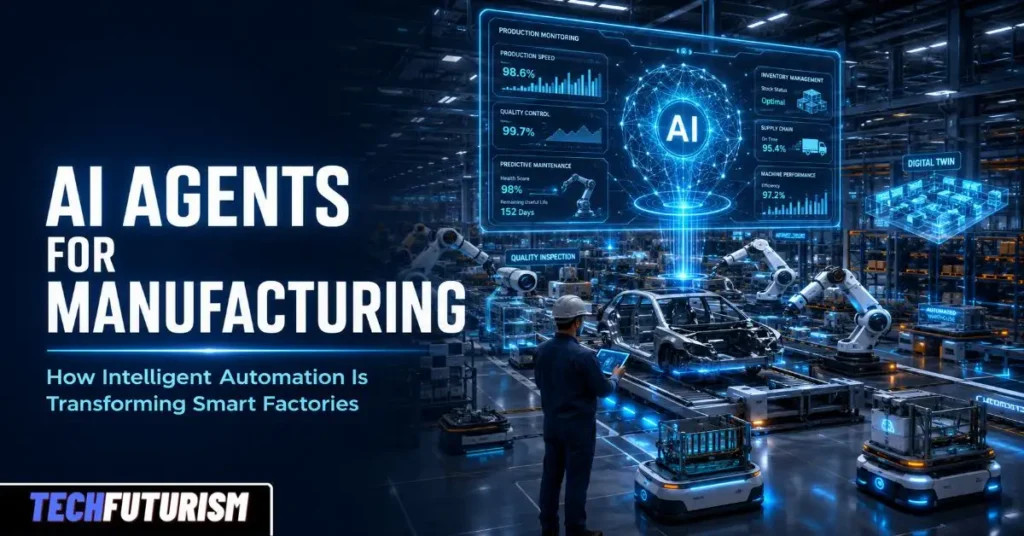
The factory floor has always been a place where efficiency matters. Every second of unplanned downtime costs money. Every defective part chips away at profit margins. Every supply chain disruption ripples across production schedules. For decades, manufacturers worked hard to squeeze out inefficiencies — and they made real progress. But today, a new force is changing what is possible: AI agents for manufacturing.
These are not simple robots that follow pre-programmed instructions. AI agents are intelligent software systems that perceive their environment, make decisions, and take independent action — all without waiting for a human to press a button. They are already doing extraordinary things inside factories around the world, and the results are impossible to ignore.
- What Are AI Agents, and Why Do Manufacturers Need Them?
- AI for Manufacturing: Core Applications on the Factory Floor
- AI Agents for Manufacturing Examples: Real-World Deployments in Action
- Industrial AI Agents: What Sets Them Apart from Standard Automation
- Agentic AI in Manufacturing: The Shift From Reactive to Autonomous Operations
- AI in Manufacturing Examples: How Leading Companies Are Using AI Today
- AI Manufacturing Software: How to Choose the Right Platform for Your Operation
- Agentforce for Manufacturing: What Salesforce's Platform Brings to the Factory Floor
- Best AI Agents Manufacturing: How to Evaluate and Select the Right Solution
- How to Implement AI Agents in Your Manufacturing Operation: A Step-by-Step Guide
- The Real-World ROI of AI Agents in Manufacturing
- Addressing Common Concerns About AI in Manufacturing
- The Future of AI Agents in Manufacturing
- Why Now Is the Time to Act
- Frequently Asked Questions
What Are AI Agents, and Why Do Manufacturers Need Them?
Think of an AI agent as a tireless digital worker. Unlike traditional automation, which follows fixed rules, an AI agent uses machine learning, real-time data, and contextual reasoning to adapt to changing conditions on its own.
Consider the story of a mid-sized auto parts supplier in Ohio. Their production line kept experiencing unexpected halts — a conveyor belt would slow, a sensor would throw an alert, and technicians would scramble to diagnose the problem. After deploying an AI-powered predictive maintenance agent, the system began reading vibration patterns, temperature shifts, and motor load data in real time. Within weeks, it flagged a bearing about to fail — three days before it would have caused a major breakdown. The plant avoided $200,000 in downtime costs from a single alert.
That is the promise of AI agents in manufacturing: not just doing tasks faster, but doing tasks smarter. Furthermore, that intelligence compounds over time — every data point makes the agent more accurate, more responsive, and more valuable.
Just as AI agents help factories work faster and smarter, AI-powered SEO agents help businesses grow online by improving website content, increasing search rankings, and bringing in more customers.
AI for Manufacturing: Core Applications on the Factory Floor
AI agents are not a single tool with a single purpose. They operate across nearly every function inside a modern manufacturing facility, each one eliminating a different category of waste or risk. Here is where their impact is greatest.
1. Predictive Maintenance
Equipment failure is one of the biggest costs in manufacturing. Predictive maintenance powered by AI agents monitors machines continuously, analyzing sensor data to detect anomalies before they cause failures. Instead of scheduling maintenance by the calendar, manufacturers can act exactly when needed — saving money and preventing costly shutdowns.
An AI agent in this role might monitor hundreds of machines simultaneously, something no human team could do around the clock. As a result, maintenance teams spend less time reacting and more time preventing.
2. AI-Driven Quality Control and Defect Detection
Traditional quality inspection relies on human eyes — and human eyes get tired. AI-driven quality control systems use computer vision to inspect every single product with consistent precision. These agents catch microscopic defects, surface irregularities, and dimensional errors at speeds human inspectors cannot match.
A consumer electronics manufacturer in South Korea deployed a machine vision AI agent on its circuit board assembly line. Defect detection rates jumped from 87% to 99.4%. Returns fell dramatically. Customer satisfaction climbed. The agent never called in sick.
3. Supply Chain Optimization
AI agents are powerful tools for supply chain management. They monitor inventory levels, track supplier lead times, and analyze demand signals — then automatically trigger purchase orders, reroute shipments, or flag risks before they escalate into costly disruptions.
During the global chip shortage, companies using AI-powered supply chain agents adapted faster than their competitors. Their agents spotted early signs of constraint in supplier data and triggered alternative sourcing months before others realized there was a problem. That head start translated directly into revenue protected and customers retained.
4. Production Scheduling and Planning
Scheduling a manufacturing plant is an enormously complex puzzle. Machines have different capacities. Orders carry different priorities. Materials arrive on different timelines. AI agents for production planning solve this puzzle continuously, adjusting schedules in real time as conditions change — something static enterprise resource planning (ERP) software simply cannot do on its own.
Advanced planning and scheduling (APS) systems enhanced with AI can cut production lead times by 20–30%, according to industry analysts. Those gains flow directly to on-time delivery rates and customer relationships.
5. AI Energy Management
Energy is a significant and often underestimated cost in manufacturing. AI energy management agents analyze usage patterns, production loads, and utility pricing to optimize when machines run and how much power they draw. These systems can automatically shift energy-intensive processes to off-peak hours, cutting utility bills without impacting output or workforce schedules.
AI Agents for Manufacturing Examples: Real-World Deployments in Action
Reading about capabilities is one thing. Seeing how manufacturing AI agents perform inside real operations makes the case far more convincingly. The following examples span industries and use cases — each one a blueprint other manufacturers can adapt.
BMW Group — Predictive Quality on the Assembly Line
BMW deployed AI-powered visual inspection agents across its assembly lines to check body panels, welds, and paint finishes. The system processes thousands of images per shift, flags anomalies in milliseconds, and has reduced manual inspection time by more than 30% at participating plants. What used to require a team of inspectors now runs continuously with greater consistency.
Siemens — Digital Twin-Driven Optimization
At its Amberg Electronics Plant in Germany, Siemens runs AI agents alongside digital twins to simulate production scenarios before executing them on the floor. When a machine goes down, the AI agent immediately recalculates the optimal production sequence across the remaining equipment — minimizing disruption without human involvement. The plant achieves a defect rate of just 11.5 parts per million.
Unilever — AI-Powered Supply Chain Resilience
Unilever uses AI-driven demand forecasting agents to balance production across more than 300 factories worldwide. The system continuously ingests point-of-sale data, weather signals, and economic indicators to refine predictions. During supply disruptions, agents automatically rebalance inventory allocation — a task that previously took days of human analysis now completes in hours.
Johnson & Johnson — Pharmaceutical Manufacturing Compliance
In pharmaceutical manufacturing, where regulatory compliance is non-negotiable, J&J deployed AI agents to monitor batch production in real time. The agents flag deviations from approved manufacturing processes before they result in a failed batch — reducing costly write-offs and accelerating FDA compliance documentation.
These are not experimental pilots. These are production-scale deployments generating measurable, auditable results that any manufacturer can study and apply.
Industrial AI Agents: What Sets Them Apart from Standard Automation
Not all AI is the same — and the distinction matters for manufacturers evaluating their options. Industrial AI agents operate under a different set of constraints and demands than the AI tools built for consumer applications or general enterprise software.
Standard AI tools process data and return insights. Industrial AI agents go further: they perceive complex physical environments through IIoT sensors, make multi-step decisions under real-time pressure, and execute actions that directly affect machinery, materials, and safety systems. That requires a fundamentally different architecture.
Key characteristics that define true industrial AI agents include the following.
Real-time decision-making. Responses are measured in milliseconds, not minutes, to keep pace with physical production systems that cannot wait.
Fault tolerance. The agent continues operating safely even when sensor inputs are degraded, incomplete, or temporarily unavailable — a common reality on active factory floors.
Integration depth. True industrial agents connect natively to SCADA systems, programmable logic controllers (PLCs), manufacturing execution systems (MES), and ERP platforms — not just surface-level data pulls through APIs.
Explainability. The agent can show operators why a decision was made, which is essential for regulated industries and safety-critical environments where accountability matters.
Continuous learning. Models update as conditions change, rather than degrading as the production environment drifts from training data over time.
These characteristics separate purpose-built industrial AI agents from generic automation tools — and they are what manufacturers should demand when evaluating vendors.
Agentic AI in Manufacturing: The Shift From Reactive to Autonomous Operations
Traditional software waits for instructions. Agentic AI in manufacturing does something fundamentally different: it sets its own sub-goals, plans sequences of actions, and completes complex tasks without human direction at every step.
Agentic AI represents a meaningful evolution beyond standard machine learning models. Where a conventional AI model might analyze a maintenance report and flag a potential issue, an agentic AI system will detect the anomaly, cross-reference the maintenance history, schedule a technician, reorder the replacement part, and update the production schedule — all autonomously, in a single continuous workflow.
This shift from reactive to proactive to autonomous has profound implications for manufacturing operations.
From reactive maintenance to self-healing operations. Rather than waiting for a fault alert, agentic systems detect degradation trends, plan interventions, and execute them during scheduled low-production windows — without a human initiating the process.
From static scheduling to continuous optimization. Agentic AI does not produce a weekly production plan and stop. It continuously re-optimizes the schedule as orders change, machines fluctuate, and materials arrive — keeping the factory running at peak efficiency around the clock.
From siloed decisions to coordinated intelligence. A single agentic AI system can simultaneously manage procurement signals, production throughput, quality thresholds, and logistics timing — making coordinated decisions across functions that typically operate in isolation from each other.
The manufacturers who understand this shift — and build for it — will not just reduce costs. They will operate at a level of speed and precision that competitors without agentic systems simply cannot replicate. That gap will widen every year agentic adoption accelerates.
AI in Manufacturing Examples: How Leading Companies Are Using AI Today
Beyond individual AI agents, it is worth examining how AI in manufacturing is being deployed as a comprehensive operating strategy — not just a point solution. The following examples illustrate what full-scale AI adoption looks like across different manufacturing contexts.
General Electric — Industrial AI Across the Asset Lifecycle
GE deploys Predix, its industrial AI platform, to monitor gas turbines, wind turbines, and jet engines in real time. AI agents analyze performance data from thousands of sensors per asset, predict component degradation, and generate maintenance recommendations automatically. Across its installed base, GE reports that Predix-driven predictive maintenance has saved customers more than $1.5 billion in avoided downtime.
Toyota — AI-Driven Lean Manufacturing
Toyota integrates AI agents directly into its Toyota Production System to strengthen its legendary lean manufacturing discipline. AI agents monitor production lines for muda (waste), flag inefficiencies in real time, and recommend corrective actions aligned with Toyota’s continuous improvement philosophy. The result is a factory floor where AI and human judgment reinforce each other rather than compete.
Procter & Gamble — AI for Consumer Goods Manufacturing
P&G applies AI agents to demand-driven manufacturing, adjusting production volumes across its global network based on real-time retail data. When a product category sees an unexpected spike in consumer demand, AI agents automatically adjust production scheduling, raw material procurement, and distribution routing — cutting the time from demand signal to shelf replenishment significantly.
What connects these examples is scale, integration, and commitment. These companies did not deploy a single AI agent and call it done. They built AI into the operating fabric of their factories — and the competitive results speak for themselves.
AI Manufacturing Software: How to Choose the Right Platform for Your Operation
The tools you choose will either accelerate your AI adoption or limit it. AI manufacturing software has matured significantly in recent years, and the market now offers solutions suited to operations of every size and complexity. The critical decision is matching the right platform to your environment.
Capability Fit
Not all platforms serve every use case equally. Some AI manufacturing software platforms excel at predictive maintenance; others are built for quality inspection or supply chain optimization. Before evaluating vendors, define the two or three capabilities you need most urgently and verify that the platform delivers them in production — not just in demo environments.
Leading platforms worth evaluating include the following.
Siemens Industrial Copilot offers deep integration with Siemens automation hardware and strong capabilities in process optimization and digital twin simulation. Rockwell Automation FactoryTalk AI is purpose-built for discrete and process manufacturing, with strong SCADA and MES integration. PTC ThingWorx provides strong IIoT connectivity and augmented reality integration for operator guidance. Microsoft Azure Industrial IoT brings cloud-scale infrastructure with strong connectivity to existing Microsoft enterprise systems. IBM Maximo Application Suite delivers industry-leading asset management with AI-powered predictive maintenance built in. GE Digital Predix is proven at enterprise scale for heavy industrial and energy-adjacent manufacturing environments.
Integration With Existing Systems
The best AI manufacturing software is the kind that connects cleanly to the systems you already run — your ERP, your MES, your SCADA, your historian. Evaluate how each platform handles data ingestion from your existing operational technology (OT) environment. A platform that requires you to rip and replace your existing infrastructure will cost far more than its license fee suggests.
Deployment Model
Cloud, on-premise, and edge computing each carry different tradeoffs. Facilities with sensitive intellectual property or unreliable connectivity often prefer on-premise or edge deployments. Operations running across multiple global sites often benefit from cloud-scale infrastructure. Many modern platforms offer hybrid architectures — evaluate which model fits your operational and security requirements.
Vendor Support and Roadmap
AI manufacturing software is not a set-and-forget purchase. Evaluate the vendor’s implementation support, the depth of their manufacturing domain expertise, and their product roadmap. A platform that is strong today but lacks investment in agentic capabilities will lag behind the market within three to five years.
Agentforce for Manufacturing: What Salesforce’s Platform Brings to the Factory Floor
One of the most discussed entries in the AI manufacturing software market is Agentforce for Manufacturing, Salesforce’s purpose-built AI agent platform for industrial operations. Agentforce for Manufacturing takes a distinct approach: rather than starting on the factory floor itself, it focuses on the commercial and operational workflows that surround manufacturing — dealer management, service operations, order management, and field service.
Here is what Agentforce for Manufacturing delivers in practice.
Dealer and Channel Partner Management. Agentforce agents can autonomously handle dealer inquiries, process warranty claims, update inventory allocations, and flag at-risk partner relationships — all without human intervention. For manufacturers with complex dealer networks, this eliminates significant administrative burden and accelerates response times across the partner ecosystem.
Service and Maintenance Coordination. When a piece of industrial equipment in the field requires service, Agentforce agents can diagnose the issue using connected asset data, dispatch the right technician with the right parts, and update the customer — creating a closed-loop service experience that previously required multiple handoffs between teams.
Order and Forecast Management. Agentforce integrates with manufacturers’ CRM and ERP systems to monitor order pipelines, flag fulfillment risks, and proactively communicate with customers when lead times shift. During supply disruptions, agents automatically prioritize orders based on strategic account value and available inventory.
Most AI manufacturing software focuses exclusively on the production environment. Agentforce for Manufacturing addresses the commercial layer — the customer-facing and partner-facing workflows that determine whether a manufacturer’s operational efficiency actually translates into revenue. For manufacturers looking to close the loop between factory performance and commercial outcomes, it represents a genuinely differentiated option that complements, rather than replaces, factory-floor AI platforms.
Best AI Agents Manufacturing: How to Evaluate and Select the Right Solution
With a crowded market and high stakes, choosing the best manufacturing AI agents for requires a disciplined evaluation process — not just a vendor shortlist. The right agent for a pharmaceutical plant looks very different from the right agent for an automotive stamping facility. Here is a framework for making the decision confidently.
Define Success Before You Shop
The single most common mistake manufacturers make is evaluating AI agents before defining what success looks like. Start with specific, measurable outcomes: reduce unplanned downtime by 30%, cut first-pass yield losses by 20%, or reduce energy costs per unit by 15%. Those targets will guide every vendor conversation and every contract negotiation.
Evaluate on These Five Dimensions
Domain depth. Does the vendor understand your industry — its regulatory requirements, its production rhythms, its data patterns? A platform trained primarily on generic industrial data will underperform compared to one built with deep domain expertise in your specific vertical.
Proven ROI. Ask for case studies from operations similar to yours in scale, complexity, and industry. Verify the numbers. The best AI agents manufacturing has documented, auditable results — not just analyst endorsements or demo-environment benchmarks.
Time to value. How long from contract signing to a live, producing agent? Some platforms require 12–18 months of integration work before delivering results. Others go live in weeks. Match your patience to your competitive timeline.
Scalability. Your first AI agent will not be your last. Evaluate whether the platform can scale across dozens of use cases and facilities without requiring a full re-architecture. Modular platforms that allow you to add capabilities incrementally carry significantly lower risk than monolithic deployments.
Human-AI collaboration design. The best AI agents do not replace human judgment — they enhance it. Evaluate how the platform presents recommendations to operators: Are they explainable? Actionable? Does the interface work for operators on the floor, or only for data scientists in the office? Adoption depends on usability, not just accuracy.
Build vs. Buy
Some large manufacturers with mature data science teams choose to build proprietary AI agents using platforms like Google Vertex AI, AWS SageMaker, or Azure Machine Learning. This approach offers maximum flexibility but carries significant time, cost, and talent risk. For most manufacturers, purpose-built AI manufacturing software from established vendors delivers faster, lower-risk results.
How to Implement AI Agents in Your Manufacturing Operation: A Step-by-Step Guide
Getting started with AI agents manufacturing does not require a complete overhaul of your facility. Here is a practical roadmap built for real operational environments.
Step 1: Identify Your Biggest Pain Points
Start where the pain is greatest. Is it unplanned equipment downtime? High defect rates? Inventory imbalances? Pick one high-impact problem as your starting point. This focused approach produces measurable results quickly — and builds the internal confidence needed for broader adoption across the organization.
Step 2: Assess Your Data Infrastructure
AI agents need data to function. Before deploying any agent, evaluate your current Industrial Internet of Things (IIoT) setup. Do your machines generate sensor data? Is that data collected and stored consistently? If gaps exist, address them first. Investing in industrial sensors and data integration platforms pays dividends across every subsequent AI initiative.
Step 3: Choose the Right AI Agent Platform
Several strong platforms serve manufacturing specifically. Match your platform choice to your existing technology stack and your team’s technical capabilities. Use the evaluation framework in the section above to make a structured, defensible decision that stakeholders can support.
Step 4: Start with a Pilot Program
Deploy your first AI agent in a controlled environment — one production line, one facility, one use case. Set clear key performance indicators (KPIs) before launch: reduce unplanned downtime by 25%, cut defect rates by 15%, or shorten cycle times by 10%. Pilot programs let you learn without risking full-scale disruption.
Step 5: Train Your Team
Technology alone does not drive transformation — people do. Train your operators, technicians, and managers to work alongside AI agents. Help them understand what the agent is doing, why it makes certain recommendations, and how to act on its outputs. Change management is as important as the technology itself, and neglecting it is one of the most common reasons AI deployments stall before they deliver value.
Step 6: Measure, Iterate, and Scale
After your pilot, measure results against your KPIs. Analyze what worked and what did not. Refine the agent’s parameters, expand its data inputs, and improve its decision logic. Once the pilot proves its value, scale confidently to additional use cases and facilities. Each new deployment builds faster than the last, because the organizational muscle already exists.
The Real-World ROI of AI Agents in Manufacturing
The business case for manufacturing AI agents is strong — and hard data backs it.
According to McKinsey & Company, manufacturers who deploy AI and advanced analytics across operations see EBITDA improvements of 3–5 percentage points. Deloitte research shows that predictive maintenance alone can reduce maintenance costs by 25%, cut unplanned downtime by 70%, and extend machine life by 40%.
Moreover, companies using AI-driven quality control typically reduce defect rates by 35–90%, depending on the complexity of their production process. That range reflects the diversity of manufacturing environments — but even the low end of that improvement delivers a significant competitive edge.
These numbers are not theoretical. They represent real factories, real savings, and real competitive advantages earned by manufacturers willing to act decisively.
Addressing Common Concerns About AI in Manufacturing
“Will AI agents replace our workers?”
This is the question every plant manager hears — and it deserves a direct answer. AI agents will change the nature of work, not simply eliminate it. Routine, repetitive tasks shift to machines. Meanwhile, human workers move into higher-value roles — managing AI systems, interpreting insights, solving complex problems, and driving continuous improvement. The World Economic Forum projects that AI will create more jobs than it displaces over the next decade.
“Our operation is too complex for AI.”
Actually, complexity is exactly where AI agents shine. They process vastly more variables than any human team or legacy software system can handle simultaneously. The more complex your environment, the greater the potential benefit — and the greater the competitive gap between those who adopt AI and those who wait.
“We cannot afford enterprise AI.”
The market has matured significantly. Cloud-based AI platforms have brought deployment costs down dramatically. Many manufacturers achieve full return on investment (ROI) within 12–18 months of deployment. Furthermore, the cost of not adopting AI — continued inefficiency, quality problems, and supply chain fragility — compounds every year that passes.
The Future of AI Agents in Manufacturing
The next generation of AI agents for manufacturing will not just react to data — they will anticipate, plan, and coordinate across entire value chains. Imagine agents that autonomously negotiate with suppliers, dynamically adjust pricing based on real-time cost inputs, and coordinate production across multiple global facilities without human intervention.
Digital twins — virtual replicas of physical production environments — will become the standard operating environment for AI agents, letting them simulate and stress-test decisions before executing them in the real world. Generative AI will layer on top, enabling agents to surface insights in plain language and communicate recommendations directly to decision-makers. Manufacturers who build this foundation today will operate at a level of intelligence their competitors simply cannot replicate.
Why Now Is the Time to Act
Every month that passes without AI agents is a month competitors gain ground. The manufacturers who invested early in Industry 4.0 technologies during the 2010s did not just survive the disruptions of recent years — they thrived while others scrambled. The same dynamic is playing out right now with AI agents manufacturing.
The tools are proven. The ROI is documented. The implementation pathways are clear. What manufacturers need now is the will to move forward.
AI agents manufacturing are not a distant possibility. They are already on the floor of factories worldwide, cutting costs, improving quality, and building resilience. The question is not whether your operation will eventually use them. The question is whether you will lead — or follow.
Frequently Asked Questions
What is an AI agent in manufacturing?
An AI agent in manufacturing is an intelligent software system that collects data from machines, sensors, and enterprise systems, then makes autonomous decisions to optimize production, maintenance, quality, or supply chain operations — with minimal human intervention.
What are the best AI agents manufacturing?
The best AI manufacturing agents depend on your use case. For predictive maintenance, IBM Maximo and GE Predix lead the market. For quality control, Cognex and Landing AI are widely adopted. For supply chain and commercial workflows, Agentforce for Manufacturing by Salesforce is a strong option. Define your priority use case first, then match the platform to it.
What are some real AI agent manufacturing examples?
Strong manufacturing AI agent examples include BMW’s visual inspection agents, which reduced manual inspection time by more than 30%; Siemens’ AI-driven production sequencing at the Amberg plant, which achieves 11.5 defective parts per million; Unilever’s demand forecasting agents balancing production across 300-plus factories; and GE’s Predix platform, which has saved customers more than $1.5 billion in avoided downtime.
What is agentic AI in manufacturing?
Agentic AI in manufacturing refers to AI systems that do not simply analyze data and report findings — they take autonomous, multi-step action. An agentic AI system can detect an equipment anomaly, schedule a technician, reorder a part, and update the production schedule, all without human direction. This makes it fundamentally more powerful than conventional AI tools.
How do AI agents improve manufacturing efficiency?
AI agents improve efficiency by continuously monitoring operations, predicting failures before they occur, optimizing production schedules in real time, detecting quality defects instantly, and managing energy consumption automatically. Each capability eliminates a different category of waste.
How long does it take to implement AI agents in a factory?
A focused pilot program can go live in eight to 16 weeks. Full-scale deployment across multiple use cases typically takes 12–24 months, depending on the complexity of your operations and existing data infrastructure.
What industries use AI agents in manufacturing?
AI agents are active across automotive, aerospace, electronics, food and beverage, pharmaceuticals, consumer goods, and heavy equipment manufacturing, among many others.
Are AI agents safe to use in industrial environments?
Yes. Modern AI agents are designed with industrial safety standards in mind. They integrate with existing safety systems and operate within defined parameters to protect both workers and equipment. Regulatory frameworks such as ISO 10218 govern how automated systems interact with human workers on the factory floor.
How do AI agents actually work on a factory floor?
This is one of the most common questions manufacturers ask when they first hear about AI agents — and it is a great place to start, because understanding how these systems work makes everything else easier to grasp.
An AI agent on a factory floor works in a continuous loop: it senses, it decides, and it acts. That cycle repeats thousands of times per day, often in milliseconds, without any human telling it what to do at each step.
Here is a simple way to picture it. Imagine a machine on your production line is running slightly hotter than usual. A traditional system might log that temperature reading and wait for a technician to check the report at the end of the shift. An AI agent does something very different. It reads that temperature spike, cross-references it against thousands of historical readings, compares it to the machine’s current workload, checks the maintenance history, and within seconds flags the anomaly as an early sign of bearing failure. Then it does not just send an alert — it books a technician, generates a parts order, and adjusts the production schedule to compensate for a likely window of reduced capacity. All of that happens automatically, while the machine is still running.
This is possible because AI agents draw on several technologies working together. They receive a continuous stream of data from IIoT sensors — devices attached to machines, conveyor belts, robotic arms, and environmental systems that measure everything from vibration and temperature to pressure and power draw. That raw data feeds into machine learning models that have been trained to recognize what normal looks like and what abnormal looks like. The agent compares incoming data against those patterns in real time and decides whether action is needed.
What makes modern AI agents especially powerful is their ability to connect across systems. A single agent can pull data from your manufacturing execution system (MES), your ERP platform, your SCADA controls, your supplier databases, and your maintenance logs — all at once. It does not work with one slice of information. It works with the whole picture, which is exactly what good decisions require.
The result is a factory that responds to problems before they become emergencies, maintains itself before it breaks down, and adjusts its own schedule before a disruption cascades. That is not science fiction. It is what manufacturers running AI agents are experiencing today.
Will AI agents in manufacturing take away jobs from workers?
This is the question that comes up in almost every conversation about AI in manufacturing — and it deserves a straight, honest answer rather than a corporate talking point.
The short answer is: AI agents will change jobs far more than they will eliminate them. But that change is real, and it is worth understanding clearly.
Think about what happened when manufacturers introduced barcode scanners in the 1980s, or when computer numerical control (CNC) machines replaced manual lathes. Workers who once spent their days on purely repetitive, physical tasks moved into roles that required more skill, more judgment, and more problem-solving. The jobs did not disappear — they evolved. AI agents are driving a similar shift, just at a faster pace and across more job categories.
What AI agents do exceptionally well is handle tasks that are repetitive, data-intensive, and time-sensitive. Monitoring 400 machines simultaneously for early fault signs. Inspecting every single product on a conveyor line for microscopic defects. Recalculating a production schedule every time a machine goes down or an order changes. These are tasks that physically exhaust human workers or simply cannot be done at the speed and scale the factory requires. AI agents take those tasks over.
What that frees up is human capacity for the work that actually requires a human: troubleshooting unusual problems the AI has never encountered before, building relationships with suppliers, training colleagues, making ethical judgment calls, and driving continuous improvement initiatives that make the whole operation smarter. Early adopters of agentic AI in manufacturing are reporting that workers are shifting from manual data entry and repetitive monitoring into roles as strategic orchestrators — people who manage the AI systems, define the goals, and verify the quality of outputs.
According to a survey by the Manufacturing Leadership Council, 40% of manufacturers expect plants to operate without any human input by 2030 — but that projection refers to specific routine tasks inside plants, not to the elimination of workforces. Even the most automated factories in the world still employ skilled technicians, engineers, and managers.
Google is working with the Manufacturing Institute to equip 40,000 current and future manufacturing employees with critical AI skills, recognizing that the real challenge is not job loss — it is making sure workers have the skills to thrive alongside AI. That is the right framing. The manufacturers who handle this transition well will invest in retraining, communicate openly with their workforce, and involve workers in the AI deployment process from the start. The ones who handle it poorly will face resistance, low adoption, and AI systems that never deliver their potential.
What is the return on investment (ROI) for AI agents in manufacturing, and how quickly can I expect to see results?
This is the question that matters most to anyone who controls a budget — and it is also the question with the most variation in honest answers, because ROI depends heavily on what you deploy, where you deploy it, and how well your data infrastructure is set up beforehand.
That said, the data from real deployments is compelling.
McKinsey & Company has found that manufacturers who deploy AI and advanced analytics across their operations see EBITDA improvements of 3–5 percentage points. For a company running at $500 million in revenue, that is $15–25 million in additional profit annually. Deloitte’s research on predictive maintenance specifically shows cost reductions of 25%, unplanned downtime reductions of up to 70%, and machine life extensions of 40%. Based on deployments discussed at IIoT World Days 2025, prescriptive maintenance and computer vision quality control consistently deliver some of the fastest ROI of any AI use case in manufacturing.
Early adopters are reporting a 95% reduction in query time for materials data, 80% automation of transactional order processing decisions, and up to $1.3 million in avoided productivity impact per site through automated document management.
As for timing, here is a realistic breakdown. A focused pilot — one AI agent, one use case, one production line — can typically go live in eight to 16 weeks and begin generating measurable results within the first 30 to 90 days. The most common first deployments are predictive maintenance agents, because the data is usually already available from existing sensors, and the ROI is easy to measure: how many unplanned failures did we avoid, and what did each one cost us in the past?
Full-scale deployment across multiple use cases and multiple facilities is a 12–24-month journey for most manufacturers. The biggest variable is data readiness. If your machines are already connected and generating clean, consistent sensor data, you can move quickly. If you need to retrofit sensors, build data pipelines, and clean up historical records first, add three to six months to your timeline.
The most important thing to understand is that the ROI compounds over time. The more data an AI agent processes, the more accurate its predictions become. The more use cases you add, the more the agents can coordinate with each other. Manufacturers who started deploying AI agents in 2022 and 2023 are now running significantly more sophisticated, higher-value systems than they were at launch — because the foundation they built continues to appreciate in value.
How is agentic AI in manufacturing different from regular AI or traditional automation?
This question comes up constantly, and it matters because these three things — traditional automation, regular AI, and agentic AI — are genuinely different, and confusing them leads to the wrong purchasing decisions and the wrong expectations.
Start with traditional automation. A traditional automated system follows a fixed script: if this happens, do that. A robotic arm on an assembly line is a perfect example. It does its job brilliantly — as long as nothing unexpected happens. The moment a part is out of position or a new product type comes down the line, the robot stops and waits for a human to intervene. Traditional automation is fast, reliable, and completely inflexible.
Regular AI — the kind that has been around in manufacturing for the past decade — is smarter than that. It uses machine learning to find patterns in data and make predictions. A regular AI model might analyze vibration data from a motor and tell you: “This motor has a 78% probability of failing within the next 14 days.” That is genuinely valuable. But the AI stops there. It surfaces the insight, and then a human decides what to do with it.
Agentic AI goes a step further. It can plan, make decisions, and execute multi-step workflows across multiple systems. So instead of just telling you the motor is likely to fail, an agentic AI system will detect the risk, check the parts inventory, find an available technician, schedule the repair during a low-production window, adjust the production plan to compensate, notify the affected downstream teams, and update the maintenance record — all without a human directing each step.
Unlike traditional automation that follows fixed “if-then” scripts, agentic AI is goal-oriented. It understands a complex objective, creates a multi-step plan, and executes actions across different software environments while keeping a human in the loop for oversight.
This distinction has massive practical implications. Traditional automation handles one task in one place. Regular AI handles analysis and prediction. Agentic AI handles entire workflows that span multiple departments, multiple systems, and multiple decisions — the kind of coordination that used to require a team of experienced people working together. The conversation in 2026 is shifting from AI experimentation to deployment at scale, with momentum growing beyond predictive and generative AI to agentic AI — where technology not only analyzes data and makes recommendations, but pursues defined outcomes by coordinating decisions, taking actions, and orchestrating processes across planning, production, and execution.
For manufacturers, the practical takeaway is this: if you have already deployed basic AI tools for monitoring or prediction, agentic AI is the next step — the one that takes the insights your current systems generate and automatically turns them into action. That is where the biggest efficiency gains are still sitting, waiting to be captured.