
Picture a recruiter named Sarah. She has 200 resumes sitting in her inbox for a single marketing role. She has back-to-back interviews all week. She has a hiring manager texting her every few hours asking, “Any good candidates yet?” By Friday, Sarah is exhausted, and she still hasn’t called half the people who applied.
This story plays out in HR departments every single day. But here’s the good news: it doesn’t have to. AI agents for recruiting are changing how companies find, screen, and hire talent, and they’re doing it faster and more accurately than ever before. In this article, we’ll walk through what these tools actually do, why they matter, and how you can start using them with confidence.
- What Are AI Agents for Recruiting?
- Why Recruiting Needs Help (And Why Now)
- How AI Agents Actually Work in Recruiting
- The Real Benefits: Speed, Accuracy, and a Better Candidate Experience
- Best AI Agents Recruiting: What Separates the Good from the Great
- Addressing Bias: The Honest Conversation
- A Step-by-Step Guide to Adopting AI Recruiting Agents
- AI Agents Recruiting Reddit Discussions: What Real Users Are Saying
- Why This Is the Right Time to Make the Move
- AI Agents for Recruiting Jobs: What This Means for Recruiters' Careers
- FREQUENTLY ASKED QUESTIONS
What Are AI Agents for Recruiting?
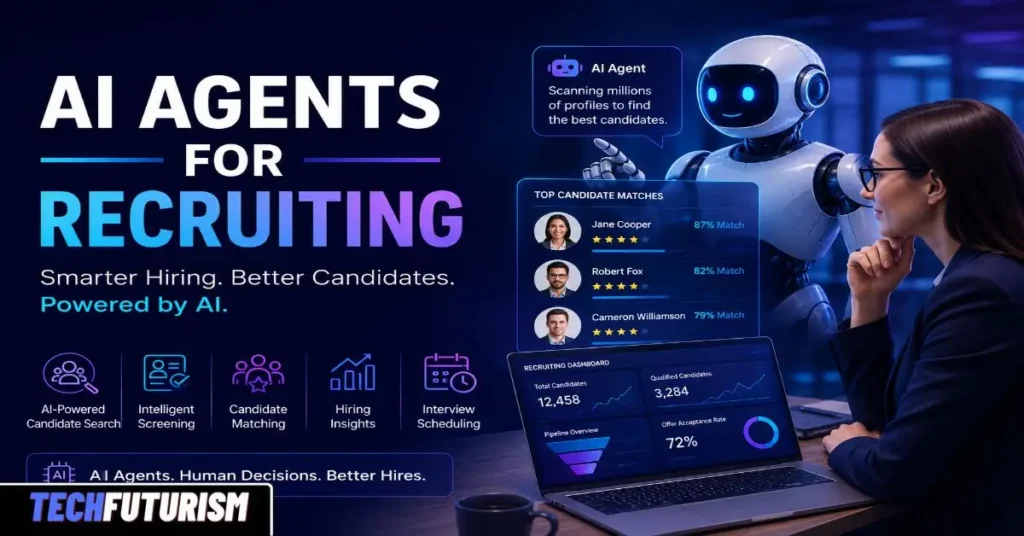
Let’s start simple. An AI agent is a software program that can perform tasks on its own, make decisions, and learn from data without a human guiding every single step. When you apply that idea to hiring, you get an AI recruiting agent: a digital assistant that can scan resumes, chat with candidates, schedule interviews, and even predict who’s likely to succeed in a role.
Unlike older recruiting software that simply stored resumes in a database, today’s AI agents actively work the hiring process. They read between the lines of a resume, hold natural conversations with applicants through a chatbot or voice interface, and flag the best-fit candidates for a recruiter to review. Think of it less like a filing cabinet and more like a tireless junior recruiter who never sleeps, never gets bored, and never skips a follow-up email.
So, why does this matter right now? Let’s look at the bigger picture.
AI agents for recruiting become even more useful when combined with AI workforce planning HR support, helping companies hire the right people while planning future staffing needs more effectively.
Why Recruiting Needs Help (And Why Now)
Hiring has quietly become one of the most stressful jobs in business. According to data referenced by the Society for Human Resource Management (SHRM), recruiters often juggle dozens of open roles at once, each with its own pile of applications. Meanwhile, job seekers expect quick replies. A slow hiring process doesn’t just frustrate candidates — it actively costs companies their best talent, since top performers rarely stay unemployed for long.
At the same time, the volume of applications has exploded. Online job boards and one-click “Easy Apply” buttons mean a single posting can attract hundreds of applicants within hours, many of whom aren’t even close to qualified. Recruiters end up drowning in noise, searching for a handful of strong signals.
This is exactly the kind of repetitive, high-volume, time-sensitive work that AI handles best. And that’s where recruiting agents step in to lighten the load.
How AI Agents Actually Work in Recruiting
To understand the real value here, it helps to break down what these systems do, step by step.
Step 1: Resume Screening and Matching
Instead of a human skimming hundreds of resumes, the AI agent reads each one and compares it against the job requirements. It looks at skills, experience, and even contextual clues, like whether someone’s project history matches what the role actually needs. This process is often called resume parsing, and modern systems do it in seconds rather than hours.
Step 2: Candidate Engagement
Next, the agent reaches out. This might be a friendly chatbot message confirming interest in the role, or an automated email answering common questions like salary range or work location. Good systems keep this conversational and warm, not robotic, so candidates still feel like they’re talking to a real company that values their time.
Step 3: Pre-Screening and Assessment
Many AI agents conduct an initial round of screening through structured questions, skills tests, or even short video interviews analyzed for relevant competencies. This step replaces the painful first-round phone screen that used to eat up hours of a recruiter’s week.
Step 4: Interview Scheduling
Anyone who has played email tag trying to coordinate five people’s calendars knows this pain well. AI agents sync with calendars automatically, suggest open time slots, and confirm interview scheduling without a single back-and-forth email.
Step 5: Data-Driven Recommendations
Finally, the agent hands the recruiter a shortlist, often ranked by fit, along with a clear explanation of why each candidate made the cut. This keeps a human in the loop for the final, most important decisions, while removing the grunt work that came before it.
Once you see the process laid out this way, the appeal becomes obvious: every stage that used to take days now takes minutes.
The Real Benefits: Speed, Accuracy, and a Better Candidate Experience
Let’s go back to Sarah for a second. Imagine if, instead of manually reading 200 resumes, an AI agent had already sorted them by relevance, automatically messaged the top 30 candidates, and scheduled interviews for the best five. Sarah’s Friday suddenly looks a lot different. She’s not buried in admin work. She’s actually talking to people, building relationships, and making thoughtful decisions.
That’s the core promise of AI in recruitment: it doesn’t replace the human side of hiring, it protects it. Some of the most meaningful benefits include:
- Faster time-to-hire, since manual screening bottlenecks disappear
- Consistent decision-making, since every resume is evaluated against the same criteria
- Better candidate experience, since applicants get faster responses instead of radio silence
- Reduced recruiter burnout, since repetitive tasks are automated away
- Stronger talent pipelines, since the system can re-engage past applicants who fit new openings
Of course, no tool is magic. It’s worth addressing the elephant in the room next: bias and fairness.
Best AI Agents Recruiting: What Separates the Good from the Great
Not every tool on the market lives up to the hype, so it helps to know what the best AI agents recruiting actually have in common before you commit to one. The strongest platforms share a handful of traits that are worth checking off your list.
- Deep ATS integration: The best tools plug directly into your existing applicant tracking system (ATS) instead of forcing you to manage two separate systems.
- Explainable matching: Top platforms show why a candidate was ranked highly, not just a black-box score, so recruiters can trust and verify the recommendation.
- Natural, low-friction candidate communication: Leading agents sound human in chat and email, which keeps your employer brand intact instead of feeling like a cold, automated process.
- Proven bias auditing: As covered below, the best vendors publish fairness data rather than asking you to take their word for it.
- Scalability: A strong agent should handle one open role just as smoothly as fifty, without losing accuracy as volume grows.
When comparing options, ask vendors for case studies, request a trial period, and talk to current customers if possible. The best recruiting AI agents earn that title through measurable results, not just slick marketing pages.
Addressing Bias: The Honest Conversation
If you’ve read anything about AI hiring tools, you’ve probably seen concerns about algorithmic bias. This is a fair and important concern. Early hiring algorithms, trained on historical data, sometimes absorbed the same biases that existed in human decision-making — favoring certain schools, names, or backgrounds without anyone intending it.
The good news is that the best AI recruiting tools today are built with this problem directly in mind. They’re regularly audited, trained on diverse and representative data, and designed to focus strictly on job-relevant skills rather than demographic proxies. Many platforms now publish fairness reports or comply with emerging regulations, like New York City’s Local Law 144, which requires bias audits for automated hiring tools.
The takeaway here is simple: don’t avoid AI recruiting because of bias risk — choose a provider that takes it seriously and proves it with transparency. That single decision separates a risky tool from a trustworthy one.
With that concern addressed, let’s talk about how to actually get started.
A Step-by-Step Guide to Adopting AI Recruiting Agents
If you’re convinced this is worth exploring (and by this point, you probably are), here’s a practical path forward.
1. Map your current hiring process. Before adding any tool, write down every step your team takes today, from job posting to offer letter. This helps you spot exactly where the bottlenecks live.
2. Identify your biggest pain point. Maybe it’s resume screening. Maybe it’s scheduling. Start with the one stage that’s costing you the most time, rather than trying to automate everything at once.
3. Shortlist a few platforms. Look for vendors with strong candidate experience reviews, clear bias-testing practices, and integrations with your existing applicant tracking system (ATS).
4. Run a small pilot program. Test the AI agent on one or two open roles before rolling it out company-wide. This lets you see real results without risking your entire hiring pipeline.
5. Keep humans in the loop. Use the AI agent to surface strong candidates and handle busywork, but keep final hiring decisions in human hands. This builds trust internally and protects against blind spots.
6. Measure and adjust. Track metrics like time-to-hire, candidate satisfaction, and quality of hire after 90 days. Adjust your settings or criteria based on what the data tells you.
Follow these steps, and you’ll move from curiosity to confident adoption without the common rookie mistakes.
AI Agents Recruiting Reddit Discussions: What Real Users Are Saying
If you’ve searched for honest opinions, you’ve likely landed on recruiting AI agents Reddit threads, where recruiters, hiring managers, and job seekers swap unfiltered experiences. These communities are worth reading, because they surface the kind of practical detail polished marketing pages tend to skip.
On the recruiter side, posts in forums like r/humanresources and r/recruiting often discuss which platforms genuinely save time versus which ones create more cleanup work than they save. Common themes include the importance of testing a tool on a real job opening before trusting it with high-stakes roles, and the value of keeping a human reviewer involved in every shortlist.
On the candidate side, job seekers sometimes share frustration with applicant tracking systems that reject qualified resumes due to formatting issues or missing keywords. This feedback loop is valuable. It pushes vendors to build fairer, more transparent systems, and it reminds employers that a tool is only as good as the experience it creates for the people on the other side of the screen.
The lesson from these communities is consistent: read real reviews, not just case studies, before choosing a platform. Reddit threads won’t replace a proper evaluation, but they offer a useful gut check from people who’ve actually lived with these tools day to day.
Why This Is the Right Time to Make the Move
Hiring isn’t getting any simpler. Candidate expectations keep rising, talent pools keep shrinking for specialized skills, and recruiters keep getting asked to do more with less. Companies that cling to fully manual processes will keep losing strong candidates to competitors who respond faster and communicate better.
recruiting AI agents aren’t a futuristic concept anymore — they’re a practical, proven way to give your hiring team its time back while improving the quality of every hire. The technology has matured. The fairness safeguards have improved. And the results — faster hiring, happier candidates, less burned-out recruiters — speak for themselves.
So, the next time you imagine Sarah staring down 200 resumes on a Friday afternoon, picture a different ending: an AI agent that already did the heavy lifting, leaving her free to do what she does best, connecting with people and making great hires.
AI Agents for Recruiting Jobs: What This Means for Recruiters’ Careers
A common worry surfaces whenever automation enters a profession: will AI agents for recruiting jobs replace the recruiters themselves? The honest answer is no, but the role is shifting, and it’s worth understanding how.
Rather than eliminating recruiting jobs, AI agents are reshaping what a strong recruiter actually does day to day. Administrative tasks, like resume screening, scheduling, and follow-up emails, increasingly belong to the machine. What’s left for humans is the work that actually requires judgment: building relationships with candidates, advising hiring managers on tough calls, negotiating offers, and shaping a company’s employer brand.
In fact, this shift is creating new specialized roles. Titles like “AI recruiting strategist” or “talent technology manager” are starting to appear in job postings, reflecting a growing need for people who know how to configure, audit, and get the most out of these tools. So if you’re a recruiter wondering where you fit into this picture, the honest answer is: closer to the center of the action, not further from it. The agents handle the busywork. You handle the people.
That’s not just a nicer Friday. That’s a smarter, more sustainable way to build a team.
FREQUENTLY ASKED QUESTIONS
1. What are AI agents recruiting, and how are they different from regular hiring software?
An AI agent for recruiting is a digital assistant that can carry out an entire task on its own, not just one small piece of it. Older recruiting software usually followed a fixed set of rules. It might flag a resume if it contained the word “Python,” for example, but it couldn’t read the resume the way a person would or make a judgment call about whether the candidate was actually a good fit.
AI agents work differently. They can read a resume in context, compare it to the job description, reach out to the candidate, answer their questions, and schedule an interview, all without a recruiter manually stepping in at every stage. Think of the difference between a basic kitchen timer and a smart oven that knows what you’re cooking and adjusts the temperature on its own. One just follows instructions. The other actually understands the task and adapts as it goes.
This doesn’t mean recruiters are removed from the process. The best AI agents still hand off the final decision to a human. The agent does the time-consuming groundwork, like sorting through hundreds of applications, while the recruiter focuses on the parts that need real human judgment, like deciding who’s truly the right fit for the team.
2. Are AI recruiting tools biased, and can they discriminate against certain candidates?
This is one of the most common worries people have, and it’s a fair one to ask. Early AI hiring tools sometimes did pick up biases, because they learned from old hiring data that already reflected unfair patterns. If a company had historically hired more people from certain schools or backgrounds, an early AI tool might “learn” that pattern and repeat it without anyone intending it.
The good news is that this problem is well understood today, and reputable AI recruiting platforms are built to address it directly. They’re regularly tested for bias across different demographic groups, trained on broader and more representative data, and designed to score people based on job-relevant skills rather than personal characteristics. Some cities and states have also started requiring companies to run bias audits on automated hiring tools and report the results publicly, which adds another layer of accountability.
The smart move isn’t to avoid AI recruiting tools out of fear of bias. It’s to ask the vendor direct questions: Do you audit for bias? How often? Can you show me the results? A company that takes bias seriously will have a clear answer ready. One that dodges the question is a red flag worth paying attention to.
3. Will AI agents replace human recruiters and take away recruiting jobs?
No, and this is worth saying plainly. AI agents are built to take over the repetitive, time-consuming parts of recruiting, like screening resumes, sending follow-up emails, and coordinating interview times. They are not built to replace the parts of the job that require real human connection, like building trust with a candidate, negotiating a job offer, or convincing someone to leave a comfortable job for a new opportunity.
In fact, people often join a company because of a conversation with a real person who made them feel confident about the decision. No AI agent can fully replicate that kind of trust-building. What’s actually happening is that the recruiting job is shifting, not disappearing. Recruiters are spending less time on data entry and more time on strategy, relationship-building, and closing offers. New job titles are even starting to appear, like “AI recruiting strategist,” for people who know how to manage and get the most out of these tools.
So if you’re a recruiter wondering where you fit in, the honest answer is that you’re moving closer to the center of the hiring process, not further away from it. The agent handles the busywork. You handle the people.
4. What’s the best way to choose an AI recruiting agent for my company?
There’s no single “best” tool that works for every company, since the right choice depends on your hiring volume, your budget, and which part of your process feels the most painful right now. That said, a few qualities separate the strong tools from the weak ones.
First, look for a tool that connects directly with your existing applicant tracking system, so you’re not stuck managing two separate systems by hand. Second, look for “explainable” matching, meaning the tool tells you why it ranked a candidate highly instead of just spitting out a score with no reasoning behind it. Third, check how the tool talks to candidates. If the messages sound robotic or impersonal, candidates will notice, and it can hurt how people see your company. Fourth, ask about bias testing, as covered in the question above. And finally, make sure the tool can grow with you, handling one open role just as well as fifty.
A smart way to test all of this is to run a small pilot first. Pick one or two open roles, try the tool on those, and see how it performs in the real world before rolling it out company-wide. Real results on a real job opening will tell you more than any sales pitch ever could.