
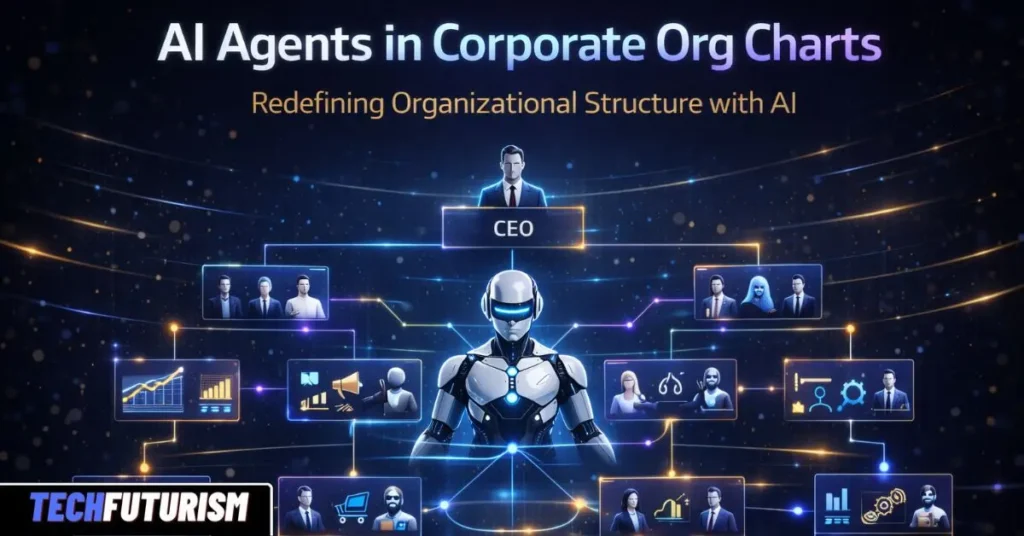
Quick take: AI agents in corporate org charts are no longer an experiment — they are a business imperative. From IBM’s pioneering research to real-world enterprise deployments, this guide covers everything you need to know to integrate AI agents into your organization with confidence.
- Introduction
- What Is an AI Agent?
- AI Agents in Corporate Org Charts — Examples from the Real World
- AI Value Creators IBM: the Framework for Enterprise AI Success
- The IBM AI Value Creators Book: What It Teaches Business Leaders
- Artificial Intelligence IBM: What IBM Actually Builds for the Enterprise
- How to Conduct AI Integration Into Your Org Chart — Step by Step
- IBM AI Articles: the Research That Should Inform Your Strategy
- IBM AI Blog: Staying Current as the Landscape Evolves
- The Future of AI Agents in Corporate Org Charts
- Why Act Now — and Why Confidence Is Justified
- Final Thoughts
- Frequently Asked Questions
Introduction
Picture this: it is Monday morning at a Fortune 500 company. The CFO opens her dashboard and sees that three financial reconciliation issues have already been flagged, triaged, and routed to the right humans — all before 7 a.m. The legal team has a pre-reviewed contract sitting in their inbox. The customer service queue is 40% shorter than it was on Friday. And none of those outcomes required a single overnight shift from a human employee.
This is the reality that AI agents charts are creating right now, in companies across every major industry. These systems do not just assist — they hold defined roles, report to human managers, and collaborate across departments like any other team member. The question is no longer whether to add them. The question is how to do it right.
This guide brings together everything: real-world examples, IBM’s industry-leading research framework, a step-by-step integration process, and the most important resources available — so you can move from curiosity to confident action.
What Is an AI Agent?
Before we talk about org charts, we need to understand what an AI agent actually is. In simple terms, an AI agent is software that can perceive its environment, reason about what needs to happen, and then take actions to reach a goal — often without a human guiding every step.
Think of the difference this way. A calculator is a tool. An accountant is a professional who uses tools, makes judgments, and delivers results. An AI agent is closer to the accountant — it exercises judgment within defined boundaries and produces outcomes, not just outputs.
Modern agents are built on large language models combined with the ability to use external tools — browsing the web, querying databases, executing code, sending communications, and coordinating with other systems. Unlike traditional robotic process automation (RPA), which follows rigid pre-programmed rules, modern agentic AI systems adapt to new situations, handle exceptions, and collaborate inside structured, formal teams. Furthermore, as multi-agent systems mature, these agents coordinate with each other — passing tasks, checking each other’s work, and escalating intelligently.
AI Agents in Corporate Org Charts — Examples from the Real World
Nothing makes the concept clearer than concrete examples. Here are five real patterns companies are deploying today, each illustrating a different way AI agents fit inside organizational structures. Together, these examples cover five of the most common enterprise functions — finance, legal, HR, executive strategy, and IT operations.
Example 1: The finance department’s reconciliation agent
A global retail company integrated an intelligent document processing agent into its accounts payable team. The agent now sits on the org chart under the VP of Finance as “Automated Reconciliation Coordinator.” It matches invoices to purchase orders, flags discrepancies, and routes exceptions to human analysts. Average processing time dropped from 4.5 days to 6 hours within the first quarter.
Example 2: The legal team’s contract review agent
A mid-size technology firm placed a contract intelligence agent inside its legal department. The agent scans every incoming vendor contract for non-standard clauses, liability exposure, and missing terms — producing a risk summary before a human attorney ever opens the file. Contract review time dropped from three days to four hours on average.
Example 3: The HR department’s recruiting coordinator
A logistics company deployed a recruiting agent that handles initial resume screening, sends calendar invitations, and manages candidate communications through the first two interview rounds. The human HR team now focuses entirely on assessment, culture fit, and offer negotiation.
From the field
Sarah, an HR director at that logistics company, describes the shift: “I used to apologize to candidates for slow responses. Now they tell me we have the fastest, most organized hiring process they have ever experienced — and that’s entirely the agent doing its job. My team handles the human parts. It actually feels like HR again.”
Example 4: The executive intelligence briefing agent
Several large financial services firms now place executive decision-support agents at the VP and C-suite layer. These agents synthesize market data, competitor news, internal KPIs, and macroeconomic signals into a personalized morning briefing delivered before the leadership team’s first meeting. Executives describe it as having a brilliant, tireless analyst who never misses a detail.
Example 5: The IT operations monitoring agent
In technology companies, AIOps agents now sit formally inside IT org charts as “Autonomous Infrastructure Monitors.” They detect anomalies, initiate remediation workflows, and escalate only the issues that require human judgment — driving dramatic reductions in mean time to resolution.
Taken together, these examples make one thing clear: AI agents charts are not a futuristic concept. They are a present-day operational reality — and the companies using them well are gaining measurable advantages over those that are not.
AI Value Creators IBM: the Framework for Enterprise AI Success
No conversation about AI agents charts is complete without looking at what IBM has built and learned. IBM defines AI value creators as organizations that do not simply adopt AI tools — they redesign their operating models around AI capabilities. These companies treat AI agents as genuine organizational assets, assigning them formal roles, performance metrics, and governance structures.
According to IBM’s research, companies that take this approach consistently outperform their peers across three dimensions: speed of decision-making, operational cost efficiency, and employee satisfaction. The reason is straightforward — when AI handles high-volume routine work, human talent shifts toward differentiated, high-value activity.
IBM insight
Three characteristics of AI value creators
- They assign AI agents formal roles with defined scope and accountability
- They invest in human-AI workflow redesign, not just tool deployment
- They build AI governance frameworks as seriously as financial controls
Transitioning to an AI value creator posture requires intentional leadership. It means your org chart is not just a document showing who reports to whom — it becomes a map of how intelligence flows through your organization, human and artificial alike. Moreover, it signals to the entire workforce that AI is a first-class participant in the company’s mission — not a background utility.
The IBM AI Value Creators Book: What It Teaches Business Leaders
IBM’s Institute for Business Value has published extensively on this topic, with the AI value creators research serving as a practitioner’s handbook for enterprise AI transformation. The research draws on surveys of thousands of executives and deep case studies from IBM’s global client portfolio.
One of its most important arguments is that the biggest barrier to AI value is not technology — it is organizational design. Companies that deploy AI agents into poorly defined roles, without clear escalation paths or performance expectations, consistently underperform. Conversely, companies that treat agent deployment like a structured hiring and onboarding process — with role clarity, training, and accountability — see far stronger returns.
Worth noting
IBM’s research consistently shows that the companies getting the most value from AI are not the ones with the most advanced models — they are the ones with the clearest organizational structures around AI. The technology is a commodity. The governance and design are the differentiator.
Additionally, the IBM AI value creators framework provides a practical maturity model. Organizations can assess where they sit — early adopter, emerging value creator, or full AI-native — and set realistic transformation milestones accordingly. For anyone building a business case, this data-driven foundation makes the conversation with skeptical stakeholders far more productive.
Artificial Intelligence IBM: What IBM Actually Builds for the Enterprise
Understanding what artificial intelligence IBM offers helps companies make smarter platform decisions when building their agent-enabled org charts. IBM’s AI portfolio is purpose-built for enterprise environments — security, compliance, and integration with legacy systems are first-class concerns, not afterthoughts.
IBM’s flagship AI platform, watsonx, delivers AI agents and foundation models to enterprise clients through three core components: watsonx.ai for building and deploying models and agents, watsonx.data for governing the data those models need, and watsonx.governance for monitoring, auditing, and controlling AI behavior across the organization.
That governance layer deserves special attention. When companies integrate AI agents into their org charts, they take on responsibility for everything those agents do. IBM’s approach of building governance tooling directly into the platform — rather than treating it as an add-on — reflects a mature understanding of what enterprise AI actually requires. IBM also offers AI consulting services that help organizations map workflows, identify agent-ready processes, and design human-AI structures — significantly reducing the risk of expensive missteps for teams without deep internal AI expertise.
How to Conduct AI Integration Into Your Org Chart — Step by Step
Knowing the theory is one thing. Actually doing it is another. Here is a practical, step-by-step process for companies ready to formally integrate AI agents into their organizational structure. Follow these steps in order and you will avoid the most common — and costly — deployment mistakes.
- Audit your current workflows for agent-readiness. Identify tasks that are high-volume, rule-following, data-intensive, or prone to human error. Document inputs, outputs, decision points, and current owners. This audit becomes your agent-readiness map.
- Write a job description for your agent. What tasks will it own? What can it decide autonomously? What must it escalate? What does “done well” look like? This clarity prevents scope creep and sets the foundation for performance measurement.
- Select a platform that fits your industry’s requirements. Evaluate enterprise AI platforms on security, compliance certifications, integration capabilities, and support for multi-agent orchestration. IBM watsonx, Claude for Work, and Microsoft Azure AI are among the leading enterprise options.
- Design your human oversight checkpoints. Define the exact conditions under which the agent stops and asks for help. This is your safety net, your compliance shield, and — in regulated industries — your audit trail.
- Pilot in one department before scaling. Choose a department with a patient manager and a well-defined process. Run the pilot for 60–90 days before drawing conclusions. The insights from this phase are invaluable for every subsequent deployment.
- Add the agent to your official org chart. Give the agent a role title, a reporting line, and a documented scope. This signals to the whole organization that AI is a legitimate part of the team — not a shadow system.
- Invest in AI literacy for your human team. Employees need to understand how to interpret agent outputs, when to override, and how to flag problems. Even a half-day AI literacy workshop can dramatically improve adoption and trust.
- Review performance quarterly and evolve. Track KPIs, gather human feedback, and expand the agent’s scope as confidence grows. The best deployments compound in value because the organization learns alongside the agent.
IBM AI Articles: the Research That Should Inform Your Strategy
If you want to go deep on the evidence base for AI agents in corporate environments, IBM’s Institute for Business Value is one of the richest sources of rigorous, data-driven research available to business leaders. Their articles cover everything from workforce transformation to AI governance to industry-specific use cases.
Among the most strategically important IBM AI articles for org chart planning: their work on the CEO’s guide to the AI era, which outlines how top executives are restructuring leadership teams to include AI coordination responsibilities; their research on workforce reinvention, which provides detailed data on which job functions are being augmented versus replaced; and their deep-dive reporting on AI governance in regulated industries, which shows how financial services and healthcare organizations are building oversight frameworks that satisfy regulators without sacrificing agent capability.
Additionally, IBM’s cross-industry benchmarking data allows companies to see how their AI maturity compares to sector peers — a rare and enormously useful form of external calibration for leadership teams deciding where to invest next.
IBM AI Blog: Staying Current as the Landscape Evolves
Enterprise AI moves fast. What was cutting-edge six months ago is table stakes today. That is why ongoing education matters as much as the initial strategy — and the IBM AI blog is one of the most reliable places to stay current on what is actually happening inside enterprise AI deployments.
Unlike general technology media, which often covers AI in breathless, hype-driven terms, IBM’s blog writes for practitioners. You will find posts about specific deployment patterns, lessons from real client engagements, technical breakdowns of how agents handle edge cases, and honest analysis of where current AI still falls short. A source willing to acknowledge limitations is far more trustworthy than one that promises the moon — and that intellectual honesty is one of the IBM AI blog’s greatest strengths.
The blog also covers the human side of AI transformation: how managers communicate changes to their teams, how companies handle the emotional reality of workflow disruption, and how to build the internal coalition needed to sustain a multi-year transformation. Furthermore, following IBM Research’s blog gives you a window into what is coming next — new agent architectures, advances in multi-agent coordination, and breakthroughs in AI reliability that will shape the next generation of corporate deployments. Staying current here gives you a 12-to-18-month lead on where the market is heading.
The Future of AI Agents in Corporate Org Charts
We are still early. The patterns described in this article represent the leading edge of adoption — but within five years, they will be standard practice. Here is where the most credible research and deployment experience points next:
- Agent hierarchies — orchestrator agents managing networks of specialist sub-agents, mirroring human management structures
- Dynamic org charts — structures that reorganize in real time as workloads shift, with agents activating and deactivating as needed
- Cross-company agent collaboration — agents from different organizations working together on shared logistics, compliance, or supply chain tasks
- AI board-level reporting — governance agents providing audit-ready performance reports directly to board-level oversight committees
- Personalized agent interfaces — agents that adapt their communication style and escalation thresholds to each individual human colleague
The companies building toward this future are not waiting for the technology to mature fully. They are building the organizational muscle — the governance frameworks, the human-AI collaboration norms, the data infrastructure — that will let them move quickly when capability arrives. That organizational muscle takes time to develop. Starting now is a genuine competitive advantage.
“These amazing AI agents in business are not just tools—they are now becoming part of corporate org charts, helping companies get work done faster and smarter.”
Why Act Now — and Why Confidence Is Justified
At this point, you might feel energized but still cautious. Change of this scale is not trivial, and skepticism is healthy. But consider what the evidence actually shows: companies that deployed AI agents thoughtfully, with clear roles and strong governance, consistently report better outcomes than those that either moved recklessly or waited too long.
According to McKinsey’s research, companies leading in AI-driven automation are pulling ahead of peers on both cost efficiency and revenue growth simultaneously — and that gap is widening every year. The risk of acting thoughtfully is low. The risk of waiting is increasingly high. The frameworks exist, the platforms are mature, and the step-by-step guide in this article gives you a clear starting point.
Ready to put AI agents on your org chart?
The organizations winning right now did not wait for perfect conditions. They started with one process, one department, and one agent — learned fast, and scaled with confidence. Claude for Work gives your team enterprise-grade AI agents that integrate with your existing systems, respect your governance requirements, and deliver measurable results from day one.
Final Thoughts
The corporate org chart has always been a living document. It changed when companies went multinational. It changed again when remote work became permanent. Now, AI agents in corporate org charts are driving the next great structural shift — and the companies that approach it thoughtfully will gain advantages that compound for years.
The shift is not about replacing people. It is about redesigning how work flows through an organization — with AI agents handling high-volume, data-intensive, and time-sensitive work that was once unavoidable overhead, and with humans freed to focus on judgment, creativity, relationships, and strategy.
Whether you are reading IBM’s research for the first time or ready to add your first agent to the org chart this quarter, the path forward is the same: start small, design clearly, govern seriously, and scale with confidence. The new colleague you never expected is already changing companies like yours — and it is very good at its job.
Frequently Asked Questions
1 Will AI agents replace human employees in corporate organizations?
This is the question most people ask first — and it deserves a straight, honest answer. The short version: AI agents are not replacing entire jobs, but they are reshaping what those jobs look like. The difference matters enormously.
What is actually happening right now is that AI agents are taking over specific tasks inside jobs — not the jobs themselves. Things like entering data, processing invoices, screening resumes, scheduling meetings, and generating routine reports are increasingly handled by agents. The humans who used to spend most of their day on those tasks are now doing something different: making decisions, solving complex problems, managing relationships, and thinking strategically.
That said, it would be dishonest to say no jobs are at risk. The World Economic Forum’s Future of Jobs Report 2025 estimated that around 22% of current jobs could be disrupted by AI automation by 2030 — with roles built almost entirely around repetitive, rules-based work being most vulnerable. Entry-level data entry, basic customer service scripting, and routine administrative coordination are the clearest examples.
But here is the bigger picture that often gets lost in the headlines: AI agents are also creating demand for new roles. Companies now need AI supervisors, governance specialists, human-AI workflow designers, and people who can interpret and act on agent outputs. According to McKinsey, the firms gaining the most from AI are those that redeploy their people into higher-value work — not the ones shrinking their headcount fastest.
The most accurate way to think about it is this: AI agents are taking the least satisfying parts of people’s jobs and doing those parts faster and better than any human could. In surveys, most employees working alongside agents report higher job satisfaction — because the work they are left with is more meaningful, more creative, and more human.
Bottom line: AI agents reshape jobs far more than they eliminate them. The roles most at risk are those built almost entirely around repetitive, predictable tasks. The roles safest from disruption are those that require judgment, empathy, creativity, and trust — which, in most companies, represent the most valuable work anyway.
2. How do AI agents actually work inside a company’s org chart — what role do they hold?
Great question — and one that confuses a lot of people, because most of us have only ever thought of org charts as maps of people. So how does a piece of software earn a spot on one?
The answer is simpler than it sounds. An AI agent earns a place on the org chart when it takes on a defined, repeatable role with real accountability. Just like a human employee, a well-deployed AI agent has a job title, a set of responsibilities, a reporting line to a human manager, and performance metrics that get reviewed regularly.
In practice, companies are placing AI agents into three main types of positions:
Functional specialists — agents that own one specific job, like processing invoices, reviewing contracts, or triaging customer service tickets. They sit within a single department and report to the department head.
Cross-functional coordinators — agents that work across multiple teams, collecting inputs, routing tasks, and making sure complex multi-step workflows complete on time. Think of them as project managers that never sleep and never lose track of a task.
Executive-level analysts — agents that sit closer to leadership, synthesizing market data, internal performance numbers, and competitive intelligence into briefings that help senior executives make faster, better-informed decisions.
The key distinction between an AI agent on the org chart and a basic software tool is autonomy. A tool waits for a human to use it. An agent takes initiative — it monitors for conditions, decides what action to take, executes the work, and then reports the result. IBM describes this as a shift from instruction-based computing, where people specify how tasks get done, to intent-based computing, where people define the goal and the agent works out the steps.
Google Cloud’s 2026 AI Agent Trends Report found that more than half of executives in organizations already using generative AI have agents actively running in production — across customer service, marketing, security, technical support, and product development. As that model matures, employees increasingly become supervisors of AI agents rather than performers of every individual task themselves.
Bottom line: An AI agent holds a real organizational role when it has a defined scope, a human it reports to, and measurable performance standards. It is not just running in the background — it is a named participant in how work gets done, with its place on the org chart making that formal and visible to the whole team.
3. What are the biggest risks of putting AI agents in a corporate org chart, and how do companies manage them?
This is exactly the right question to ask — and the fact that you are asking it puts you ahead of most companies rushing to deploy AI right now. The risks are real, they are manageable, and ignoring them is the single most common reason AI deployments fail or cause harm.
Here are the four biggest risks companies face, and what serious organizations do about each one:
Over-automation without human oversight. The biggest failure mode is giving an agent too much autonomy too quickly, without clear escalation paths. An agent that cannot recognize the limits of its judgment and ask for help will eventually make a consequential mistake — and no human will catch it in time. The fix is designing specific human checkpoints into every agent workflow: defined conditions under which the agent must pause and get a human decision before proceeding. SS&C Blue Prism’s 2026 research found that AI governance is the single most neglected area in enterprise AI deployments — most companies focus on building agents, not governing them.
Lack of transparency with employees. When employees do not understand what an agent is doing, why it is doing it, or how it affects their work, trust collapses. A Gallup survey found that employee engagement in the US dropped to its lowest level in over a decade in 2025, with AI-related anxiety cited as a key contributor. The solution is radical transparency: tell your team what the agent does, what it cannot do, and what changes it will and will not create for them. Employees who understand their AI colleagues perform dramatically better alongside them.
Compliance and auditability failures. In regulated industries — finance, healthcare, legal, government — every decision an agent makes needs to be traceable. If an agent approves a loan, flags a patient record, or routes a legal document and something goes wrong, someone needs to be able to explain exactly what the agent did and why. Platforms like IBM watsonx.governance are built specifically to provide this audit trail. Without it, companies face serious regulatory exposure.
Scope creep and over-authorization. Google Cloud’s 2026 research specifically warns that as AI agents gain more system permissions over time, security risks grow. An agent that starts with read access to a database and gradually accumulates write access, send access, and approval authority has drifted far outside its original mandate. Regular audits of what each agent can actually do — not just what it is supposed to do — are essential.
Bottom line: The risks of AI agents in the org chart are not technical — they are organizational. Companies that build governance, transparency, and clear human oversight into their deployments from day one manage these risks well. The ones that skip those steps to move faster are the ones that end up in the news for the wrong reasons.
4. How do small and mid-sized businesses get started with AI agents — is it only for large enterprises?
This is one of the most important questions — and the good news is that the answer has changed dramatically in the past two years. AI agents are no longer only accessible to companies with enormous IT budgets and dedicated AI research teams. The playing field has leveled significantly, and small and mid-sized businesses (SMBs) now have real, practical options.
Here is why it has become more accessible. Most major enterprise software platforms — CRMs, HR tools, financial systems, customer service platforms — are now building AI agent functionality directly into their existing products. IDC predicts that by 2026, 80% of enterprise workplace applications will include built-in AI agent capabilities. That means if you already use tools like Salesforce, HubSpot, QuickBooks, or Zendesk, you may already have access to AI agents — and simply need to turn them on and configure them correctly.
For SMBs starting from scratch, here is the practical path forward:
Start with one painful process. Do not try to automate everything at once. Pick the task that eats the most time, creates the most bottlenecks, or produces the most errors. That is your first agent. Build confidence there before expanding.
Use platforms built for non-technical teams. Tools like Claude for Work, Zapier’s AI agents, and built-in CRM automation require no coding. A business owner or operations manager can set them up without an engineering team.
Think about ROI concretely. An agent that handles customer inquiry responses and saves your team 10 hours a week is delivering measurable value from week one. Calculate what those 10 hours cost you and what you could do with them instead — that calculation usually makes the decision obvious.
Do not skip governance even at small scale. Even a small business deploying its first agent needs to define: what can it decide on its own, and what must it ask a human? Without that boundary, problems compound fast. The competitive reality is stark. McKinsey’s research shows that companies leading in AI adoption are pulling ahead of peers on both cost efficiency and revenue growth simultaneously — and that includes smaller companies. The size of your company is no longer the barrier it once was. The barrier now is simply deciding to start.