
Artificial intelligence may look magical from the outside, yet at its core, it depends on something very human: machine learning data notation. Without properly labeled, tagged, and structured data, even the world’s most advanced algorithms fail spectacularly.
In fact, one of the biggest secrets in the AI world is this:
“AI doesn’t learn from data. It learns from well-annotated data.” — Andrew Ng
Whether you’re a student, a tech founder, or someone exploring AI careers, understanding it will give you an instant advantage. This article breaks it all down—simply, clearly, and with real-world examples—so you can apply it with confidence.
- A True Anecdote to Show Why Data Notation Matters
- Machine Learning Data Annotation Example: Real Use Cases That Make It Easy to Understand
- Machine Learning Data Annotation Python: How Developers Actually Do It
- Types of Data Annotation: Everything You Need to Know
- Machine Learning Annotation Jobs: The Fastest-Growing AI Career Path
- Data Annotator Salary: How Much You Can Earn
- Data Annotation Meaning: A Simple Definition Anyone Can Understand
- Data Annotation Tools: The Best Platforms for Businesses and Learners
- Data Annotation Course: Learn the Skill That Powers AI
- Step-by-Step Guide: How to Start ML Data Notation Today
- Why Investing in Quality Machine Learning Data Notation Is Worth Every Dollar
- Expert Insight to Remember
- Final Thoughts
- FAQ:
A True Anecdote to Show Why Data Notation Matters
A robotics company once spent months training a model to detect manufacturing defects. The model had an impressive 95% accuracy—until it failed miserably in real-world testing.
Why?
Their training photos always had defects circled in red marker.
The AI didn’t learn to detect cracks.
It learned to detect red circles.
This is why proper data notation isn’t just necessary—it’s the foundation of all machine learning success.
Machine Learning Data Annotation Example: Real Use Cases That Make It Easy to Understand
To understand data notation, let’s look at real examples.
📘 Example 1: Image Annotation for Self-Driving Cars
To teach a car how to recognize its environment, annotators must:
- Draw bounding boxes around pedestrians
- Label cars, bikes, and buses
- Mark road lanes and traffic lights
- Identify obstacles, signs, or signals
Each label helps the model “see” the world.
📘 Example 2: Text Annotation for Chatbots
A customer support AI learns through:
- Sentiment labeling (angry, happy, confused)
- Intent classification (refund, complaint, product inquiry)
- Entity marking (name, product, payment method)
Suddenly, a chatbot becomes smart, helpful, and conversational.
Machine Learning Data Annotation Python: How Developers Actually Do It
Python makes annotation easier, faster, and scalable. Data teams use it daily.
Popular Python Tools for Annotation
- LabelImg — Easy image bounding boxes
- spaCy — Text NLP annotation
- OpenCV — Preparing and reviewing annotated images
- Prodigy — Fast, modern annotation with Python
- Pandas — Organizing annotation output
Developers even write custom Python scripts to streamline workflows.
Types of Data Annotation: Everything You Need to Know
To master it, you must know its types.
1️⃣ Image Annotation
Used for autonomous driving, medical imaging, e-commerce, and robotics.
- Bounding boxes
- Segmentation masks
- Polygon outlines
- Landmark points
2️⃣ Text Annotation
Used for chatbots, document AI, sentiment analysis, and search engines.
- Intent labeling
- Named Entity Recognition
- Sentiment tagging
- Keyphrase extraction
3️⃣ Audio Annotation
Used in voice assistants, call centers, healthcare, and transcription tools.
- Speaker identification
- Emotion labeling
- Voice segmentation
4️⃣ Video Annotation
Used in sports tech, surveillance, drone systems, and robotics.
- Object tracking
- Frame-by-frame classification
5️⃣ Sensor / Time-Series Annotation
Used in smart home tech, IoT, industrial systems.
- Event labeling
- Pattern detection
Machine Learning Annotation Jobs: The Fastest-Growing AI Career Path
AI companies can’t train models without good annotation, which means machine learning annotation jobs are in high demand worldwide.
Who Hires Annotators?
- Tesla
- Google
- OpenAI
- Amazon
- Healthcare AI labs
- Robotics startups
- Financial institutions
Skills Needed
- Attention to detail
- Understanding of labeling guidelines
- Ability to follow instructions
- No coding required
Anyone can start—even without a technical degree.
Data Annotator Salary: How Much You Can Earn
Salaries vary based on region and specialization.
| Role | Experience | Average Salary (US) |
| Entry-Level Annotator | 0–1 year | $28k–$42k |
| Skilled Annotator | 1–3 years | $40k–$55k |
| Medical/AI Specialist | 3+ years | $55k–$95k |
| Quality Lead | 5+ years | $80k–$130k |
Sources:
- Glassdoor
- Indeed
This field is becoming one of the most accessible entry points into AI careers.
Data Annotation Meaning: A Simple Definition Anyone Can Understand
If you want a clean, timeless definition:
Data annotation means adding labels, notes, or markers to raw data so a machine learning model can understand it.
Without annotation, data is meaningless noise.
With annotation, it becomes machine-readable knowledge.
Data Annotation Tools: The Best Platforms for Businesses and Learners
Whether you’re building a small AI project or managing a large enterprise dataset, these tools are industry favorites:
| Tool | Best For | Link |
| Labelbox | Enterprise annotation | https://labelbox.com |
| CVAT | Free & open-source | https://cvat.org |
| SuperAnnotate | Image & video annotation | https://www.superannotate.com |
| Prodigy | Python NLP labeling | https://prodi.gy |
| Supervisely | Full AI ecosystem | https://supervise.ly |
The right tool increases speed, accuracy, and consistency.
“Good data notation is a big part of data preparation for machine learning because clean, well-labeled data helps models learn faster and make better decisions.”
Data Annotation Course: Learn the Skill That Powers AI
If you want a head start in AI, taking a data annotation course is a great move.
Top Recommended Courses
- Coursera: AI Data Annotation Specialization
- Udemy: Data Labeling & Annotation for Machine Learning
- LinkedIn Learning: Introduction to Data Annotation
- OpenCV Masterclass
These courses teach:
- Annotation workflows
- Tool proficiency
- Guidelines and best practices
- Real dataset projects
Great for beginners and career switchers.
Step-by-Step Guide: How to Start ML Data Notation Today
Here is a simple, actionable roadmap:
Step 1 — Understand the Data Type
Text, audio, video, sensor, or images?
Step 2 — Select the Annotation Technique
Bounding boxes, masks, or tagging?
Step 3 — Choose the Right Tool
CVAT, Labelbox, Prodigy, etc.
Step 4 — Follow Clear Labeling Guidelines
Consistency is the key to accurate AI.
Step 5 — Perform Quality Checks
At least 10% of annotated samples should be reviewed.
Step 6 — Export & Format the Dataset
COCO, YOLO, CSV, JSON, TFRecord.
Step 7 — Feed into Your ML Model
Use TensorFlow, PyTorch, or Scikit-learn.
Why Investing in Quality Machine Learning Data Notation Is Worth Every Dollar
When you invest in annotation tools or services, you’re not just paying for labels—
you’re paying for:
- Higher model accuracy
- Faster training
- Better customer experience
- More reliable predictions
- A competitive advantage
Businesses that invest in high-quality annotation often see:
✨ 40–60% improvement in model performance
✨ Reduced training time
✨ Fewer deployment failures
In other words, investing in proper It pays for itself many times over.
Expert Insight to Remember
“Your model is only as good as the data you train it on. Bad annotation makes great algorithms useless.”
— Dr. Fei-Fei Li, AI Vision Researcher
Final Thoughts
In the end, machine learning data notation stands as the silent force powering every intelligent system we use today. From self-driving cars recognizing street signs to healthcare models spotting early signs of disease, nothing works without clean, well-labeled data—and that’s exactly what data notation provides. As more businesses rely on AI to solve real-world problems, the demand for skilled data annotators continues to grow, opening doors for freelancers, full-time workers, and aspiring tech professionals.
Moreover, today’s annotation tools, courses, and automation-assisted workflows make it easier than ever to get started. Whether someone wants to build a career, enhance their technical skillset, or simply understand how AI truly learns, mastering data notation is one of the smartest steps they can take. And while machine learning models may seem complex, good annotation makes the entire process more human, precise, and trustworthy.
So, as AI continues to evolve, one thing will always stay the same: the quality of data shapes the quality of intelligence. With the right tools, training, and mindset, anyone can become part of this growing industry—and play a meaningful role in building the future of smart technologies.
FAQ:
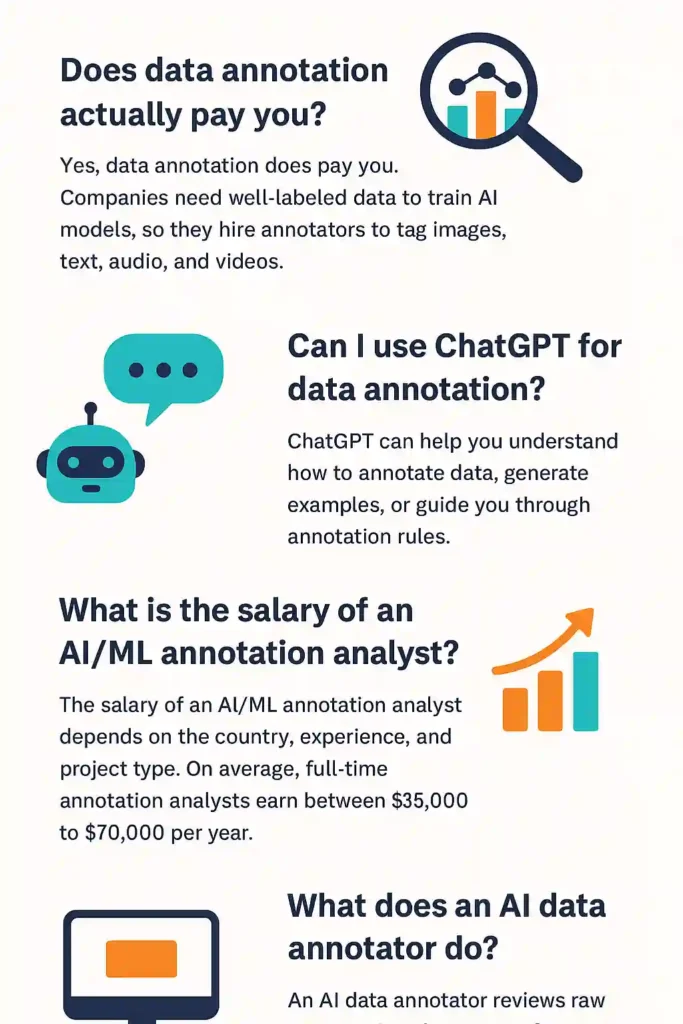
1. Does data annotation actually pay you?
Yes, data annotation does pay you. Companies need well-labeled data to train AI models, so they hire annotators to tag images, text, audio, and videos. The pay varies based on your skill level, the type of annotation, and the company you work for. Beginners may earn a modest amount, while experienced annotators can earn more, especially if they handle complex tasks like medical or technical labeling.
2. Can I use ChatGPT for data annotation?
ChatGPT can help you understand how to annotate data, generate examples, or guide you through annotation rules. However, ChatGPT cannot replace human annotators for tasks that require precision, manual labeling, or platform-based tagging. Many companies still require human review even if AI tools are involved, so ChatGPT is more of a helper than a full annotation engine.
3. What is the salary of an AI/ML annotation analyst?
The salary of an AI/ML annotation analyst depends on the country, experience, and project type. On average, full-time annotation analysts earn between $35,000 to $70,000 per year. In some technical fields—like healthcare, autonomous vehicles, or advanced machine learning—salaries can go higher because the work requires specialized knowledge and accuracy.
4. What does an AI data annotator do?
An AI data annotator reviews raw data (such as images, audio, text, or video) and labels it so the AI system can learn patterns. Their tasks may include tagging people in photos, typing captions, marking objects, labeling customer messages, or cleaning datasets. In simple words, they help “teach” the machine what it is looking at or reading. Without data annotators, AI models cannot learn or improve.