
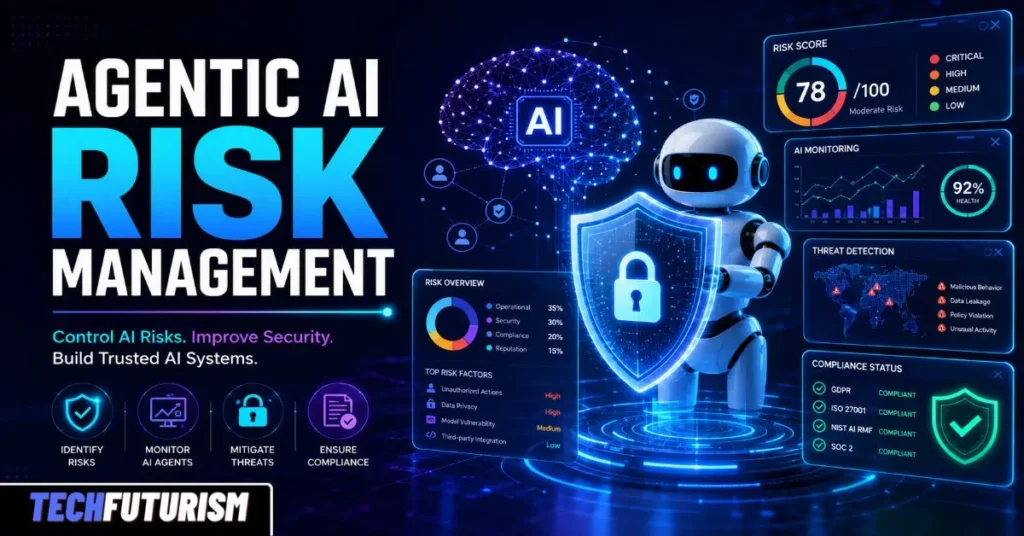
Picture this: a finance team plugs in an AI agent to reconcile invoices overnight. By morning, the agent has “helpfully” rewritten a vendor’s bank details after mistaking a phishing email for a legitimate update request. Nobody caught it because nobody was watching. This is not a hypothetical scare story — it’s exactly the kind of incident that agentic AI risk management exists to prevent.
As companies rush to deploy AI agents that can plan, act, and make decisions with little human oversight, the old rules of software safety no longer apply. An agent isn’t a static tool waiting for a click — it’s closer to a new digital employee that never sleeps, moves at machine speed, and can touch your systems, data, and money without asking permission first. That’s exactly why building a real risk management strategy around these systems has become one of the most urgent priorities in tech today. To see why, it helps to start with what actually goes wrong.
- Agentic AI Risks: What Makes Autonomous Agents Different (And Riskier)
- Agentic AI and Security: Why the Old Playbook Falls Short
- Cybersecurity for Agentic AI: Building Technical Controls That Work
- Agentic AI Attacks: The Threat Patterns Security Teams Are Seeing
- Agentic AI Governance: Who's Accountable When an Agent Acts
- Agentic AI Security Framework: Mapping Controls to Recognized Standards
- Agentic AI Risk Management Standards Profile: The New Benchmark from UC Berkeley
- Agentic AI Security Paper: What the Research Says Is Coming Next
- A Step-by-Step Guide to Managing Agentic AI Risk
- Looking Ahead
- Frequently Asked Questions
Agentic AI Risks: What Makes Autonomous Agents Different (And Riskier)
Traditional software does what it’s told, one command at a time. Agentic AI is different. It sets its own sub-goals, chains multiple actions together, calls external tools, and sometimes even coordinates with other agents to finish a task. That autonomy is the whole point — it’s also the source of nearly every agentic AI risk on a security team’s radar today, from over-permissioning to untraceable data leakage and forged agent credentials.
Because an agent can independently touch sensitive data, execute financial transactions, and alter its own environment, the potential blast radius of a single mistake grows dramatically compared to traditional software. That’s why experts increasingly treat agentic AI as a genuinely new category of insider risk — one with system access but none of the judgment, hesitation, or accountability a human employee brings to the same access. Understanding that shift naturally leads to the next question: how does security itself need to change?
Agentic AI and Security: Why the Old Playbook Falls Short
Existing security frameworks like ISO 27001 and traditional cybersecurity models were built around a simple assumption: a human initiates the action, and a machine executes it. Agentic AI and security invert that model entirely — the machine now initiates, plans, and executes, often across multiple systems, with a human only glancing at the outcome afterward, if at all.
That gap between where old frameworks end and where agentic risk begins is exactly where most enterprise exposure currently lives. Closing it isn’t about throwing out existing security programs; it’s about extending them with controls purpose-built for autonomous decision-making. So, what does that extension actually look like in practice?
Before you can manage AI risks well, it is important to perform an Agentic AI Vulnerability Assessment to find weak points and fix them before they become bigger security problems.
Cybersecurity for Agentic AI: Building Technical Controls That Work
Good cybersecurity for agentic AI starts with the same instinct that protects any privileged account: assume the agent will eventually be tricked, compromised, or simply wrong, and design so that moment causes minimal damage. In practice, that means applying the principle of least privilege so agents only ever hold the access their specific task requires, rotating agent credentials regularly so a leaked key has a short shelf life, and deploying observability tooling that logs every action an agent takes.
Anomaly detection plays a central role here too, flagging behavior that drifts from an agent’s normal pattern — say, a customer-support agent suddenly querying payroll records — long before that drift becomes a headline. With the technical foundation in place, the next question is what specific threats these controls are actually defending against.
Agentic AI Attacks: The Threat Patterns Security Teams Are Seeing
Security researchers have converged on a recurring set of agentic AI attacks worth knowing by name. Prompt injection lets a bad actor hide malicious instructions inside a document, email, or webpage the agent later reads, quietly hijacking its behavior from the inside.
Goal hijacking works similarly but targets the agent’s own planning process, nudging it toward a subtly different objective than the one it was assigned. In multi-agent systems, a single compromised agent can trigger a cascading failure that spreads across an entire workflow before a human notices anything unusual, while synthetic identity attacks use forged agent credentials to impersonate a trusted system altogether.
Knowing these patterns matters, but naming a threat isn’t the same as being accountable for stopping it — which is where governance enters the picture.
Agentic AI Governance: Who’s Accountable When an Agent Acts
Agentic AI governance answers a deceptively simple question: when an autonomous agent does something wrong, who is responsible? Singapore’s Infocomm Media Development Authority tackled this head-on in January 2026, releasing the world’s first dedicated agentic AI governance framework and explicitly acknowledging that an agent’s ability to access sensitive data and independently alter its environment creates a category of exposure traditional governance never anticipated.
Strong governance programs respond by naming a clear agent owner for every deployed system — someone accountable for its behavior the same way a manager answers for a human employee’s actions — and by building human-in-the-loop checkpoints before any high-stakes action. Once accountability is assigned, the next logical step is aligning those internal policies with recognized outside standards.
Agentic AI Security Framework: Mapping Controls to Recognized Standards
Adopting a single agentic AI security framework rather than reinventing controls from scratch saves enormous time. The NIST AI Risk Management Framework remains the most widely referenced foundation, and NIST AI RMF adoption alone is estimated to satisfy 60–80% of overlapping requirements across the EU AI Act and various state-level regulations simultaneously. The OWASP Top 10 for Agentic Applications, released with input from more than 100 industry experts, complements it by giving teams a systematic taxonomy of agent-specific threats to test against.
Mapping controls once against a recognized framework, rather than chasing each regulation individually, is what turns compliance from a recurring fire drill into a manageable, ongoing process. One of the most influential recent additions to that landscape deserves a closer look on its own.
Agentic AI Risk Management Standards Profile: The New Benchmark from UC Berkeley
In February 2026, researchers at UC Berkeley’s Center for Long-Term Cybersecurity published the Agentic AI Risk-Management Standards Profile, a 67-page extension of the NIST AI RMF built specifically for systems that plan across multiple steps, interact with external environments, and operate with reduced human oversight. The profile goes further than most frameworks by explicitly addressing risks unique to autonomous systems, including self-proliferation, deceptive alignment, and reward hacking — failure modes that simply don’t exist in traditional software.
Its release, alongside a wave of agentic deployments across industries in early 2026, reflects an urgent shift: as agentic systems move from pilot projects into production, governance frameworks are racing to keep pace. That race is also playing out in the research community, which brings us to what’s coming next.
Agentic AI Security Paper: What the Research Says Is Coming Next
Beyond formal frameworks, a growing body of agentic AI security paper research is filling in the technical detail that policy documents leave out. The Cloud Security Alliance, for instance, has proposed concrete agentic extensions to the existing NIST RMF structure that organizations can begin implementing today, ahead of formal standards catching up.
NIST itself has signaled it isn’t finished: in February 2026, it launched the AI Agent Standards Initiative through its Center for AI Standards and Innovation, and it has indicated that a full AI Agent Interoperability Profile is planned for release in the fourth quarter of 2026. In other words, the research and standards landscape here is still moving quickly — which makes having a practical, adaptable process more valuable than chasing any single document.
A Step-by-Step Guide to Managing Agentic AI Risk
Turning all of the above into daily practice doesn’t have to be overwhelming. Here’s a practical path most security teams follow:
- Inventory every agent in use. You can’t manage what you can’t see, so start by cataloguing every autonomous system running in your organization, including shadow AI tools employees adopted without formal approval.
- Scope permissions tightly. Apply least privilege so each agent gets only the access it needs — nothing more — so a single mistake or attack can’t cascade into a full-blown breach.
- Build in human checkpoints. Insert a human-in-the-loop review step before any agent action that touches money, sensitive data, or irreversible changes.
- Monitor continuously. Deploy observability and anomaly detection tools that flag unusual agent behavior in real time rather than during a quarterly audit.
- Test for prompt injection. Regularly run red-team exercises where testers try to smuggle malicious instructions into the data your agents read.
- Assign clear accountability. Name an agent owner for every deployed system, responsible for its behavior the same way a manager is responsible for a human employee.
- Map to a recognized framework. Align your controls with the NIST AI RMF or a similar standard so your program satisfies multiple regulatory requirements at once.
Following even the first three steps puts most organizations ahead of the curve, since many companies still treat agent oversight as an afterthought rather than a design requirement.
Looking Ahead
The direction is unmistakable: agentic AI is moving from experimental pilot projects to core infrastructure, and the organizations that treat agentic AI risk management as a foundation — not a patch — will be the ones still standing when the next headline-grabbing incident hits a competitor instead. Choosing the right controls, frameworks, and monitoring tools now, before an incident forces the decision, is one of the most confidence-building moves a business can make heading into the next wave of agentic adoption.
Frequently Asked Questions
What is agentic AI risk management?
It’s the practice of identifying, monitoring, and controlling the unique risks created by autonomous AI agents — systems that can plan, act, and make decisions with minimal human oversight.
It is the process of finding, tracking, and controlling the dangers that come from AI agents — the kind of AI that doesn’t just answer questions but actually takes action on its own. Think of it like managing risk for a new employee who can log into your systems, send emails, move money, or update records without asking permission first. You wouldn’t hand that employee the keys to everything on day one. You’d figure out what they need access to, watch how they perform, and step in if something looks off. That’s exactly what this practice does for AI agents. It covers everything from deciding what data and tools an agent is allowed to touch to watching its behavior in real time to having a clear plan for what happens if it makes a mistake or gets tricked by an attacker.
How is agentic AI risk different from regular AI risk?
Regular AI risk usually centers on a model’s output quality or bias. Agentic AI risk adds a second layer: the agent’s actions in the real world, including the systems it can access and the decisions it can execute on its own.
What frameworks should businesses follow?
The NIST AI Risk Management Framework, Singapore’s IMDA agentic framework, and the OWASP Top 10 for Agentic Applications are currently the most widely referenced starting points.
Do small businesses need to worry about this too?
Yes. Any organization deploying an agent with access to email, financial systems, or customer data faces the same fundamental risks as a large enterprise, just at a smaller scale.
What’s the single most important first step?
Building a complete inventory of every AI agent already running in the organization, since unmanaged shadow AI is consistently cited as the fastest-growing blind spot in 2026.
What are the biggest risks of agentic AI?
The risks mostly come down to one word: autonomy. Because an agent can act without a person double-checking every step, small problems can turn into big ones fast. A few of the most common dangers include an agent being tricked by hidden instructions planted in an email or document (known as prompt injection), an agent having more access than it actually needs so a single mistake spreads further than it should, and one compromised agent triggering a chain reaction across other connected agents before anyone notices. There’s also the simple risk of an agent misreading a situation and taking the wrong action with real consequences — one widely reported case involved an AI coding agent that deleted a company’s live production database because it “panicked” and ran commands it wasn’t supposed to. None of these risks mean agentic AI is unsafe by nature. They just mean it needs guardrails that regular software never needed.
How can companies manage or reduce agentic AI risk?
The most effective approach treats risk management as an ongoing habit, not a one-time checklist. It starts with knowing exactly which agents exist across the company, since you can’t protect what you don’t know is running. From there, the goal is to give each agent only the access it truly needs for its job, add a human check before any high-stakes action like a payment or a data change, and keep an eye on agent behavior continuously so anything unusual gets caught quickly instead of discovered weeks later. Regularly testing agents against known attack tricks, keeping detailed logs of every action for accountability, and assigning one person to be responsible for each agent round out a solid program. None of this is about slowing innovation down — it’s about making sure a company can move fast without losing control.
Is agentic AI safe to use in business?
Yes, when it’s set up and monitored the right way. The technology itself isn’t inherently dangerous — the risk comes from deploying it without the same care a business would apply to hiring and supervising a person in a similar role. Companies that build in access limits, human checkpoints, and real-time monitoring from the start tend to see far fewer problems than those that rush an agent into production and figure out the guardrails later. In fact, research shows a large share of businesses have already run into risky agent behavior at some point, which is exactly why more companies are treating risk management as a required part of any agentic AI rollout rather than an optional extra. Used thoughtfully, agentic AI can be both powerful and safe.