
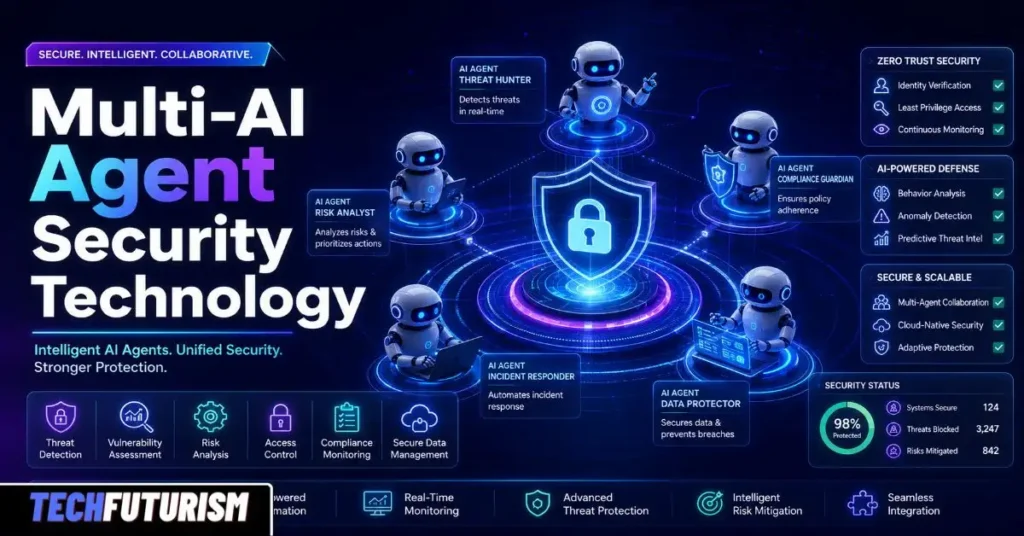
Picture a busy customer support floor, except every “employee” on it is an AI agent. One agent reads incoming tickets, another checks the customer’s account, a third issues refunds, and a fourth updates the CRM. No one sleeps, no one takes lunch, and the whole team moves at machine speed. It sounds like a dream setup — until one of those agents gets tricked into doing something it shouldn’t.
That’s the real story behind multi-AI agent security technology. As companies move from single chatbots to entire teams of cooperating AI agents, the old rules of software security stop being enough. This article walks through what multi-agent security actually means, why it matters right now, and how you can start protecting your own AI systems with confidence.
- Multi-AI Agent Systems Explained: What Makes Them Different
- Single Agent vs Multi-Agent in AI: Why the Difference Changes Your Risk
- Multi-Agent Security Risks and Opportunities You Need to Know
- Multi-Agent Security as Key to AI Safety
- Multi-Agent AI Safety: The Core Building Blocks
- How to Secure a Multi-Agent AI System: A Step-by-Step Guide
- Example of AI in Security: The Calendar Agent That Almost Leaked Everything
- AI Security Companies and AI-Based Cyber Security Companies Leading the Way
- Why Investing in Multi-AI Agent Security Technology Pays Off
- Frequently Asked Questions
Multi-AI Agent Systems Explained: What Makes Them Different
A multi-agent system is simply a group of AI agents working together toward a shared goal, each with its own role, memory, and set of tools. Instead of one giant model trying to do everything, the work gets split up — a bit like a relay race where each runner hands off the baton to the next.
This setup is powerful. It’s also risky because every hand-off is a moment where something can go wrong. If one agent passes along bad or manipulated information, the next agent may act on it without ever knowing it was compromised. That’s the core challenge that AI agent security exists to solve, and it’s why the topic deserves more than a passing mention in your security roadmap.
Single Agent vs Multi-Agent in AI: Why the Difference Changes Your Risk
Before going further, it’s worth pausing on a basic but important distinction: single agent vs multi-agent in AI. A single-agent system is one model handling one conversation or task from start to finish — it takes an input, produces an output, and the interaction ends there. There’s no hand-off, so there’s no one else to fool.
A multi-agent setup is a different animal entirely. Multiple agents plan, delegate, and pass information to one another, often across several steps and tools, before a task is considered done. That extra coordination is exactly where the extra risk lives. A single-agent chatbot that gets a strange input might just give a strange answer. A multi-agent system that gets the same strange input might have that bad information travel through three or four “trusted” hand-offs before anyone — human or machine — notices something is wrong. In short, more agents mean more capability, but also more places for an attacker to aim.
“To understand how businesses can plan and manage AI security risks better, explore the Agentic AI Security Scoping Matrix on the AWS Blog for a clear framework to protect advanced AI systems.”
Multi-Agent Security Risks and Opportunities You Need to Know
Every new technology brings a trade-off, and multi-agent security risks and opportunities sit on opposite sides of the same coin. On the risk side, traditional security tools were built to protect static software: a program takes input, produces output, and stops. Multi-agent systems don’t work that way. They plan, remember, act, and coordinate with other agents and outside tools on their own. This gap is exactly what pushed the OWASP GenAI Security Project to publish a dedicated framework — the OWASP Top 10 for Agentic Applications — separate from its earlier, LLM-focused guidance.
Four characteristics make agentic systems uniquely exposed:
- Autonomous decision-making — an agent can be redirected by a single manipulated instruction, since it decides its own next steps.
- Persistent memory — agents remember things across sessions, and that memory can be quietly poisoned and trusted later.
- Tool and API access — agents don’t just talk, they act, turning a reasoning mistake into a real-world consequence.
- Multi-agent coordination — a compromise in one agent can ripple sideways into every agent that trusts it.
Consider our support-floor example again. If someone slips a hidden instruction into a support ticket — a technique known as prompt injection — the “reader” agent might not just misread it. It could pass that poisoned instruction downstream, and by the time it reaches the “refund” agent, it looks like a normal, trusted request. That’s how one sentence buried in a support ticket can turn into an unauthorized payout.
But the opportunity side is just as real. Organizations that get ahead of these risks unlock automation that a single agent could never handle alone — entire workflows running end-to-end, monitored and self-correcting. The risk isn’t a reason to avoid multi-agent AI; it’s simply the price of admission, and it’s a price you can manage.
Multi-Agent Security as Key to AI Safety
It helps to zoom out for a moment. Multi-agent security as key to AI safety isn’t just a catchy phrase — it reflects how the field actually thinks about the problem. Broader AI safety is concerned with making sure AI systems behave as intended and don’t cause unintended harm. Multi-agent security is the practical, hands-on layer that makes that broader goal achievable, because a system that can be hijacked, poisoned, or misled can never be considered safe, no matter how well-intentioned its design.
Put simply: you can’t claim an AI system is safe if you haven’t secured the channels agents use to talk to each other, the memory they rely on, and the tools they’re allowed to touch. Security and safety aren’t separate conversations here — one is the foundation the other stands on.
Multi-Agent AI Safety: The Core Building Blocks
With that connection in mind, multi-agent AI safety in practice comes down to a handful of proven ideas borrowed from mainstream security and adapted for agents that think and act on their own.
1. Zero Trust Between Agents
Just as a company shouldn’t trust every employee with the master key, agents shouldn’t automatically trust each other. Zero trust means every request between agents gets verified, every time, instead of being waved through simply because it “came from inside the system.”
2. Least-Privilege Tool Access
The principle of least privilege means giving each agent only the tools and data it needs for its specific job, and nothing more. A ticket-reading agent has no business holding the keys to issue refunds. This single habit alone closes off a large share of real-world tool misuse incidents before they ever start.
3. Guardrails and Output Filtering
Guardrails act like a supervisor checking work before it goes out the door. They screen what an agent is about to say or do against a set of safety rules, catching manipulated instructions or unsafe actions before they cause real damage.
4. Memory Integrity Checks
Because agents carry memory across sessions, that memory needs the same protection as a production database — encrypted, access-controlled, and regularly checked for signs of tampering, a risk commonly referred to as memory poisoning.
5. Human-in-the-Loop for High-Stakes Actions
For anything consequential — refunds, account changes, financial transfers — keep a human-in-the-loop checkpoint in place. It’s a small amount of friction that prevents a very large mistake.
Understanding these building blocks is one thing; putting them into practice is another. Here’s a straightforward way to get there.
How to Secure a Multi-Agent AI System: A Step-by-Step Guide
- Map every agent and its permissions. List each agent, the tools it can call, and the data it can see. You can’t protect what you haven’t mapped.
- Apply least privilege everywhere. Strip away any tool access or data visibility that isn’t strictly required for that agent’s job.
- Add verification at every hand-off. Before one agent acts on another agent’s output, route it through a validation or guardrail layer.
- Log every action. Full observability — a complete, timestamped record of who did what, and when — is what lets you spot and trace a problem after the fact.
- Red-team your system. Actively try to break it. Send in fake malicious tickets, poisoned documents, or conflicting instructions, and see how your agents respond. Frameworks like MITRE ATLAS catalog real, documented attack techniques you can test against.
- Set human checkpoints for high-risk actions. Decide in advance which actions always require a person’s sign-off, and enforce it in the workflow itself, not just in policy.
- Review and update regularly. New attack techniques appear constantly, so treat this checklist as an ongoing habit rather than a one-time project.
Follow that checklist, and you turn a fragile chain of trusting agents into a system that questions, verifies, and double-checks itself — the same way a well-run team of humans would.
Example of AI in Security: The Calendar Agent That Almost Leaked Everything
A good example of AI in security doesn’t have to be dramatic to make the point. Consider a scheduling assistant built from three agents: one that reads emails for meeting requests, one that checks calendar availability, and one that sends confirmations. A tester once slipped a hidden line into an email signature that read like an internal system command. The email-reading agent picked it up as an instruction and passed it along. The scheduling agent, trusting its “teammate,” nearly forwarded the entire week’s meeting list — attendee names, topics, and all — to an external address.
Nothing was compromised in the end, because the team had a guardrail layer checking outbound messages for unexpected recipients. But the near-miss made the risk obvious: a security gap in an agent’s chain doesn’t stay contained to that one agent. It’s exactly why organizations are increasingly investing in dedicated agentic AI security platforms rather than trying to bolt protection on after the fact.
AI Security Companies and AI-Based Cyber Security Companies Leading the Way
You don’t have to build every defense from scratch. A growing field of AI security companies and AI-based cyber security companies now sells purpose-built protection for exactly the risks described above. Palo Alto Networks, for example, offers agent-focused monitoring for threats like memory manipulation and prompt injection through its Prisma AIRS platform. Wiz maps AI risk directly to OWASP’s frameworks and correlates it with cloud identity and data exposure. Vendors like Aembit, Astrix Security, and Entro Security have extended their non-human identity expertise specifically to govern AI agents as first-class identities, each with credentials, permissions, and an accountable human owner.
The common thread across this vendor landscape is treating agents the way you’d treat employees: discovered, inventoried, scoped to least privilege, monitored in real time, and logged for audit. Whether you build in-house or buy a platform, that’s the standard worth holding your system to.
Why Investing in Multi-AI Agent Security Technology Pays Off
Multi-agent systems aren’t a passing trend — they’re becoming the standard way businesses automate complex work, from customer service to finance to healthcare operations. Every efficiency gain that comes from agents working together also comes with a matching increase in attack surface. Waiting until something goes wrong is the expensive way to learn this lesson.
The good news is that the tools to get ahead of this problem already exist and continue to mature quickly. Purpose-built multi-agent security platforms now offer permission management, real-time guardrails, memory monitoring, and audit trails right out of the box, so teams don’t have to build all of this from scratch. Choosing a solution mapped to recognized frameworks like the OWASP Agentic Security Initiative and the NIST AI Risk Management Framework gives you a credible, defensible baseline — and a much shorter path to deploying AI agents you can actually trust with real work.
In short: the same autonomy that makes multi-AI agent security technology so useful is what makes it worth protecting properly. Get the fundamentals right — least privilege, verification at every hand-off, guardrails, and human oversight where it counts — and you get to keep the speed and scale of an AI workforce without gambling on its safety.
Frequently Asked Questions
1. What Is AI Agent Security?
AI agent security is the practice of protecting AI systems that can act on their own, not just answer questions. A regular chatbot reads a message and writes a reply. An AI agent goes further: it can look up information, fill out forms, send emails, move money, or change settings in other software, all without a person clicking the button each time.
That extra power is exactly why agent security is its own field now. Once an AI system can take real actions, a mistake or a trick isn’t just a wrong sentence on a screen. It can be a wrong action in the real world, like sending a payment to the wrong account or sharing a file that should have stayed private. Good AI agent security covers a few key areas at once: making sure the agent only has access to the tools and data it actually needs, checking its instructions for hidden or malicious commands before it acts on them, watching what it does in real time, and keeping a human able to step in when something risky is about to happen. Think of it less like locking a single door and more like managing an entire employee’s access badge, task list, and supervisor sign-off, except the “employee” is software that works around the clock.
2. What Are the Security Risks of AI Agents?
The biggest risks come from the same things that make AI agents useful: they act on their own, they remember things, and they can reach outside systems. Here are the risks that come up again and again in real deployments.
Prompt injection is the most talked-about risk. This is when someone hides an instruction inside a piece of text the agent reads, like an email, a document, or a website. The agent can’t always tell the difference between a legitimate task and a sneaky command buried in the content it’s processing, so it may follow the hidden instruction without realizing anything is wrong.
Too much access is another common problem. Many companies give their agents broad permissions so the agent can “just get things done,” which sounds convenient until that same broad access becomes a wide-open door if the agent is ever tricked or compromised.
Memory tampering is a newer risk that’s specific to agents with long-term memory. If bad information gets planted into an agent’s memory, the agent may keep trusting and acting on that bad information in future conversations, long after the original trick took place.
Finally, in systems with more than one agent working together, a compromised or confused agent can pass its bad output to the next agent in line, and that next agent may treat it as trustworthy simply because it came from a “teammate.” This is sometimes called agent-to-agent trust abuse, and it’s one of the main reasons multi-agent systems need their own dedicated security approach rather than reusing old software security rules.
3. How Do You Secure a Multi-Agent AI System?
Securing a multi-agent system comes down to treating every agent the way you’d treat a new employee: give it limited access, check its work, and keep records of what it does. In practice, that breaks down into a few concrete steps.
Start by giving each agent only the tools and data it truly needs for its specific job, a rule often called least privilege. A support agent who reads tickets shouldn’t also be able to approve refunds. Next, add a checking step between agents so that whenever one agent hands off a task or piece of information to another, that hand-off gets verified instead of automatically trusted. This is usually done with a guardrail layer that screens content for suspicious instructions before it’s acted on.
You’ll also want to log everything. A complete, timestamped record of every action every agent takes makes it possible to catch problems early and trace exactly what happened if something does go wrong. On top of that, keep a human in the loop for anything with real consequences, like a payment, an account change, or anything that can’t easily be undone. Routine, low-risk tasks can run fully on their own, but high-stakes ones deserve a person’s sign-off.
Finally, test your defenses on purpose. Send in fake, tricky messages and poisoned documents to see how your agents react, a practice known as red-teaming. Doing this regularly, rather than as a one-time setup step, is what keeps your defenses current as new attack methods appear.
4. What Is the Difference Between Single-Agent and Multi-Agent AI?
A single-agent AI system handles one task from start to finish by itself. You give it an input, it thinks it through, and it gives you an output. There’s no hand-off to anyone or anything else, so there’s no extra opportunity for something to go wrong between steps.
A multi-agent AI system splits a bigger job across several agents that each specialize in a piece of the work, then coordinate to get the whole thing done. One agent might read an email, another might check a database, and a third might send a reply, with each agent passing its results to the next.
The upside is real: multi-agent systems can handle bigger, more complex jobs than a single model could manage alone, and they can often do it faster by working on different pieces at the same time. The downside is that every hand-off between agents is a new point where things can go wrong. A single-agent system that receives a strange or malicious input might just give a strange answer. A multi-agent system that receives the same input might pass that bad information through two, three, or four “trusted” agents before anyone notices, because each agent assumes the one before it did its job correctly. That’s the core reason multi-agent security has become its own specialty: more coordination means more capability, but it also means more places an attacker or a mistake can slip through.