
Picture this: a customer named Sarah calls her internet provider because her Wi-Fi has been down since morning. She’s greeted by a robotic voice that says, “Press 1 for billing, press 2 for technical support, press 3 to speak with an agent.” She presses 2, waits through three more menus, gets disconnected once, and finally reaches someone twenty minutes later. By then, she’s already tweeted her frustration and started looking at competitors.
Now imagine a different version of that same call. Sarah dials in, and a natural-sounding voice says, “Hi Sarah, I see your Wi-Fi has been intermittent since 8 a.m. Let me check your router status right now.” Within seconds, the issue is diagnosed, a fix is applied remotely, and Sarah is back online before she even finishes her coffee. That’s the difference between an old-school IVR (Interactive Voice Response) system and a modern AI phone agent.
Both technologies exist to handle phone calls without tying up an entire human workforce. But the way they do it — and the customer experience they create — couldn’t be more different. In this article, we discuss IVR vs AI Phone Agent Comparison. We’ll break down what each system actually is, compare their features side by side, and help you decide which one fits your business today.
- What Is an IVR System, Exactly?
- Enter the AI Phone Agent
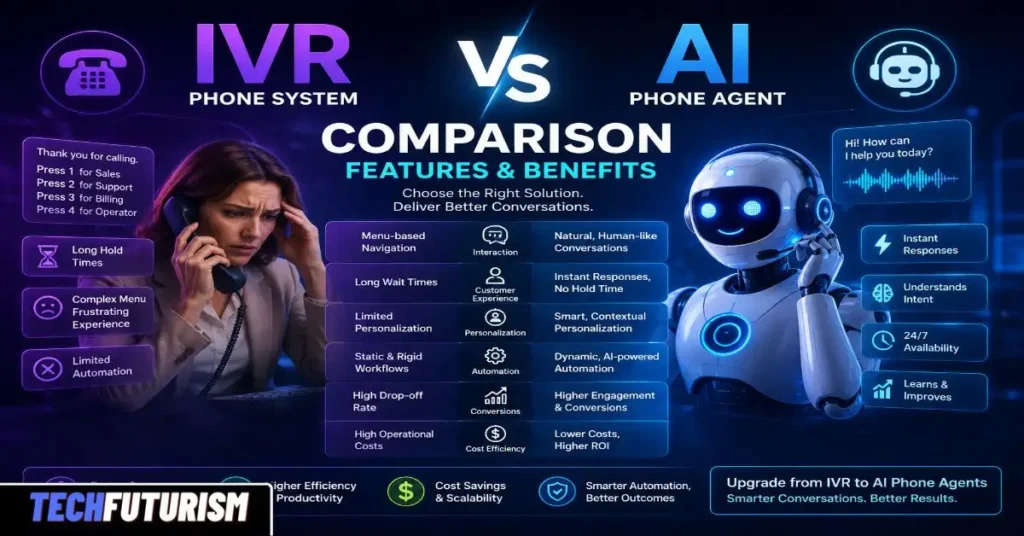
- IVR vs AI Phone Agent Comparison: Feature-by-Feature Comparison
- Key Benefits of Upgrading to an AI Phone Agent
- Step-by-Step Guide: How to Decide Which One Your Business Needs
- Why Businesses Are Making the Switch Now
- IVR vs Virtual Agent: Which One Actually Talks Back?
- IVR vs AI: Two Technologies, Two Different Jobs
- Is IVR Considered AI? Here's the Honest Answer
- IVR vs Conversational AI: Where the Line Really Sits
- Final Thoughts: Making the Right Call
- Frequently Asked Questions
What Is an IVR System, Exactly?
An IVR (Interactive Voice Response) is an automated telephony system that greets callers with a fixed menu of options, usually navigated through touch-tone keypad presses or very simple voice commands like “yes” or “no.” It’s the “press 1 for sales, press 2 for support” voice you’ve heard a thousand times.
IVR has been the backbone of call center technology for decades because it’s cheap, dependable, and easy to set up. It routes calls, plays pre-recorded messages, and collects basic account information before handing a caller off to a human representative. For simple, high-volume, repetitive tasks — like checking an account balance or confirming a package delivery — IVR still gets the job done.
However, IVR has a hard ceiling. It can only understand what it was explicitly programmed to recognize. If a caller says something slightly off-script, the system either loops back to the main menu or transfers the call, often leading to the frustrating “phone tree maze” that so many customers dread. That limitation is exactly where the next generation of phone technology comes in.
“While comparing IVR and AI phone agents, it is also important to understand the rules around AI outbound calls because using AI agents for calls must follow privacy laws and customer consent requirements.”
Enter the AI Phone Agent
An AI phone agent takes a fundamentally different approach. Instead of forcing callers down a rigid path of button presses, it uses natural language processing (NLP) and natural language understanding (NLU) to actually listen, interpret intent, and respond conversationally — much like a trained human representative would.
Under the hood, an AI voice agent combines three core technologies: speech recognition (to convert speech to text), a large language model (to understand context and generate a relevant reply), and text-to-speech synthesis (to respond in a natural-sounding voice). Together, these pieces allow the system to hold a genuine back-and-forth conversation, remember what was said earlier in the call, and take real actions — like booking an appointment, updating a CRM record, or checking order status — without ever needing a human to step in.
So while an IVR asks, “Press 1 for billing,” an AI phone agent simply asks, “How can I help you today?” and lets the caller answer in their own words. From here, it’s worth lining the two systems up side by side to see exactly where they diverge.
IVR vs AI Phone Agent Comparison: Feature-by-Feature Comparison
Let’s connect the dots between these two systems by comparing them across the features that matter most to a growing business.
| Feature | Traditional IVR | AI Phone Agent |
| Call navigation | Fixed menu, keypad or basic voice commands | Open-ended, natural conversation |
| Understanding intent | Limited to pre-programmed keywords | Full NLP-driven intent recognition |
| Personalization | Generic, same script for everyone | Greets callers by name, references history |
| Multi-step requests | Struggles with more than one request per call | Handles multiple intents in a single conversation |
| Scalability | Scales well but experience degrades with complexity | Scales without losing conversational quality |
| CRM and system integration | Limited or requires custom development | Deep, real-time integration with CRM, calendars, and databases |
| Availability | 24/7, but often just routes to voicemail after hours | True 24/7 resolution, not just routing |
| Setup and maintenance cost | Lower upfront cost | Higher initial investment, lower long-term cost per resolved call |
| Customer satisfaction (CSAT) | Often lower due to rigid menus | Generally higher due to human-like interaction |
Naturally, the next question is: which of these advantages actually moves the needle for your business? Let’s dig into the benefits in more detail.
Key Benefits of Upgrading to an AI Phone Agent
1. Fewer Dropped and Frustrated Calls
Since an AI phone agent understands natural speech rather than forcing callers into a menu tree, there’s a dramatically lower chance of someone hanging up out of frustration. This directly protects your brand reputation and reduces the number of calls that spill over into negative reviews or social media complaints.
2. Faster First-Call Resolution
Because the agent can pull data from your CRM, check calendars, and process multiple requests in one conversation, most issues get resolved on the very first call. That means fewer callbacks, fewer transfers, and a much smoother customer experience.
3. True Round-the-Clock Coverage
An AI phone agent doesn’t clock out at 5 p.m. It answers every single call, day or night, weekday or holiday, and handles it with the same quality every time. That’s a meaningful upgrade from an IVR that simply routes after-hours calls to voicemail.
4. Consistent, On-Brand Conversations
Every human agent has a slightly different tone, pace, and phrasing. An AI phone agent, on the other hand, is trained to represent your brand voice consistently on every single call, which builds trust and predictability for your customers.
5. Lower Cost Per Resolved Call Over Time
Yes, deploying an AI phone agent typically costs more upfront than an IVR. But since it resolves issues without escalating nearly as often, businesses typically see a lower cost per resolved call within the first few months of usage, freeing up human agents to focus on complex, high-value conversations.
6. Smarter Escalation to Humans
Modern AI phone agents are built with guardrails. When a conversation goes outside their scope — say, a highly emotional complaint or a legal question — they recognize it and hand the caller off to a human agent along with full context, so nobody has to repeat themselves.
Step-by-Step Guide: How to Decide Which One Your Business Needs
Choosing between IVR and an AI phone agent doesn’t have to be an all-or-nothing decision. Here’s a simple process to help you figure out the right fit.
- Map your most common call types. List out the top five reasons customers call you. If most are extremely simple and repetitive (like “check my balance”), a basic IVR might still suffice.
- Estimate your call volume and complexity. High volume with variable, multi-step requests is where AI phone agents shine brightest.
- Audit your current CSAT and drop-off rates. If customers frequently hang up mid-menu, that’s a strong signal your current IVR is costing you more in lost trust than it saves in cost.
- Calculate your true cost per call. Add up agent wages, average handle time, and missed-call losses. Compare that to the estimated cost of an AI phone agent subscription.
- Pilot the AI phone agent on one call flow. Start with a single use case — like appointment scheduling or order status — before rolling it out company-wide.
- Review call transcripts and CSAT weekly. Use this data to fine-tune the AI phone agent’s responses and expand it to additional call types.
- Keep a human-escalation path visible at all times. Even the best AI phone agent should make it effortless for a caller to reach a person when needed.
Following this roadmap helps you avoid the common mistake of ripping out your entire phone system overnight — instead, you make a confident, data-backed transition.
Why Businesses Are Making the Switch Now
The shift from IVR to AI phone agents isn’t just a passing trend — it’s being driven by real market momentum. The voice and speech recognition market is projected to grow from roughly $14.8 billion in 2024 to more than $61 billion by 2033, a signal that businesses across every industry are betting heavily on conversational AI. Customers, too, have grown less tolerant of rigid phone trees; they expect the same natural, responsive experience from a phone call that they get from a well-designed app or website chat.
For any business that depends on the phone as a core channel — whether that’s healthcare scheduling, real estate inquiries, e-commerce support, or financial services — sticking with legacy IVR alone increasingly means falling behind competitors who’ve already modernized.
IVR vs Virtual Agent: Which One Actually Talks Back?
It’s easy to lump every automated phone system into one bucket, but IVR vs virtual agent is really a comparison between a menu and a conversation partner. A virtual agent is a broader category of AI-driven software that understands free-form speech or text, learns from past interactions, and can complete multi-step tasks like updating an account or processing a refund. Traditional IVR, by contrast, only recognizes a narrow set of pre-programmed inputs — keypad presses or a handful of trigger words.
An AI phone agent is essentially a virtual agent built specifically for the phone channel. So when you’re weighing IVR against a virtual agent, you’re really asking whether you want callers confined to a script, or free to explain their issue in plain language and get it resolved without ever touching a keypad.
IVR vs AI: Two Technologies, Two Different Jobs
Comparing IVR vs AI can feel confusing because IVR is often marketed alongside artificial intelligence terminology. In reality, classic IVR is rule-based automation — it follows a fixed decision tree with no ability to learn or adapt. Artificial intelligence, on the other hand, refers to systems that can interpret unstructured input, recognize patterns, and improve over time using machine learning.
When a phone system uses AI, it can understand synonyms, tone, and context rather than requiring an exact keyword match. That’s why a caller can say “my internet’s been spotty all day” to an AI-powered system and get help immediately, while the same phrase might stump a legacy IVR menu that only recognizes the word “outage.”
Is IVR Considered AI? Here’s the Honest Answer
The short answer to “is IVR considered AI” is: usually, no — at least not in its traditional form. Classic IVR relies on scripted logic and touch-tone or basic keyword matching, not on machine learning or natural language understanding. It doesn’t get smarter with use, and it can’t infer what a caller means if they phrase a request in an unexpected way.
That said, the line has blurred in recent years. Some vendors now sell “AI-enhanced IVR,” which layers basic speech recognition or simple intent detection on top of an otherwise rigid menu system. These hybrids are a step up from pure touch-tone IVR, but they still fall short of a true AI phone agent, which relies on large language models and full conversational understanding rather than a bolted-on recognition layer.
IVR vs Conversational AI: Where the Line Really Sits
At its core, IVR vs conversational AI comes down to flexibility. Conversational AI refers to the broader family of technologies — including AI phone agents, chatbots, and virtual assistants — that can hold genuine, multi-turn dialogue and adapt based on what a person actually says. IVR, even in its more modern speech-enabled forms, is still built around a predetermined menu structure that callers must navigate.
Conversational AI systems maintain context across an entire call, handle several requests within a single conversation, and integrate with backend systems to take real action. IVR simply can’t do this without handing the caller off to a human or another system. If your business is evaluating long-term phone automation, understanding this distinction is essential: conversational AI is where the technology — and customer expectations — are headed.
Final Thoughts: Making the Right Call
There’s no denying that traditional IVR still has a place, especially for very simple, low-stakes interactions and for businesses with tight budgets. But for IVR vs AI Phone Agent Comparison that want to protect their brand reputation, boost customer satisfaction, and resolve issues faster without expanding headcount, an AI phone agent is quickly becoming the smarter long-term investment.
Think back to Sarah and her Wi-Fi outage. The difference between a frustrated customer who churns and a loyal customer who tells their friends about a great support experience often comes down to exactly this kind of technology choice. If your business is still relying solely on old-fashioned phone menus, now is the time to explore how an AI phone agent could transform the way your customers experience your brand — one conversation at a time.
Frequently Asked Questions
What is the main difference between IVR and an AI phone agent?
The biggest difference comes down to how each system listens. An IVR only understands what it’s been explicitly programmed to recognize — a keypad press or a small handful of trigger words like “yes,” “no,” or “billing.” It follows a fixed decision tree, so if a caller says anything outside that script, the system either loops back to the main menu or hands the call off to a person.
An AI phone agent works the opposite way. It uses natural language processing to understand full sentences; however, a caller happens to phrase them. So instead of forcing someone to say the exact word “billing,” it understands “I have a question about my last invoice” just as easily. It also remembers what was said earlier in the same call, so a caller can change their mind mid-sentence or ask a follow-up question without starting the whole menu over. In short: IVR follows a script, while an AI phone agent actually holds a conversation.
Is an AI phone agent more expensive than a traditional IVR system?
The honest answer is: it depends on how you measure “expensive.” A basic IVR system is usually cheaper upfront, often costing anywhere from a modest monthly fee for simple routing up to a larger amount if you need custom menus built. An AI phone agent typically costs more per month at the outset, since it involves more sophisticated technology.
That said, price per month isn’t the whole story. Because an AI phone agent resolves far more issues on its own, without transferring the call or making someone wait for a live representative, most businesses see the true cost per resolved call actually drop over time. Fewer missed calls, fewer repeat calls, and fewer human hours spent on simple, repetitive questions all add up. Many businesses find that the AI phone agent pays for the cost difference within the first few months, especially if their call volume is high or their current IVR is losing customers due to abandoned calls.
Can an AI phone agent completely replace a traditional IVR system?
For many businesses, yes — a modern AI phone agent can handle everything a classic IVR does, and considerably more. It can route calls, collect account information, and play informational messages, just like an IVR. But it can also go further: booking appointments, answering detailed questions, processing simple transactions, and picking up on a caller’s tone or urgency.
That said, a full replacement isn’t the right move for every business. Some companies keep a simple IVR layer at the very front of a call — for instance, letting a caller quickly choose between departments — before handing things over to the more conversational AI phone agent. Others in heavily regulated industries, like certain areas of healthcare or finance, may need to keep a structured, script-based flow for compliance reasons. The good news is you don’t have to choose one system for your entire phone line overnight; many businesses pilot the AI phone agent on one call type first, then expand it once they see the results.
What happens when an AI phone agent can’t handle a caller’s request?
A well-built AI phone agent isn’t designed to handle absolutely everything on its own, and it shouldn’t try to. Instead, it’s built with clear guardrails: a set of topics and situations where it knows to hand the call over to a human being. If a caller asks something outside the agent’s scope, becomes upset, or specifically asks to speak with a person, the AI phone agent recognizes that moment and transfers the call.
The key advantage here is that the handoff comes with full context. Instead of making the caller repeat their name, account details, and problem all over again, the human agent receives a summary of everything that’s already been discussed. This keeps the experience smooth for the caller and saves time for the human representative, which is one of the biggest reasons businesses see higher satisfaction scores after switching.