
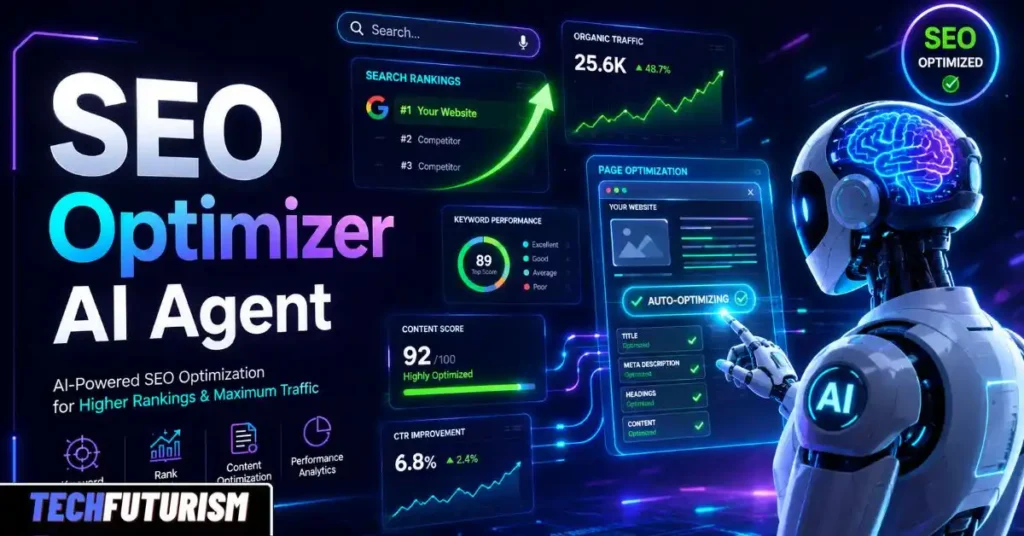
How an AI-powered SEO agent does in minutes what used to take your team days — and why it may be the best investment you make this year.
Imagine you just launched a brand-new website. You spent weeks perfecting the design, polishing the copy, and getting your products ready. Then you hit publish — and nothing happens. No visitors. No clicks. Just silence.
That is the reality for thousands of website owners every single day. Not because their product is bad, but because nobody can find them. In a world where over 5.4 billion people use the internet, standing out in search results has become one of the hardest — and most important — challenges in business.
This is exactly where an SEO optimizer AI agent changes everything.
SEO optimizer AI agent: what it is and why it matters
A SEO optimizer AI agent is a software tool powered by artificial intelligence that automates, analyzes, and improves your website’s visibility on search engines like Google. It is not just a checklist tool that flags missing metatags. It actually thinks — identifying patterns, predicting what search engines want, and delivering actionable recommendations that move the needle.
Think of it as having a seasoned SEO specialist working around the clock — one who never gets tired, never misses a detail, and stays current with every Google algorithm update.
Real story: Marcus, a small business owner selling handmade leather goods, spent two years stuck on page four of Google. He tried freelance consultants, bought courses, and watched countless tutorials. Nothing worked — until he started using an AI-powered SEO agent. Within three months, his product pages climbed to page one for six target keywords. His monthly organic traffic jumped from 400 visitors to over 11,000. “I just wish I had found it sooner,” he said.
SEO optimizer AI agent free options: where to start without spending a penny
One of the most common questions beginners ask is whether a capable SEO optimizer AI agent, free of charge, actually exists. The good news is that several platforms offer genuinely useful free tiers — enough to audit your site, identify quick wins, and build a keyword strategy before committing to a paid plan.
Google Search Console remains the most powerful free tool available. It shows you exactly which queries are driving impressions and clicks, flags crawl errors, and highlights rich result opportunities — all at no cost. Pair it with Google Analytics, and you have a solid performance baseline before investing in AI-powered automation.
Beyond Google’s own tools, platforms like Ahrefs, Webmaster Tools, the free tier of SEMrush, and Moz Free Tools each offer a meaningful window into your site’s backlink profile,on-page health, and keyword rankings without requiring a credit card.
That said, free tiers have limits. As your site grows and competition intensifies, the automation, depth, and speed of a paid AI agent become hard to replicate manually. Think of free tools as a starting point — not a long-term strategy.
An SEO optimizer AI agent works best when it follows a clear SEO AI agent content outline, so every part of the content is well-structured and easy to rank on search engines.
Best SEO optimizer AI agent tools: the top platforms compared
Choosing the best SEO AI agent depends on your goals, budget, and technical comfort level. However, a handful of platforms consistently lead the field — and each takes a meaningfully different approach to AI-powered optimization.
SEMrush — All-in-one: The most comprehensive platform on the market. Its AI features cover keyword research, content gap analysis, competitor tracking, and technical audits under one roof. Ideal for teams that want everything in a single dashboard.
Surfer SEO — Content-first excels at AI-generated content briefs and real-time on-page scoring. Writers and content teams find its editor intuitive and immediately actionable. If your priority is producing well-optimized articles at scale, Surfer is hard to beat.
Ahrefs — Backlink-first: The gold standard for backlink analysis and competitor research. Its keyword explorer and SERP analysis tools are among the deepest available anywhere.
Moz Pro — Beginner-friendly Trusted for its DomainAuthority metric and clean interface. A strong choice for smaller teams new to search engine optimization who want guided, jargon-free recommendations.
Each platform offers a free trial, so testing two or three before committing is always a sensible approach. The best tool is ultimately the one your team will actually use consistently.
SEO AI agent GitHub: open-source tools for developers and technical teams
For developers and technically-minded marketers, the SEO AI agent GitHub ecosystem offers a growing library of open-source projects that you can run, customize, and extend on your own infrastructure.
Open-source SEO agents are particularly valuable for teams that need to process large volumes of pages, integrate with proprietary CMS platforms, or build custom reporting pipelines. Rather than paying per seat for a SaaS tool, you control the entire stack.
Notable open-source projects include SerpApi’s Python client for programmatic SERP data, community-built auditing bots on GitHub, and a growing number of LangChain-based agent frameworks that let developers wire together large language models, search APIs, and custom crawlers into fully automated SEO workflows.
The trade-off, of course, is setup time and ongoing maintenance. Open-source SEO agents reward teams with engineering resources but can frustrate non-technical users. If you have developers on staff and want complete control over your data and logic, GitHub-hosted tools are worth exploring seriously.
SEO AI agent free tier vs. paid: how to decide what you actually need
The question of whether to use a SEO AI agent free offering or invest in a paid plan comes down to one thing: the gap between where your site is now and where you need it to be.
If you run a personal blog, a local business with limited competition, or a brand-new site still finding its footing, free tools are more than sufficient to get started. They will surface your most critical technical issues, show you which keywords you are already ranking for, and help you prioritize your first wave of content improvements.
However, if you are competing in a crowded niche, managing an e-commerce catalogue with hundreds of product pages, or trying to close the gap on established competitors, free tiers quickly hit their ceilings. Crawl limits, delayed data, and the absence of NLP-driven content optimization leave you working with incomplete information at exactly the moment you need it most.
“Free tools show you what is broken. Paid AI agents tell you exactly how to fix it — and then help you fix it automatically.”
A good rule of thumb: start free, measure results for 60 to 90 days, and upgrade when you clearly need more data, more automation, or more speed than your free tools can provide.
Best AI agents for SEO: a framework for evaluating any tool
With so many platforms claiming AI superiority, how do you objectively identify the best AI agents for SEO? A structured evaluation framework cuts through the marketing noise.
Data freshness. Your tool should pull live or near-live data from search engines. Stale keyword rankings and outdated backlink profiles lead to decisions based on a reality that no longer exists.
Automation depth. The best agents do not just surface recommendations — they act on them. Look for tools that can automatically update title tags, generate meta descriptions, propose internal links, and flag crawl errors without requiring manual intervention for every step.
Semantic understanding. A truly intelligent SEO agent understands semantic relationships between topics, not just keyword frequency. It should help you build topic clusters that signal genuine topical authority to Google.
Explainability. You should understand why the agent makes each recommendation. Black-box tools that issue directives without reasoning are harder to trust and harder to learn from over time.
Integrations. The best tools connect natively with Google Search Console, Google Analytics, WordPress, Shopify, and your preferredCMS so your entire workflow stays seamless.
SEO AI agency vs. SEO AI agent: understanding the difference
The terms SEO AI agency and SEO AI agent are often used interchangeably, but they describe meaningfully different things — and understanding the distinction helps you make a smarter investment decision.
An SEO AI agency is a team of human SEO professionals who use AI tools to deliver services to clients. They bring strategic judgment, creative content development,link-building relationships, and bespoke consulting — but at a correspondingly higher price. A typical agency retainer ranges from $1,000 to $10,000 per month, depending on scope and market.
An AI agent, by contrast, is software. It works autonomously, scales instantly, costs a fraction of agency fees, and never goes on holiday. What it lacks is human creativity, relationship-building, and the kind of nuanced strategic judgment that comes from years of hands-on experience.
The smartest approach for most growing businesses is a hybrid: use an AI agent for continuous monitoring, technical fixes, and content optimization — and bring in agency expertise for high-stakes projects like site migrations, penalty recovery, or entering a new market.
Case study: Sarah ran a travel blog stuck at 3,000 monthly visitors for two years despite publishing consistently. After her first week with an SEO AI agent, she discovered that 80% of her posts lacked proper internal linking, nearly all her title tags were too long and poorly optimized, and she had never targeted high-converting long-tail keywords in her niche. Within 90 days, traffic grew to 27,000 monthly visitors — without writing more posts. She simply wrote smarter ones.
WordLift AI SEO agent: turning content into structured knowledge
WordLift AI SEO agent occupies a distinctive position in the market. While most SEO tools focus on keywords and backlinks, WordLift approaches optimization through the lens of knowledge graphs and structured data — the very mechanisms that power Google’s understanding of entities, relationships, and context.
At its core, WordLift uses natural language processing to analyse your content, identify key concepts and entities, and automatically generate Schema.org markup that makes your pages machine-readable. This directly improves your eligibility for featured snippets, local packs, and FAQ rich results — all of which drive significantly higher click-through rates without requiring you to climb to position one.
WordLift is particularly well-suited for publishers, e-commerce sites with large product catalogues, and any organization that produces high volumes of content and wants to build genuine topical authority over time. If your content strategy is built on depth rather than volume, WordLift is worth a close look.
Relevance AI SEO: building autonomous SEO workflows without code
Relevance AI SEO represents the next frontier of agentic SEO. This platform lets you build and deploy autonomous AI agents for marketing and SEO workflows without writing a single line of code.
Rather than using a pre-built tool with fixed features, Relevance AI lets you assemble custom agents from a library of AI capabilities: keyword clustering, content gap analysis, brief generation, meta description writing, and competitor monitoring. You connect these capabilities into multi-step workflows — and then let the agent run them on a schedule, on event triggers, or on demand.
This makes Relevance AI especially powerful for digital marketing teams that want the flexibility of a custom solution without the overhead of building from scratch. It bridges the gap between off-the-shelf SaaS tools and fully custom open-source agent frameworks, making sophisticated SEO automation accessible to teams of any size.
Because agents in Relevance AI can call external APIs, read from databases, and write back to your CMS, it is also one of the most extensible platforms available for teams ready to move beyond standard SEO tooling into genuinely autonomous marketing automation.
How to use an SEO AI agent: a step-by-step guide
Getting started is easier than most people expect. Here is how to go from zero to measurable results in six clear steps.
Step 1: Connect your website to Integrate via an aCMS plugin or by linking Google Search Console and Google Analytics. This gives the agent access to your real organic traffic data, crawl data, and ranking history from day one.
Step 2: Run a full SEO audit. Let the agent scan your entire site for technical health, content quality, backlink profile, and page speed. This typically takes minutes and produces a prioritized issue list ranked by potential impact.
Step 3: Conduct keyword research. Enter your primary topic or product category. The agent generates target keywords — including long-tail variations, question-based queries, and semantic relatives. Export this list as the foundation for your editorial calendar.
Step 4: Optimize existing pages first. Before creating new content, improve what you already have. Updating title tags, sharpening meta descriptions, adding internal links, and fixing technical errors can lift your rankings within weeks — without writing a single new word.
Step 5: Create new content using AI-generated briefs. Use the agent’s content briefs to write new articles, landing pages, or product descriptions. Each brief specifies which keywords to include, optimal word count, questions to answer, and the structure that performs best for your target query.
Step 6: Monitor, iterate, and improve. Review your ranking positions weekly, act on the agent’s ongoing recommendations, and keep refining. Consistent, data-informed effort compounds over time into lasting organic growth that no paid campaign can replicate.
Why traditional SEO methods are no longer enough
Not long ago, search engine optimization was relatively straightforward. You found a keyword, worked it into your content, built a few backlinks, and watched your rankings climb. Today, Google’s algorithm uses over 200 ranking factors, and competition for the top positions is fiercer than ever.
Furthermore, the rise of AI-generated content, voice search, and Google’s ongoing helpful content updates means the rules keep shifting. Manual SEO audits are slow, expensive, and often incomplete. By the time you fix one issue, three more have appeared — which is precisely why AI-driven SEO tools have become essential, not optional.
“SEO is no longer a set-it-and-forget-it game. It is an ongoing, intelligent conversation between your website and search engines — and AI makes that conversation far more effective.”
Is an SEO optimizer AI agent worth the investment?
A good SEO optimizer AI agent is not free. But consider the alternative. A single page-one ranking for a competitive keyword can drive thousands of targeted visitors every month — people who are actively searching for exactly what you sell. The average cost per click in Google Ads for competitive industries ranges from $2 to over $10. If AI-driven SEO earns you 5,000 organic visitors per month that you would otherwise have to pay for in ads, that is $10,000 to $50,000 worth of traffic — every single month, at no incremental cost.
Research consistently shows that the number-one result in Google earns roughly 27–30% of all clicks for a given query. Moving from position seven to position one for a high-volume keyword can mean ten times more traffic. The math is straightforward. The only real question is how soon you want to start seeing those results.
The future of SEO is agentic — and the businesses that adopt these tools early will compound their advantage. Those who wait will find themselves playing catch-up in an increasingly competitive SERP landscape.
Ready to rank higher — starting today?
Stop guessing and start growing. An SEO AI agent gives you the clarity, direction, and automation you need to climb the search rankings — faster than you thought possible. Try SEMrush free →
Frequently asked questions
Q1. What does an SEO AI agent actually do?
An SEO AI agent is essentially a tireless digital assistant that works on your website around the clock. It scans every page of your site, checks how you are performing on Google, finds the keywords people are actually searching for in your niche, and then tells you — step by step — exactly what to fix and what to create next.
Think of it this way. When someone types a search query into Google, the search engine looks at hundreds of signals to decide which websites to show first. Things like how fast your page loads, whether your content genuinely answers the question, how many other reputable websites link to yours, and whether your page is structured in a way Google can easily read and understand. An AI agent monitors all of these signals simultaneously — something no human could realistically do manually across an entire website.
In practical terms, it does several jobs at once. It runs a full technical audit to uncover issues like broken links, slow loading speeds, or missing meta tags that are quietly holding your rankings back. It carries out keyword research to find the exact phrases your target audience types into Google. It analyses your competitors and identifies content gaps — topics they are ranking for that you have not yet covered. And it produces clear, prioritized recommendations so you always know what to work on first for the biggest impact.
Beyond diagnosis, the most advanced agents also take action. They can automatically update your title tags and meta descriptions, suggest internal links between your pages, generate detailed content briefs for new articles, and track your ranking positions daily so you always know whether your efforts are paying off.
The bottom line is this: an AI agent replaces weeks of manual work with minutes of automated analysis — and then guides every decision you make about your website’s growth.
Q2. Is a free SEO AI agent good enough, or do I need to pay for one?
This is one of the most honest questions you can ask before investing time in any tool — and the answer genuinely depends on where your website stands right now.
Free SEO AI tools are absolutely good enough to get started. Google Search Console is free, connects directly to Google’s own data, and shows you which search queries are sending people to your site, which pages are performing, and what technical errors Google has found. Google Analytics tells you how visitors behave once they arrive. Together, these two free tools from Google give you a remarkably clear picture of your site’s health and performance.
On top of that, free tiers from platforms like Ahrefs Webmaster Tools, Moz, and SEMrush let you run basic audits, check your backlinks, and explore keyword opportunities without spending a dollar. For a new website, a local business, or a personal blog, this is more than enough to build solid SEO foundations.
However, free tools have real ceilings. Most cap the number of pages they will crawl, limit how many keywords you can track, and delay data updates by days or even weeks. They also rarely offer the AI-powered features that make a paid agent genuinely transformative — things like NLP-driven content optimization, automated fix suggestions, AI-generated content briefs, and real-time competitor tracking.
If you are running an e-commerce store with hundreds of product pages, competing in a crowded industry, or trying to close the gap on well-established rivals, a paid AI agent will earn back its cost many times over through the traffic and revenue it helps you capture. The smartest approach is to start free, learn the basics, and upgrade once you can clearly see what the limitations of your free tools are costing you.
Q3. How long does it take to see results from an SEO AI agent?
This is probably the question most people want answered before they commit to any SEO tool — and it deserves an honest, realistic answer rather than an overpromise.
The truthful answer is: it depends on your starting point, your competition level, and how consistently you act on the agent’s recommendations. That said, here is a realistic timeline based on what most users experience.
In the first two to four weeks, you will mostly be laying the groundwork. The agent runs its audit, you fix the technical issues it finds — broken links, slow page speeds, missing structured data, duplicate content — and you start optimizing your existing pages. These fixes often do not produce immediate ranking jumps, but they remove the invisible barriers that were holding you back. Think of it as clearing a blocked drain before turning the water on.
By weeks four to eight, you will typically start seeing early signals of progress. Pages that were already ranking on page two or three of Google often move up noticeably once on-page issues are fixed, and content is better aligned with search intent. Your click-through rate may improve as your title tags and meta descriptions get sharper. These are encouraging signs that the work is compounding.
The biggest gains usually appear between months three and six. By this point, new content written using the agent’s AI-generated briefs starts to rank.Topic clusters you have built begin to signal genuine authority to Google. Backlinks you have earned through quality content start to carry weight. This is when organic traffic growth becomes clearly visible and measurable.
One important thing to understand is that SEO, even with AI assistance, is not a paid advertising channel where you flip a switch and see instant results. It is a compounding investment. The effort you put in during month one pays dividends in month six. The work you do in month six pays dividends in month twelve. Businesses that treat their SEO AI agent as a long-term growth engine — rather than a quick fix — are the ones that see the most dramatic, lasting results.
Q4. Can an SEO AI agent replace an SEO agency or an SEO expert?
The short answer is: partly yes, but not entirely — and understanding that distinction could save you a lot of money and frustration.
A SEO AI agent is extraordinarily good at the parts of SEO that involve data, repetition, and speed. It can audit thousands of pages in minutes, track hundreds of keyword rankings simultaneously, spot technical issues the moment they appear, and generate content recommendations based on real-time search data. For all of that analytical, mechanical work, an AI agent does the job better, faster, and cheaper than any human team ever could.
However, there are areas where human expertise still makes a genuine difference. SEO agencies and experienced SEO professionals bring things that software cannot fully replicate — at least not yet. They build real relationships with other website owners and publishers for link-building campaigns. They apply creative judgment to content strategy that goes beyond what keyword data alone suggests. They understand the subtle nuances of brand voice, audience psychology, and market positioning. And they bring experience managing complex, high-stakes situations like Google penalty recovery, major site migrations, or entering an entirely new market.
The most successful businesses today are not choosing between an AI agent and a human expert — they are using both together. The AI agent handles the continuous, data-heavy work: daily monitoring, technical fixes, keyword tracking, content optimization, and competitive analysis. The human expert or agency steps in for strategic decisions, creative work, and relationship-driven tasks where judgment and experience genuinely matter.
If your budget is tight and you are an early-stage website, a good AI agent will take you further for your money than hiring an agency retainer. If you are a growing business with serious SEO goals, the ideal setup is an AI agent doing the heavy lifting every day — supported by a skilled human strategist who makes the big calls. That combination is, without question, the most powerful and cost-effective approach to SEO available today.