
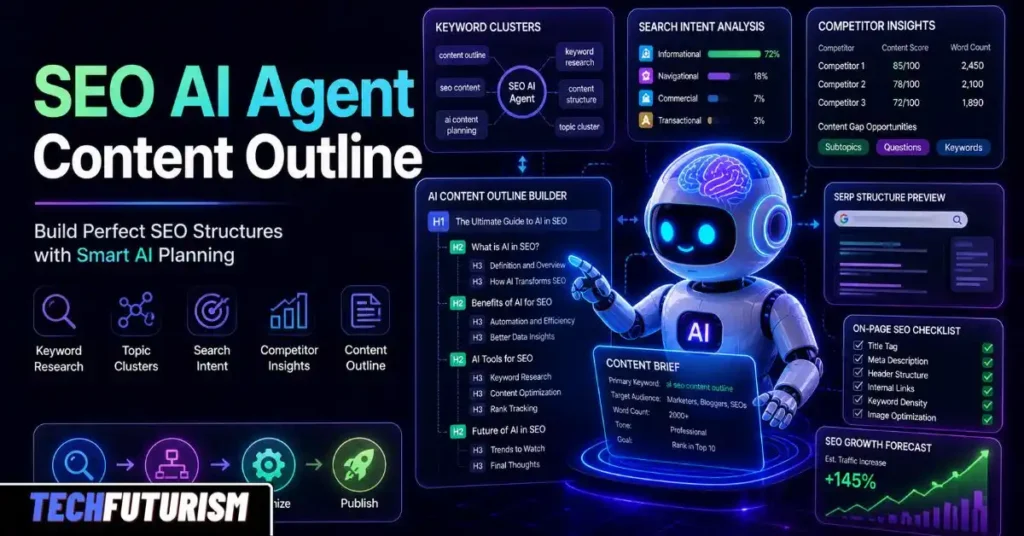
A practical guide for marketers, bloggers, and business owners who want to use AI agents to create content that search engines reward — and that real readers actually enjoy reading.
- What Is an SEO AI Agent Content Outline?
- SEO AI Agent Content Outline Template: Your Ready-to-Use Framework
- What Is an SEO Tool — and Where Do AI Agents Fit In?
- How an AI Content Outline Agent Actually Works
- Best No-Code AI Agent Builder Options for Content Teams
- Agent AI Tool Features to Look For
- Best Platform for Building AI Agents: A Side-by-Side Look
- AI Business Agent Use Cases Beyond Content
- Agentic AI Platforms List: Who Leads the Market
- Best Free AI Agents for SEO Content Outlining
- Step-by-Step: Building Your First AI-Powered Content Outline
- Using Semantic and NLP Keywords the Right Way
- Common Mistakes to Avoid
- Final Verdict:
- FAQ
What Is an SEO AI Agent Content Outline?
Let’s start with the basics. An SEO AI agent content outline is a structured plan for an article or webpage — generated by an AI-powered agent rather than written by hand. The agent analyzes top-ranking content, identifies search intent, and maps out the headings, subheadings, key points, and NLP keywords your article needs to rank competitively.
Think of it as hiring a very fast research assistant who reads every top-10 Google result for your chosen keyword, extracts the patterns, and hands you a detailed blueprint — in minutes, not hours. The result is a stronger starting point than most writers could build manually, and a far more consistent one at scale.
Real story: Sarah, a freelance content strategist in Austin, used to spend three hours building each article outline by hand — opening dozens of browser tabs and typing structures from scratch. After she started using an AI content outline agent, that process dropped to 20 minutes. Her clients noticed quickly: articles she delivered started climbing to page one within weeks of going live.
SEO AI Agent Content Outline Template: Your Ready-to-Use Framework
Before you open any tool, having a proven SEO AI agent outline content template in hand saves you from starting with a blank page every time. The framework below is built on best practices from on-page SEO, semantic SEO, and how AI agents structure high-ranking content. Use it as your default brief every time you start a new piece.
Standard SEO Content Outline Template
| Element | Guideline |
| Title (H1) | Hook → define the problem → state what the article covers. 100–150 words. Primary keyword within the first 100 words. |
| Meta description | 150–160 characters. Include primary keyword + clear benefit. Active voice. |
| Introduction | Comparison/tools list. Secondary keyword frontloaded. |
| Section 1 (H2) | Definition/context section. Secondary keyword frontloaded in heading. |
| Section 2 (H2) | How it works / mechanism. Include NLP entities and related terms. |
| Section 3 (H2) | Step-by-step guide or framework. Use H3 subheadings for each step. |
| Section 4 (H2) | Comparison / tools list. Secondary keyword frontloaded. |
| Section 5 (H2) | FAQ block. Source from People Also Ask. 4–6 questions minimum. |
| Conclusion (H2) | Summary + clear call to action. Restate primary keyword naturally. |
| Internal links | 2–4 links to related content on your site. Flag in outline before writing. |
| Target word count | Match or exceed the average of the top 5 ranking pages for your keyword. |
This template works equally well whether you fill it in yourself or let an AI agent populate the sections automatically. The key discipline is treating the outline as the editorial contract — everything in your article should trace back to a row in this framework. Treat any section you skip as a deliberate decision, not an oversight.
What Is an SEO Tool — and Where Do AI Agents Fit In?
What is an SEO tool, exactly? At its most basic, an SEO tool is software that helps you research, plan, optimize, and measure content for search engines. Traditional SEO tools — like Ahrefs or Semrush — give you data: keyword volumes, backlink profiles, site audits, and competitor rankings. They surface information expertly. You still make all the decisions yourself.
An AI agent goes one decisive step further. Rather than just surfacing data, it acts on it. A well-configured SEO AI agent can autonomously pull SERP data, identify content gaps, build an outline, suggest NLP keywords, and flag internal linking opportunities — all without you issuing a separate command for each task. It’s the difference between a dashboard and a co-pilot.
In short: Traditional SEO tools inform your decisions. AI agents execute steps of your content workflow on your behalf. The most powerful modern setups combine both — using traditional tools for data accuracy and AI agents for speed and structure.
This distinction matters practically. When you run a keyword through Semrush, you get a spreadsheet of data. When you run the same keyword through an AI SEO content agent, you get a ready-to-write blueprint. One requires a strategist to interpret it; the other hands a writer something they can act on immediately.
How an AI Content Outline Agent Actually Works
Under the hood, an AI SEO content outline tool runs through several intelligent steps automatically. First, it submits your target keyword to a search engine and pulls the top-ranking URLs. Then it reads and analyzes those pages — examining headings, word count, related topics, and on-page SEO signals. Next, it identifies NLP-driven entities and semantically related terms your article should cover. Finally, it assembles a logical, reader-friendly outline complete with suggested H2s, H3s, and key talking points for each section.
Modern tools also pull in People Also Ask questions directly from Google — invaluable for covering the subtopics your audience genuinely cares about. Many platforms now integrate with popular writing environments, so you can move from outline to draft in one smooth, uninterrupted workflow without switching between a dozen tabs.
Quick example: Marcus runs a small fitness blog. He typed “best home workouts for beginners” into his AI outline agent. Within 90 seconds, he had a 12-section outline, 22 semantically related keywords — including “bodyweight exercises,” “workout routine,” and “no-equipment training” — and five FAQ questions sourced directly from Google’s People Also Ask box. He turned that outline into a 2,000-word post. It ranked on page one within six weeks.
The speed is not the only advantage. Consistency is equally important. Without an AI agent, the quality of your outline depends entirely on how much time you spent researching that day, how fresh your competitive knowledge is, and whether you remembered to check the PAA box. With an AI agent, every outline starts from the same rigorous baseline — regardless of the day, topic, or writer producing it.
Best No-Code AI Agent Builder Options for Content Teams
You don’t need to be a developer to build and deploy an AI agent for SEO content work. The best no-code AI agent builder platforms give marketers and content teams a visual interface to configure agent workflows — no API calls, no Python scripts, no engineering overhead required.
Zapier Agents connects to over 6,000 apps and lets you build agents that trigger on specific events — such as publishing a brief to Google Docs and auto-generating an outline from it. It’s the most beginner-friendly entry point for non-technical marketing teams and integrates naturally with tools most teams already use.
Make (formerly Integromat) offers a visual workflow builder with deep branching logic. It’s excellent for multi-step content pipelines that combine SEO data pulls with AI writing tasks. If your workflow involves conditional logic — for example, treating a 1,500-word article differently from a 4,000-word pillar page — Make handles that complexity cleanly.
Relevance AI is purpose-built for constructing AI agent workflows without code. It offers pre-built content research and outline templates specifically for marketing teams, and its interface is designed around the concept of agents as reusable tools rather than one-off automations.
n8n is open-source and self-hostable — ideal for teams that want full control over their AI agent pipelines without vendor lock-in or usage-based pricing surprises. It requires slightly more technical comfort than Zapier, but offers far greater flexibility in return.
The best no-code builder for your team depends on your existing tech stack. If you already live in Google Workspace, Zapier Agents integrates most naturally. If you need complex multi-branch logic and custom data transformations, Make or n8n will serve you better at scale.
Agent AI Tool Features to Look For
Not every agent AI tool is built equally. When evaluating any platform for SEO content outlining, prioritize these capabilities above everything else.
Live SERP analysis is non-negotiable. The agent should pull real-time data from current top-ranking pages — not from a cached database that may be months out of date. Stale data produces outdated outlines, and outdated outlines produce articles that rank for yesterday’s search landscape, not today’s.
NLP keyword extraction means looking for tools that identify semantic entities and topically related terms — not just exact-match keywords. This is what drives modern semantic SEO performance and what separates a genuinely comprehensive article from one that merely repeats the target keyword in different sentence structures.
People Also Ask integration surfaces FAQ data directly from Google, telling you exactly what subtopics real users are searching for. Any strong agent tool surfaces this automatically as part of the brief, not as an afterthought.
Content scoring means the tool should evaluate your finished draft against the outline and flag gaps — so you never publish a piece that’s missing key coverage your competitors include. Think of it as a quality gate built directly into the writing workflow.
Workflow integrations ensure the outline lands where your writers actually work. The best agent AI tools connect directly to Google Docs, Notion, WordPress, or your CMS of choice — eliminating the copy-paste step that breaks team momentum.
Multi-agent orchestration is the advanced capability that separates the leading platforms from basic tools. It lets you chain agents — one for research, one for outlining, one for writing — into a seamless end-to-end agent workflow that handles the entire content production process with minimal human intervention.
Best Platform for Building AI Agents: A Side-by-Side Look
Choosing the best platform for building AI agents for SEO content work means balancing power, ease of use, and how well the platform integrates with your existing content stack. Here is how the leading options compare.
Surfer SEO is the most purpose-built option for SEO content outlining. Its real-time SERP analysis, NLP keyword grids, and Content Editor that scores as you write make it the gold standard for editorial teams focused purely on SEO performance. If ranking is the primary goal, Surfer is the benchmark.
Frase combines AI research, outline generation, and AI writing in one platform. It’s particularly strong on competitive briefs and question-based content, making it the best choice for solo creators and small teams who need an all-in-one workflow rather than separate specialized tools.
Clearscope delivers enterprise-grade NLP keyword recommendations with tight Google Docs integration. Larger content operations choose Clearscope precisely because its grading system brings consistency across multiple writers — everyone works from the same standard, regardless of experience level.
MarketMuse is the strongest platform for topical authority planning across an entire content library. If you manage an established site with hundreds of published pages, MarketMuse can identify exactly which topics to cover next to close authority gaps and which existing pages need updating to protect their rankings.
Relevance AI is the right choice for teams that want to build fully custom multi-agent content workflows without writing code. It’s not SEO-specific, but its flexibility makes it powerful for organizations that want to tailor the agent behavior to their exact editorial process rather than fitting their process to someone else’s tool.
AI Business Agent Use Cases Beyond Content
Once your team gets comfortable running an AI business agent for content outlining, it’s worth expanding your thinking. The same agent infrastructure that powers your SEO workflow can drive significant efficiency gains across other core business functions.
Lead scoring and CRM updates are a natural extension. An AI business agent can monitor new leads, score them against your ideal customer profile, and update your CRM automatically — without a human touching a single row of data. This keeps your sales team focused on conversations, not data entry.
Competitive monitoring is another high-value application. Agents can track competitor content, pricing pages, and product updates on a daily basis, then summarize changes and flag what’s strategically relevant to your team each morning. Instead of manually checking five competitor websites every week, the agent does it continuously.
Customer support triage becomes substantially faster when an AI business agent handles first contact — routing incoming support tickets to the right team member, drafting initial responses, and logging resolutions automatically. Response times drop, and support quality becomes more consistent.
Reporting and analytics no longer need to eat up a full Friday afternoon. Pull weekly performance data from Google Analytics, your CRM, and your ad platforms, then compile a unified summary report your team can act on — automatically, every week, without anyone building a spreadsheet.
The productivity gains compound quickly. Teams that deploy AI business agents across even two or three of these functions consistently report reclaiming eight to twelve hours of manual work per person per week — time that goes directly back into higher-value creative and strategic work.
Agentic AI Platforms List: Who Leads the Market
The agentic AI platforms list has grown rapidly since 2024. Below are the platforms currently leading the market, each with a distinct positioning that suits different team sizes and technical comfort levels.
OpenAI GPT-4o with Agents is the most widely used foundation model for building custom agent workflows. Accessible via API and through dozens of third-party builders, it powers more deployed AI agents today than any other model — and its tool-use capabilities make it highly adaptable for content research and outlining tasks.
Anthropic Claude offers strong long-context reasoning capabilities that make it particularly suited oífor complex, multi-step content and research agents. Its ability to hold and process large volumes of source material without losing coherence gives it a practical advantage in content-heavy workflows.
Relevance AI leads the no-code agent builder category specifically for marketing and content teams. Its growing library of pre-built agent templates means most teams can go from sign-up to first running agent in under an hour.
LangChain is the dominant open-source framework for developers building custom agentic applications. It’s highly flexible and supports virtually any underlying model, but it requires engineering resources to implement. For teams with a developer available, it offers unmatched customization.
CrewAI is an open-source multi-agent orchestration framework that lets you define specialist agents — researcher, writer, editor — that collaborate on a single task. For content production workflows specifically, the multi-agent structure maps naturally onto how editorial teams already work.
Zapier Agents is the most consumer-friendly entry point on the entire agentic AI platforms list. Its broad app integrations and approachable interface mean non-technical marketing teams can build and deploy working agents without any developer involvement.
Microsoft Copilot Studio is the enterprise-grade agent builder tightly integrated with Microsoft 365. For large organizations already operating in the Microsoft ecosystem, it offers the smoothest path to deploying AI agents at scale with enterprise-level security and compliance controls.
Best Free AI Agents for SEO Content Outlining
Budget shouldn’t be a barrier to getting started. The best free AI agents for SEO content work offer genuine capability at no cost — enough to run a full outlining workflow for most individual creators and small teams.
Frase’s free plan generates one full content brief per day. That’s enough to test the workflow thoroughly and compare AI-generated outlines against what you’d build manually — before committing to a paid subscription.
ChatGPT (free) can produce a solid SEO content outline with a well-crafted prompt. Pair it with manual SERP research — scanning the top five results yourself for heading structure and subtopics — and the combination produces a surprisingly competitive outline at zero cost.
Claude (free) is particularly strong for long-form outline generation and semantic keyword mapping. Its reasoning capabilities make it especially good for nuanced, research-heavy topics where the outline needs to go several levels deep without losing coherence or logical flow.
NeuronWriter’s free plan offers limited but functional NLP-based outline generation. It’s a good starting point for understanding how AI-driven content scoring works before committing to a more capable paid tool.
The honest trade-off with free agents: they require more manual input and don’t automatically pull live SERP data the way paid tools do. However, combining a free AI agent with manual research from Google Search and AnswerThePublic produces a surprisingly competitive outline at zero cost — and builds the research instincts that make you a better editor of AI-generated outlines over time.
Step-by-Step: Building Your First AI-Powered Content Outline
Ready to put this into practice? Follow these six steps to create your first SEO content outline with AI — from keyword selection all the way to hitting publish.
Step 1: Choose your target keyword
Pick one primary long-tail keyword with clear search intent. Use Ahrefs or Semrush to confirm real traffic volume and manageable competition before committing. A keyword with 500 monthly searches and low difficulty will outperform a keyword with 50,000 searches and impossibly stiff competition for a new or mid-sized site.
Step 2: Run it through an AI outline agent
Paste your keyword into Surfer SEO, Frase, Clearscope, or MarketMuse. The agent analyzes your top competitors and generates a full content brief within minutes — complete with recommended headings, NLP keywords, target word count, and questions to answer.
Step 3: Review and customize the outline
The AI output is your starting point — not your final answer. Add sections specific to your audience, remove anything irrelevant to their needs, and inject your own expertise and original examples. This is where your E-E-A-T (Experience, Expertise, Authoritativeness, Trustworthiness) shines through and separates your content from the generic AI-generated pages that Google is increasingly able to identify and deprioritize.
Step 4: Map in your NLP and semantic keywords
Place semantically related keywords naturally throughout your outline notes as writing cues — not as mandatory insertions. You’re ensuring topical depth that modern search engines actively reward, not practicing the keyword stuffing that got sites penalized a decade ago.
Step 5: Write or generate the draft
Write the article yourself — or use an AI writing assistant to produce a first draft and then edit it heavily for accuracy, voice, and originality. The editing step is not optional. Never publish an unedited AI draft. Beyond quality concerns, unedited AI content is increasingly detectable and increasingly discounted by both readers and search algorithms.
Step 6: Optimize and publish
Run your finished draft back through your SEO tool for a final on-page optimization check. Confirm your title tag, meta description, internal links, and image alt text are all in place before hitting publish. These are the details that separate a well-ranking page from one that was written well but never fully optimized.
Using Semantic and NLP Keywords the Right Way
This is where many writers go wrong. They hear “NLP keywords” and start cramming extra phrases into every sentence. Instead, think about topical authority — covering a subject so thoroughly that Google recognizes you as the most reliable source on that topic, not just a page that mentions the right words.
For an article targeting AI agent SEO content outlines, semantically relevant terms include: content brief, search intent, topic clusters, SERP analysis, featured snippets, heading structure, entity SEO, content strategy, and natural language processing. These don’t need to appear as exact phrases — they should flow naturally wherever they genuinely fit what you’re explaining.
Furthermore,topic clusters are a smart way to build semantic depth across your whole website — not just within one article. When your AI outline agent highlights related subtopics, consider whether some of those deserve their own dedicated articles linking back to your main pillar content. This signals topical depth to Google at the site level, not just the page level — and it’s one of the most durable ways to build ranking authority that compounds over time.
Common Mistakes to Avoid
Even with a great AI content outline tool, certain habits consistently undermine SEO results. Here are the most important ones to sidestep from the start.
Accepting the AI outline blindly is the most common mistake. The agent is trained on existing top content. It can miss fresh angles, original data, and your unique perspective — all the things that make a piece genuinely useful rather than just algorithmically complete. Always add your own insight before writing a word.
Ignoring search intent means an outline can have excellent headings and still miss the mark entirely if it doesn’t match what the searcher actually wants. Understand the four types of search intent — informational, navigational, commercial, and transactional — before you start. An article written for informational intent when the keyword has transactional intent will rarely rank, no matter how well it’s written.
Over-optimizing with keywords remains a genuine penalty risk. Keyword stuffing — forcing a phrase into sentences where it doesn’t belong naturally — reads badly to humans and is actively penalized by Google. Natural language and genuine helpfulness always outperform mechanical repetition.
Skipping human editing is a shortcut that consistently backfires. AI drafts need a human voice, accurate facts, and original examples to feel credible. The AI is your first draft partner — never your final author, and never a substitute for editorial judgment.
Not building internal links leaves ranking power on the table. Your outline should flag opportunities to link to related content on your site before you start writing. A strong internal linking strategy helps Google understand your site architecture and distributes authority from strong pages to newer ones that need a boost.
Final Verdict:
Yes — decisively, if you treat it as a tool rather than a crutch. An SEO AI Agent content outline agent doesn’t replace good writing, original research, or genuine expertise. What it does is dramatically reduce the time spent on competitive analysis and structural planning — giving you a stronger foundation and a real, measurable shot at ranking on page one.
Before AI outlines, most writers were essentially guessing at what a well-ranking article should cover. Now you can know — based on live SERP data — which headings to use, which questions to answer, and which NLP signals to hit. That’s not cutting corners. That’s working smarter with the best information available to you.
Parting thought: One editor at a mid-sized B2B company described switching to AI-powered outlines as “turning on the lights in a dark room.” Her team had been publishing consistently — but wasn’t sure they were covering the right angles. With AI outlines, they finally had a clear map. Their organic traffic grew 40% in three months — not because they wrote more, but because they wrote more strategically.
The bottom line: AI agent content outlining for SEO is one of the highest-leverage additions you can make to your content workflow right now. It’s fast, data-driven, and — when paired with human creativity and editorial judgment — extraordinarily effective. Start with one article, track the results carefully, and let the rankings speak for themselves.
FAQ
Q1: What exactly is an SEO AI Agent, and what does it do with content outlines?
An SEO AI Agent is basically a smart assistant that handles your search engine optimization work for you — automatically, and without you having to do everything by hand. Think of it like having a very tireless team member who never sleeps.
When it comes to content outlines specifically, an AI SEO agent can automate most of the ideation and development process for a piece of content — from identifying relevant keywords to drafting an SEO-optimized outline. That means instead of spending hours doing keyword research, figuring out what headings to use, and deciding what questions to answer in your article, the agent does all of that for you in minutes. Surfer
It pulls “People Also Ask” queries from Google search results to help structure your article and guide your topic coverage to match what users are actually searching for. In short, it builds the skeleton of your content based on real data — so you start writing with a clear, proven roadmap rather than a blank page. Nightwatch
Q2: How is an SEO AI Agent different from just using ChatGPT to write content?
This is one of the most common points of confusion, and it’s a great question. The short answer is: they’re very different tools.
AI chatbots like ChatGPT are conversational interfaces that can answer questions and generate content. But while they excel in natural language interaction, AI SEO agents combine that conversational ability with deep integration of SEO data, automation, and real-time monitoring. Nightwatch
In other words, ChatGPT works from its training data — it doesn’t know how your website is actually performing right now, what your competitors are ranking for, or what Google’s search results look like today. A standard ChatGPT prompt gives you a response based on training data, with no connection to your site’s actual performance data, your CMS, or live SERP information. An SEO AI agent, on the other hand, is persistently configured with detailed instructions, has ongoing access to live data sources, and can take multi-step actions. ALM Corp
A good way to think about it: ChatGPT is like asking a smart friend a question. An SEO AI Agent is like hiring a specialist who has access to all your business data and can actually get things done on your behalf.
Q3: Can an SEO AI Agent really create a good content outline on its own, or do I still need to be involved?
Yes, it can create a very solid outline — but the best results still come when a human stays in the loop, at least for review. Here’s why.
AI agents are great at structure and coverage. They’re not great at “experience” unless you provide it. What that means is the agent will nail the technical side — the right headings, the right keywords, the right questions to answer, the right word count. But the personal stories, unique opinions, and real-world examples that make content feel genuinely helpful? Those need to come from you. Seobotai
A content team producing 4 articles per month spends roughly 40–56 hours on a manual workflow (about 10–14 hours per article). An AI agent can compress that dramatically. Publishing a lot of pages isn’t the issue — publishing a lot of unoriginal, low-value pages is. So the smart approach is to let the agent do the heavy lifting on research and structure, then add your own voice and expertise on top. That combination is what actually ranks well and keeps readers coming back. FraseSeobotai
Q4: Will content outlines created by an SEO AI Agent help me rank on Google, including in AI-generated answers?
Yes — if done right. And in 2026, “ranking” means two things: showing up in Google’s regular search results and getting cited in AI-generated answers like Google’s AI Overviews or ChatGPT responses.
You’re no longer optimizing only for blue links. You’re optimizing for search features, rich results, and AI-generated answers that may summarize your content before a visitor ever reaches your page. Sight AI
A well-built SEO AI Agent helps with both. Simply asking an AI for a generic blog post won’t rank. Using AI strategically to produce expert-level content based on your unique knowledge will. The agent helps you identify the right topics, cover them thoroughly, and structure the information in a way that search engines — and AI systems — can easily understand and trust. Chrisraulf
People ask search engines questions all day, and they increasingly ask AI systems the same things in more conversational language. If your content is clear, structured, and useful, you have a chance to show up in both places. If it isn’t, you can publish a lot and still stay invisible. Sight AI
The bottom line: an SEO AI Agent content outline gives your content the best possible starting point to be found — whether someone is clicking Google links the old-fashioned way or getting answers from an AI chatbot.