
In today’s digital age, big data and banking industry innovation have become a cornerstone of strategic transformation for financial institutions worldwide. From processing large volumes of transaction data to analyzing spending patterns and customer interactions, banks now rely on data science and analytics tools to make informed decisions that impact everything from risk management to customer experience. According to recent industry analyses, nearly 90% of financial institutions use AI-powered big data solutions for fraud detection and financial crime prevention, and approaches like predictive analytics improve risk forecasting accuracy by 30–35%.
However, this power comes with responsibility: balancing innovation with regulatory requirements, data privacy, fairness, and transparency remains a critical challenge. This article provides a comprehensive and balanced view of big data analytics in banking, offering practical insights, expert perspectives, real case examples, and thoughtful discussion of risks and solutions — all grounded in evidence and best practices.
- Big Data and Banking Companies: Practical Uses Across the Banking Sector
- Why Analytics Matters: Evidence-Based Benefits
- Big Data Analytics in Banking Research Paper: Truth Behind Adoption
- Banking Data Analysis Project: How It Works in Practice
- Real Case Examples: How Banks Use Big Data Today
- Future of Big Data in Banking: Balanced Opportunities and Risks
- Big Data and Banking Industry Examples: Practical Illustrations
- Comparison Table: Big Data Use Cases in Banking
- Conclusion: Smart, Ethical Adoption for Long-Term Value
- Frequently Asked Questions (FAQ)
Big Data and Banking Companies: Practical Uses Across the Banking Sector
Today’s big data and banking companies combine advanced analytics with traditional banking processes to extract meaningful insights from data that was previously underutilized or siloed. Banks analyze vast data sets to identify patterns in customer behavior, segment customers for personalized services, and assess risk more accurately. This isn’t theoretical — it’s happening in real time across global financial institutions.
For instance, by analyzing transaction data across channels, banks can detect unusual patterns that signal fraud, enabling them to act immediately instead of reactively. Analytics also allows banks to understand customer segmentation, grouping customers by behaviors and preferences — such as preferred credit card usage — and tailoring product recommendations accordingly. This drives customer engagement while improving cross-selling opportunities and long-term loyalty.
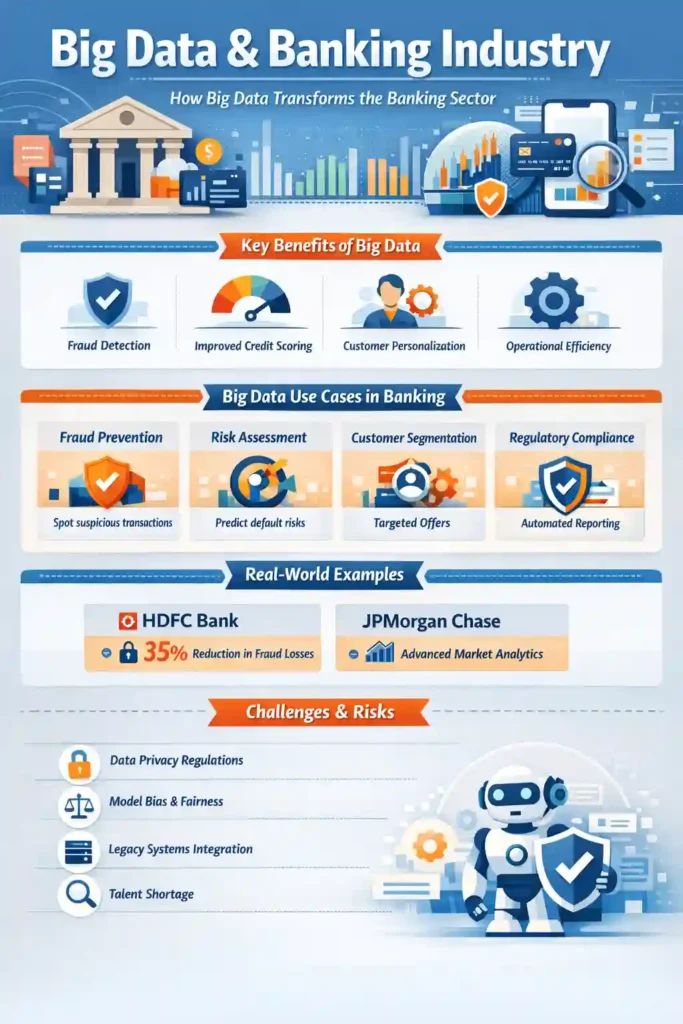
The following infographic:
Expert Insight
“Banks that master data analytics can anticipate customer needs and market risks — but to do so responsibly requires strong governance, ethical oversight, and a commitment to transparency.”
— Senior Analytics Executive, Global Financial Institution
Why Analytics Matters: Evidence-Based Benefits
1. Enhanced Fraud Detection & Prevention
Analytics scans thousands of transactions per second to detect anomalies, reducing false positives and potential losses. According to recent data, AI-powered analytics has reduced false fraud alerts by up to 80% and reduced cybersecurity breaches by 37% in large banks.
2. Stronger Risk Assessment & Predictive Modeling
By integrating historical and real-time indicators, predictive models improve credit scoring and the accuracy of default risk forecasts, helping banks lend more responsibly.
3. Personalized Customer Experiences
Banks use big data to tailor products like loans, credit cards, and savings plans based on individuals’ spending patterns. This creates more relevant offerings and improves understanding of customer needs.
4. Improved Operational Efficiency
Real-time analytics automates routine tasks, streamlines workflows, and reduces errors — helping banks lower operational costs and redeploy human resources to higher-value activities.
5. Better Data-Driven Decisions
Institutions that effectively use analytics are significantly more agile and responsive to market conditions, enabling smarter decisions around pricing, product development, and risk mitigation.
Big Data Analytics in Banking Research Paper: Truth Behind Adoption
Academic studies on big data analytics in banking reveal both potential and caution points for financial institutions. Research shows that combining alternative data sources — like mobile phone usage and social network connections — with traditional financial records can improve credit scoring performance. This kind of analysis has shown statistically significant enhancements in predictive accuracy over conventional models that rely solely on traditional credit bureau data.
However, other research warns that fine-grained data, if not handled carefully, may inadvertently incorporate proxies for sensitive or protected attributes, raising fairness concerns — especially in open banking and risk models. These vulnerabilities highlight the importance of ethical safeguards and explainable AI approaches when deploying machine learning models.
Banking Data Analysis Project: How It Works in Practice
A banking data analysis project usually follows a practical, multi-step process designed to ensure quality insights while managing risks:
- Data Collection & Governance – Centralizing data sets from multiple sources while ensuring compliance and privacy.
- Integration & Cleansing – Harmonizing structured and unstructured data for quality analytics.
- Exploratory Analysis – Using customer segmentation and consumer behavior clustering to identify patterns.
- Predictive Modeling – Applying statistical models and machine learning for risk assessment and forecasting.
- Deployment & Monitoring – Implementing insights via dashboards, alerts, and real-time systems while continuously evaluating model performance.
💡 Tip: Regularly retrain models and evaluate for fairness and accuracy — analytics isn’t “set and forget.” Keeping humans in the loop ensures that systems remain valid and ethical.
Real Case Examples: How Banks Use Big Data Today
HDFC Bank: Fraud Detection Innovation
A leading Indian bank introduced machine learning systems that continuously monitor transactions to flag potential risks instantly. As a result, the bank reduced fraud losses by 35% and improved detection accuracy dramatically.
State Bank of India: Smarter Credit Decisions
Another example saw improvements in loan risk assessment by integrating multiple data science signals — including historic transaction patterns and digital footprints. This led to a 30% improvement in loan approval accuracy and faster processing times.
These examples demonstrate how strategic analytics not only reduces risk but also enhances customer access and operational agility.
Future of Big Data in Banking: Balanced Opportunities and Risks
The future of big data in banking points toward deeper integration with AI, real-time analytics, and ecosystem collaboration. As institutions invest in robust data platforms, they can better personalize services, improve market trends forecasting, and respond to emerging risks.
However, this shift also presents risks: reliance on external tech providers for AI infrastructure might create vendor dependencies and systemic vulnerabilities if not managed appropriately. European executives have publicly warned about these concerns, emphasizing the need for careful risk governance alongside innovation.
Regulatory & Privacy Risks
Banks must comply with data protection standards such as GDPR and CCPA, and ethical usage of AI models is essential to avoid discriminatory outcomes. Transparent data policies and regular audits are critical to maintaining trust.
Big Data and Banking Industry Examples: Practical Illustrations
Here are concrete examples of how analytics transforms banking:
- Data consolidation projects like that of NatWest, which aims to unify millions of customer records to speed fraud detection and personalize digital services.
- Leadership moves such as JPMorgan’s appointment of a dedicated COO for data and AI strategies reflect how critical data leadership has become for managing technology at scale.
- Industry prioritization of analytics capabilities that drive cross-functional decisions across risk, customer growth, and operational resilience.
Comparison Table: Big Data Use Cases in Banking
| Use Case | Benefits | Risks / Considerations |
| Fraud Detection & Prevention | Reduces fraud losses and false positives; improves trust. | May disrupt legitimate transactions if calibration is poor. |
| Credit Scoring & Risk Assessment | Improves accuracy and expands lending inclusivity. | Requires careful validation to avoid biased outcomes. |
| Customer Segmentation & Personalization | Increases cross-selling and engagement. | Over-segmentation may exclude or overserve specific groups. |
| Regulatory Compliance | Automates AML and KYC; improves reporting. | Complex legal regimes demand thorough oversight. |
| Operational Efficiency | Streamlines processes and reduces costs. | Legacy systems and talent gaps can hinder adoption. |
Conclusion: Smart, Ethical Adoption for Long-Term Value
The role of big data and banking industry analytics has evolved from a competitive advantage to a strategic necessity for modern financial services. When applied responsibly — with attention to privacy, fairness, explainability, and governance — analytics drives smarter decisions, stronger risk management, and more relevant customer experiences. However, banks must balance innovation with ethical responsibility, human oversight, and thoughtful risk mitigation to ensure sustainable success.
Just like predictive maintenance, big data helps companies fix machines before they break, big data and banking industry solutions help banks spot risks early, prevent fraud, and make smarter decisions before problems happen.
Frequently Asked Questions (FAQ)
1. What is big data in the banking industry?
Big data in the banking industry refers to extremely large and complex collections of information that banks gather and analyze to improve decision-making. Unlike traditional data (like a few records in a spreadsheet), big data includes millions or even billions of entries from many sources — such as transaction histories, online interactions, customer feedback, and external market information — that can’t be processed with standard tools alone. By using advanced analytics tools, banks uncover patterns and insights that help them detect fraud earlier, improve risk modeling, tailor customer services, and even forecast market trends.
2. What data is used in the banking industry?
In the banking industry, data comes from many different sources and is used for different purposes. Common types include:
Transaction data: Records of deposits, withdrawals, transfers, and payments.
Credit and loan records: Information about repayment history, credit limits, and delinquency.
Customer interactions: Data from mobile banking apps, online platforms, call center logs, and customer feedback.
Market and economic indicators: External information like interest rates, stock prices, and inflation data.
Alternative data: Non-traditional signals like social patterns, mobile behavior, or spending trends that help improve decision models.
Banks use these diverse data types to make smarter decisions around lending, fraud detection, customer service, and regulatory reporting.
3. How does JPMorgan use big data?
JPMorgan Chase, one of the world’s largest banks, uses big data in many practical ways to improve operations and serve customers better:
Fraud Detection: The bank applies analytics to spot unusual transaction behaviors so it can intervene before losses occur — similar to systems used for security monitoring.
Risk Management: It analyzes structured and unstructured data to assess creditworthiness and other risks, helping to make more accurate lending decisions.
Market Insights: JPMorgan uses data tools to identify market trends and provide clients with real-time forecasts and insights.
Enterprise Data Platforms: The bank has built systems like a data mesh architecture so information is shared securely across teams, improving accuracy and visibility for decision-makers.
These applications help JPMorgan increase efficiency, reduce risk, and offer services that are more responsive to customer needs.
4. Who are the Big Four in banking?
The term “Big 4 in banking” can vary depending on context and geography, but in the United States, it commonly refers to the four largest retail banks that hold a significant share of deposits and assets:
JPMorgan Chase
Bank of America
Citigroup
Wells Fargo
Together, these banks control a large portion of the U.S. banking market and serve millions of customers across retail and commercial segments.
In other countries, the phrase “big four banks” can refer to the largest institutions in that market (for example, the biggest banks in Australia or the UK).