
In today’s data-driven world, businesses generate massive amounts of information from customer interactions, digital transactions, and connected systems. Yet, raw information alone is useless unless we can turn it into valuable insight. This is where big data analytics and business analytics come in — allowing organizations to extract meaningful patterns, understand customer behavior, and make smart data driven decisions that improve performance, reduce risk, and deliver competitive advantage.
This comprehensive guide will explain what these fields are, how careers like data analysts and data scientists fit into the ecosystem, what courses, degrees, and certifications can launch your journey, and why mastering techniques like data visualization and predictive modeling matters in real business environments.
- What Is Big Data Analytics and Business Analytics?
- Big Data Analytics, Business Analytics Salary — What You Can Expect
- Business Analytics Big Data Analytics Jobs — Career Paths & Roles
- Big Data Analytics Business Analytics Courses — Skills That Matter
- Big Data Analytics or Business Analytics Programs — Degrees to Advance Your Career
- Big Data Analytics Business Analytics Certification — Boost Your Credibility
- Big Data Analytics or Business Analytics Degree — Long-Term Career Value
- Big Data Analytics Examples — How Analytics Creates Value
- Core Analytics Concepts to Know
- Tips for Success in Analytics Careers
- Final Thoughts — Why Analytics Is Worth It
- FAQ —
What Is Big Data Analytics and Business Analytics?
Big data analytics refers to the process of analyzing extremely large, complex, and diverse datasets — often measured in terabytes or more — to uncover hidden patterns, trends, and relationships that traditional tools cannot easily handle. It’s about making sense of data at scale, often involving automated systems and open source frameworks like Apache Hadoop and Spark.
In contrast, business analytics focuses on using data to inform strategic and operational decisions in a business context — helping leaders make informed decisions based on evidence rather than intuition. It covers approaches from descriptive analytics (what happened?) to predictive modeling (what is likely to happen?) and prescriptive analytics (what should we do next?).
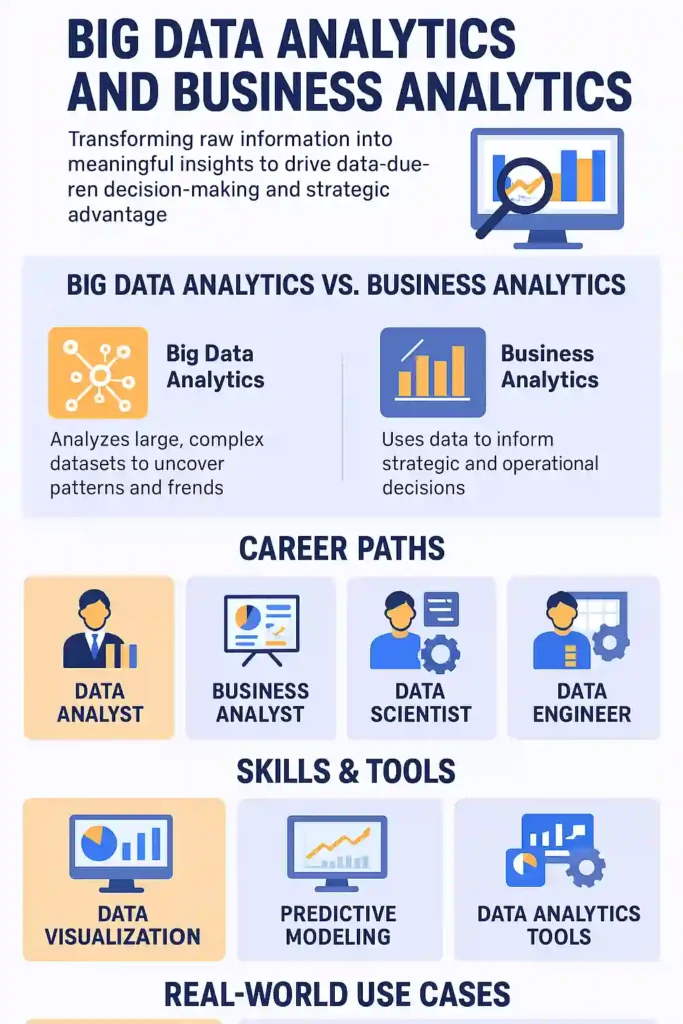
Together, big data analytics provides the technical muscle to handle large volumes of data, while business analytics converts that data into actionable business intelligence.
Big Data Analytics, Business Analytics Salary — What You Can Expect
One of the most important factors people consider when entering the analytics field is compensation.
According to current job and degree research:
- Data analysts earn an average salary of around $73,000 in the United States, with variation based on experience, region, and tools used.
- Business analysts typically earn between $70,000–$100,000+, depending on industry, specialization, and responsibilities.
- Data scientists, a technically advanced role, often command $100,000+, with top professionals reaching well above $130,000.
- Specialized leadership or architect roles (such as enterprise architect or AI strategist) can exceed $130,000–$175,000 or more.
Salaries depend on experience, technical proficiency (such as knowledge of computer science, machine learning, or model deployment), and specific role demands — but the overall trend clearly shows strong compensation and growth opportunities for analytics professionals.
Business Analytics Big Data Analytics Jobs — Career Paths & Roles
Data analytics careers are diverse and expanding across industries. Here are some key roles:
Data Analyst
Data analysts collect, clean, and interpret data to uncover trends that support business decisions. They rely heavily on data visualization tools (like Tableau, Power BI, or Excel) to communicate findings.
Business Analyst
A business analyst focuses on how data insights impact business strategy and goals, translating analytic outcomes into improved business functions. Roles may include KPI planning, market analysis, and process optimization.
Data Scientist
Data scientists dig deeper into complex problems using advanced modeling techniques, statistical analysis, and machine learning. Their work often supports long-term strategies and innovation projects.
Data Engineer
Data engineers build and maintain the infrastructure needed to ingest, store, and access large datasets. They ensure data flows smoothly to analytics systems and support data quality and reliability.
Business Intelligence (BI) Analyst
BI analysts combine analytics with business context to design dashboards, reports, and visualizations that help leaders monitor key metrics and support data informed decision-making.
According to employment data, analytics jobs remain in high demand due to the critical role they play in decision support across sectors like finance, healthcare, retail, manufacturing, and technology.
Big Data Analytics Business Analytics Courses — Skills That Matter
To succeed in analytics, learning targeted skills is essential. Many professionals start with online courses that build practical expertise in areas like:
- Data collection and preprocessing
- Descriptive analytics to summarize historical trends
- Predictive modeling using statistical techniques
- Data visualization to communicate insights
- Prescriptive analytics for recommending actions
One excellent example is the Business Analytics Specialization on Coursera, which trains learners to manage, analyze, and visualize data and apply analytics to real business decisions.
Pro Tip: Look for courses that include hands-on projects — recruiters value project portfolios just as much as certificates.
Big Data Analytics or Business Analytics Programs — Degrees to Advance Your Career
Structured academic programs give you a solid foundation in analytics theory and practice:
🎓Bachelor’s Degree
A degree in business analytics, data science, statistics, or a related field covers essential topics like database systems, analytics fundamentals, and programming. These programs prepare students for roles across data analytics, BI, and business strategy.
🎓 Master’s Degree
Advanced programs dive deeper into predictive modeling, machine learning, and optimization — often including real-world or capstone projects that simulate business challenges.
Students learn tools, frameworks, and leadership skills for strategic analytics and higher-level roles.
Big Data Analytics Business Analytics Certification — Boost Your Credibility
Certifications are a smart way to demonstrate skills and commitment — especially for early-career professionals. Popular options include:
- Google Data Analytics Professional Certificate
- IBM Data Analyst or Data Science Certificates
- Vendor-specific credentials like AWS Data Analytics and Microsoft Power BI
While industry professionals often emphasize hands-on experience, certifications help with resume visibility and may shorten interview filters.
Big Data Analytics or Business Analytics Degree — Long-Term Career Value
Having a formal degree in analytics remains valuable for many employers, especially in competitive fields. Degrees typically include coursework in computer science, statistics, data ethics, and analytical frameworks, preparing you for complex problem-solving and leadership roles.
Degrees also provide networking opportunities and often internships that lead to job placements.
Big Data Analytics Examples — How Analytics Creates Value
Analytics is not academic — it drives real business results:
Customer Personalization
Retailers analyze past purchase behavior to tailor offers and improve customer experience, boosting conversions and loyalty.
Operational Efficiency
Analytics helps identify bottlenecks in processes, allowing companies to reduce costs and improve performance.
Predictive Maintenance
Manufacturers use predictive models on machine sensor data to determine maintenance needs before failures occur.
Risk Management
Prescriptive analytics helps companies not only forecast potential risks but also recommend strategic actions to mitigate those risks.
These examples show how analytics moves from understanding past performance (descriptive analytics) to anticipating future scenarios and optimizing decision outcomes.
Core Analytics Concepts to Know
Below are essential terms that anchor modern analytics:
- Data Visualization — The ability to show insights clearly through charts, dashboards, and interactive graphics.
- Descriptive Analytics — A method for summarizing historical data to explain what happened.
- Predictive Modeling — Uses statistical techniques to forecast likely future outcomes based on patterns in data.
- Prescriptive Analytics — Suggests actions based on predictions to achieve the best results.
- Data Quality — Ensuring data accuracy and reliability, which is fundamental for trustworthy analytics.
- Analytical Skills — Includes logical reasoning, quantitative analysis, and interpretation abilities — central to successful analytics roles.
Tips for Success in Analytics Careers
✔ Build a strong foundation in data fundamentals — computation, statistics, and logic.
✔ Practice with real tools — SQL, Python, R, Tableau, Power BI, or cloud analytics platforms.
✔ Develop project portfolios that show your problem-solving impact.
✔ Understand business context — analytics without strategy lacks impact.
Big Data Analytics and Business Analytics work at their best when supported by Big Data and Analytics Solutions, helping businesses turn raw data into clear insights and smarter daily decisions.
Final Thoughts — Why Analytics Is Worth It
Big data analytics and business analytics are at the heart of modern business transformation. As companies increasingly rely on data to guide decisions, professionals who can extract insights, interpret results, and influence strategy are in high demand across every industry.
Whether you’re starting your career, considering further education, or exploring opportunities in analytics, mastering these skills positions you for long-term success, meaningful impact, and competitive compensation.
Ready to begin? Let me help you choose courses, certifications, or degree paths tailored to your goals!
FAQ —
1. What’s the difference between big data analyticsand business analytics?
At first glance, these two terms may seem similar, but they focus on different parts of the data process:
Big data analytics is all about handling very large and complex datasets that traditional systems can’t easily manage. It involves tools and techniques to collect, store, process, and make sense of vast data coming from many places (like social media, customer logs, sensors, and more). This often involves advanced technology like machine learning, NLP (Natural Language Processing), and distributed computing.
Business analytics, on the other hand, uses the findings from data (big or small) to make smarter business decisions. It focuses on translating data insights into actions that improve efficiency, boost sales, or solve problems.
Think of it this way: big data analytics puts the pieces of information together, and business analytics uses those pieces to tell a story that a business can act on.
2. Do I need to be a programmer or technical expert to work in analytics?
Not always. It depends on the role you’re targeting:
For roles like data engineer or data scientist, technical skills such as programming (Python, SQL, etc.) and understanding of algorithms and systems are very useful because these roles often build and optimize systems and models that power analytics.
For roles like data analyst or business analyst, analytical thinking, ability to interpret reports, understanding data visualization, good business communication, and the ability to help teams make data driven decisions often matter just as much — if not more. You’ll still benefit from knowing tools, but you don’t always need deep programming knowledge.
In simple terms, you don’t have to be a coder to start in analytics, but learning some technical skills helps a lot as you grow.
3. How does analytics really help businesses make better decisions?
Analytics helps because it turns the noise of collected data into clear and actionable insight — and that leads to informed decisions:
Through descriptive analytics, businesses can understand what happened (like customer purchase trends).
With predictive modeling, they can guess what is likely to happen next based on patterns in historical data (for example, predicting which products will trend next season).
Using prescriptive analytics, they can decide what to do — such as which products to stock more of or how to allocate resources.
Analytics also helps with improving customer experiences, optimizing prices, reducing waste, and even managing risk by spotting potential problems before they become costly.
The key idea is that analytics doesn’t just describe the past — it guides strategic action for the future.
4. If I’m new, what’s the best way to start learning analytics?
Great question — getting started can feel overwhelming, but you can approach it step by step:
Step 1 — Learn Core Concepts:
Start with basics like data collection, quality, how data is stored, and what analytics actually means (like descriptive vs. predictive analytics). Understanding the why makes all the tools easier to learn.
Step 2 — Learn Tools:
Tools like Excel, SQL (for querying databases), Python (for data processing), and data visualization software (like Tableau or Power BI) are very helpful and widely used.
Step 3 — Take Structured Courses: Many beginner-friendly courses explain analytics in simple language and give you hands-on experience with real data.
Step 4 — Build Small Projects: Apply what you learn to real or sample datasets. For example, analyze sales trends, create dashboards, or explore patterns in customer behavior. These projects help solidify your skills and give you something concrete to show employers.
Above all, focus on developing analytical thinking — learning how to ask the right questions and interpret what the data is telling you. This skill is what separates good analysts from great ones.