
In today’s digital world, data has become the backbone of business strategy, shaping how organizations make decisions, innovate, and compete. Yet simply gathering information isn’t enough — companies must interpret and act on that data to drive meaningful results. This is where big data analytics companies come in: they help businesses harness the power of large datasets, uncover insights, and fuel growth through intelligence.
In this comprehensive article, we’ll explain what these companies do, why they matter, provide a companies list, and guide you step-by-step through choosing the right partner. We’ve also included expert insights, real statistics, and practical examples to help you make confident decisions.
- Big Data Analytics Companies List — Leading Players Driving Modern Analytics
- What Is Big Data Analytics and Why It Matters
- Big Data Analytics in the USA Companies — A Hub of Innovation
- Top Big Data Companies — What Sets Them Apart
- Top 10 Big Data Companies — Leaders for 2026
- Top Big Data Companies 2022 vs. 2026 — Key Evolution
- Big Data Companies Hiring — Skills in Demand
- How Big Data Analytics Works — Step-by-Step Guide
- Real Business Benefits of Big Data Analytics
- Expert Tips for Choosing the Right Analytics Partner
- Final Thoughts — Why Big Data Analytics Matters Now More Than Ever
- Frequently Asked Questions (FAQ)
Big Data Analytics Companies List — Leading Players Driving Modern Analytics
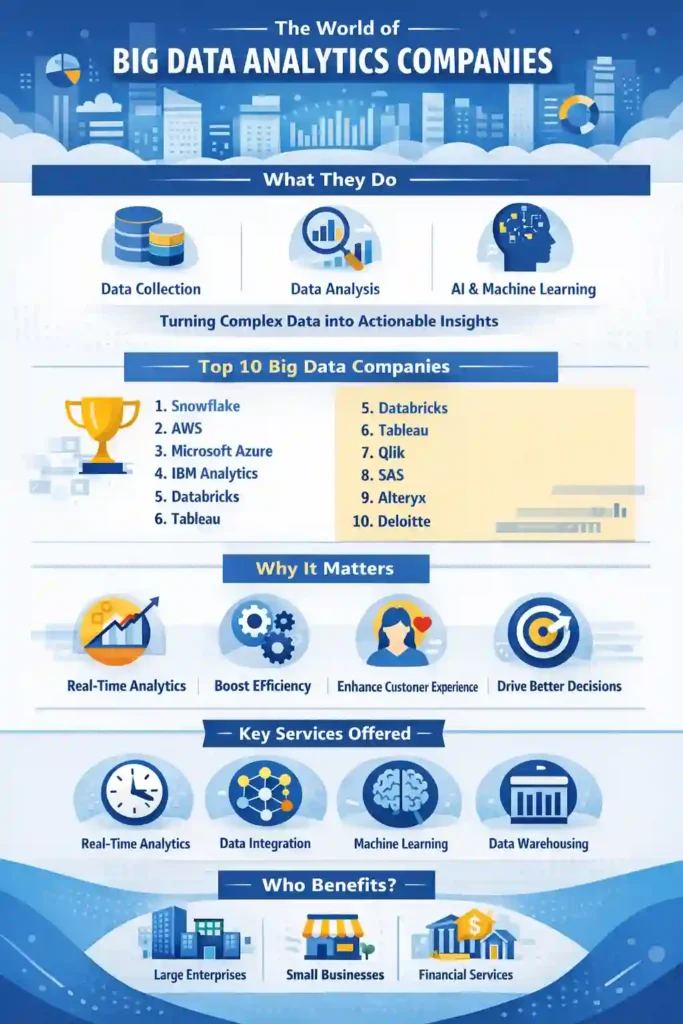
A strong big data companies list includes organizations that deliver end-to-end analytics services, from data collection and data integrations to machine learning models, real-time analytics, and strategic consulting. These companies help businesses navigate complexity data and achieve their business goals.
Key Enterprise & Cloud Players
- Snowflake Inc. – A cloud-based platform for scalable data warehouse, data analysis, and simultaneous access to datasets across environments.
- Sigma Computing – Provides a spreadsheet-style, collaborative analytics interface that connects directly to cloud data warehouses with AI-powered insights.
- Amazon Web Services (AWS) – Offers a broad analytics stack, including services for storage, streaming analytics, and ML model building.
- Microsoft Azure Synapse Analytics – Integrates data warehousing, big data, and analytics with Power BI for powerful visualization and reporting.
- IBM Analytics – Provides hybrid big data architecture and AI and machine learning analytics solutions for enterprises.
- Accenture & Deloitte – Global consulting leaders offering tailored analytics, digital transformation, and predictive insights.
These leaders are known for supporting digital transformation, advanced modeling, and scalable data ecosystems capable of addressing modern analytics needs.
What Is Big Data Analytics and Why It Matters
Big data analytics refers to the process of examining large and diverse data sets to uncover hidden patterns, correlations, and insights that can inform decision-making. In contrast to traditional reporting, real-time analytics and advanced ML systems let organizations react quickly and predict future trends.
The value of employing robust analytics includes:
- Enhanced decision-making through predictive insights.
- Operational efficiency by identifying bottlenecks and optimizing workflows.
- Improved customer experience via personalized services.
- Fraud detection and risk management through anomaly detection in real time.
Businesses that use advanced analytics often outperform their peers by leveraging data to guide strategy and execution rather than relying purely on intuition.
Big Data Analytics in the USA Companies — A Hub of Innovation
The United States remains a central hub for the analytics industry, housing many of the top big data companies with global reach. According to analytics market rankings, the U.S. market supports extensive capabilities in cloud platforms, consulting expertise, and analytics toolsets.
Companies based in the U.S. dominate the landscape, including Snowflake, AWS, Microsoft, IBM, as well as analytics consultancies such as Deloitte and Accenture — all known for delivering enterprise-scale solutions that help organizations meet complex analytics challenges.
Top Big Data Companies — What Sets Them Apart
When evaluating a big data analytics company, focus on the following essential attributes:
Data Integration & Frameworks
The ability to unify data from disparate sources — whether cloud apps, databases, IoT devices, or internal logs — ensures accuracy and flexibility in analytics outcomes.
AI and Machine Learning Models
Platforms that embed sophisticated machine learning models and AI capabilities accelerate insight discovery and predictive forecasting.
Real-Time Analytics
Fast decision-making requires systems that can deliver insights as data flows — an essential component in industries like finance, logistics, and e-commerce.
Data Warehouse & Governance
A robust data warehouse supports scalable, centralized data storage with governance, security, and compliance, ensuring reliable analytics at enterprise scale.
These strengths distinguish top companies that can support long-term transformation and measurable impact.
Top 10 Big Data Companies — Leaders for 2026
Industry research and business intelligence reports typically list these as among the top 10 big data companies based on technology innovation, market presence, and client outcomes:
- Snowflake
- AWS
- Microsoft Azure
- IBM Analytics
- Databricks
- Tableau (Salesforce)
- Qlik
- SAS
- Alteryx
- Deloitte
(Source: analytics industry summaries)
Each organization brings a unique blend of technologies and services — from cloud analytics and ML automation to enterprise governance and digital transformation support.
Top Big Data Companies 2022 vs. 2026 — Key Evolution
The analytics landscape has evolved significantly since 2022, when companies focused mostly on batch reporting and basic visualization. Today’s organizations demand real-time insights, AI-driven analysis, predictive forecasting, and data-driven strategic planning.
This shift reflects the broader adoption of AI and machine learning, automation in analytics workflows, and the growing need to respond instantly to market and operational changes.
Big data analytics companies help businesses do deep analysis on big data so large and complex information becomes easy to understand and useful for daily decisions.
Big Data Companies Hiring — Skills in Demand
The industry is also evolving as a job market. Companies across sectors — especially in technology, financial services, healthcare, retail, and logistics — are hiring professionals skilled in:
- Data engineering and pipeline development
- Machine learning and AI integration
- NLP (Natural Language Processing)
- Analytics strategy and governance
- Business intelligence tooling (e.g., Power BI)
These roles are critical as businesses invest in platforms that deliver real-time insights and predictive power across functions.
How Big Data Analytics Works — Step-by-Step Guide
To make analytics tangible, here’s a simplified process that most companies follow:
- Data Collection: Gathering structured and unstructured data from various systems.
- Data Integration: Unifying data sources into a cohesive dataset.
- Data Storage & Warehouse: Storing cleaned data in systems designed for efficient querying.
- Data Analysis & Modeling: Using analytics and machine learning models to extract insights.
- Insight Delivery: Creating dashboards and reports that help leaders understand key metrics.
This workflow transforms raw data into actionable intelligence that informs strategic and operational decisions.
Real Business Benefits of Big Data Analytics
Applying big data analytics yields measurable advantages:
- Faster and smarter decision-making supported by predictive models.
- Optimized operations by identifying inefficiencies and automating workflows.
- Personalized customer experiences that drive loyalty and revenue.
- Risk mitigation through pattern recognition and anomaly detection.
Companies that invest in analytics solutions gain competitive advantages that boost resilience and agility in uncertain markets.
Expert Tips for Choosing the Right Analytics Partner
To choose the right big data analytics company for your business:
✔ Define clear business goals — What insights do you need, and how will they help you compete?
✔ Evaluate data governance and security — Compliance and trust are essential.
✔ Assess scalability — Your analytics needs will grow over time.
✔ Look for real-world results — Ask for case studies and references.
These steps ensure you select a partner aligned with your digital transformation vision and long-term growth strategy.
Final Thoughts — Why Big Data Analytics Matters Now More Than Ever
In an era where data volumes continue to explode and technology evolves rapidly, investing in the right analytics partner is a strategic imperative. Big data analytics companies are not just vendors — they are enablers of growth, innovation, and competitive advantage.
By transforming raw data into actionable insights, organizations can:
- Make smarter decisions with confidence
- Improve operational performance across departments
- Support predictive foresight using AI and machine learning
- Align technology with long-term business goals
Whether you’re a startup or an enterprise, the time to harness data is now. Choose the right analytics partner and unlock the full potential of your business intelligence ecosystem.
Frequently Asked Questions (FAQ)
1. What exactly does a big data analytics companydo?
A big data analytics company helps businesses make sense of large and complex datasets that traditional tools can’t handle. These firms provide technology and services that collect, clean, store, and analyze data from many sources — like customer behavior, transaction records, or machine sensors.
They use advanced techniques, such as machine learning models and real-timejj` analytics, to uncover patterns and insights that help teams make smarter decisions. In simple terms, if your data is too big or too messy to understand on your own, these companies help turn it into useful information you can act on.
2. Why do companies need big data analytics — isn’t regular data analysis enough?
Great question! Traditional data analysis works well when datasets are small and neatly organized. But modern organizations deal with huge volumes, high-speed data flows, and many different types of data (like text, video, and sensor feeds). This is what makes the data “big” — it has volume, velocity, variety, variability, and complexity that classic tools simply can’t process quickly or accurately.
This is where big data analytics shines. It goes beyond basic reporting, helping companies:
Spot hidden trends and patterns faster
Predict future outcomes using advanced algorithms
Make smarter business decisions in real time
Personalize customer experiences
Improve efficiency and reduce costs
So while regular analysis answers “what happened,” big data analytics helps answer “why it happened” and “what’s likely to happen next,” even with data that’s changing all the time.
3. How do big data companies use machine learningand AIto help businesses?
Machine learning and AI are tools that help computers learn from data without being explicitly programmed. Big data companies apply these technologies to find patterns and make predictions that humans might miss.
AI can detect unusual activity in transaction data that could signal fraud
Machine learning models can forecast sales or demand based on past behavior
NLP (Natural Language Processing) can analyze customer feedback in text form
Predictive analytics helps companies plan inventory or optimize pricing
By combining traditional analytics with AI and machine learning, these companies help businesses go beyond looking at past data and move into forward-looking strategies that anticipate trends and adapt quickly.
For example:
AI can detect unusual activity in transaction data that could signal fraud
Machine learning models can forecast sales or demand based on past behavior
NLP (Natural Language Processing) can analyze customer feedback in text form
Predictive analytics helps companies plan inventory or optimize pricing
By combining traditional analytics with AI and machine learning, these companies help businesses go beyond looking at past data and move into forward-looking strategies that anticipate trends and adapt quickly.
4. Is big data analytics only for large companies, or can small businesses benefit too?
It’s a common misconception that analytics is only for big enterprises. The truth is, businesses of all sizes can benefit from big data analytics — and many already do!
Small and mid-sized businesses might start with simpler analytics tools that help them understand customer behavior, optimize advertising spend, or improve product recommendations. As they grow, they can adopt more advanced capabilities like predictive modeling, AI-enabled personalization, and real time analytics to stay competitive.
With cloud-based platforms and scalable data warehouse solutions, even small teams can now access powerful analytics without huge upfront costs. The key is to focus on solving specific business goals — whether it’s increasing customer retention, reducing churn, or improving operational efficiency — and choosing analytics partners that fit your stage and budget.