
Imagine a world where your devices don’t just connect — they think, predict, and act. That’s the transformative promise of IoT with machine learning — the synergistic fusion of connected devices and intelligent data-driven algorithms that is reshaping our world. From smart homes and industrial machines to predictive healthcare and smart cities, this powerful combination enables systems to analyze massive data, learn patterns, and make decisions without human intervention.
This comprehensive article explores:
- IoT machine learning examples
- IoT, Machine Learning projects you can build
- What makes the best IoT, machine learning solutions
- IoT full form and its significance
- Top IoT AI projects and AI in IoT applications
- The Impact of AI on IoT across industries
- Practical insights, step-by-step guidance, expert perspectives, and real use cases
Let’s dive in.
- IoT and machine learning examples: Real-World Success Stories
- IoT Machine Learning projects: Hands-On Ideas to Build and Learn
- Best IoT with machine learning Practices for Success
- IoT full form: What It Really Means
- IoT AI projects: Combining Intelligence and Connectivity
- AI in IoT: What It Means and Why It Matters
- AI in IoT applications: Key Use Cases Across Industries
- Impact of AI on IoT: Transforming Business and Society
- Final Insights:
- Frequently Asked Questions (FAQ)
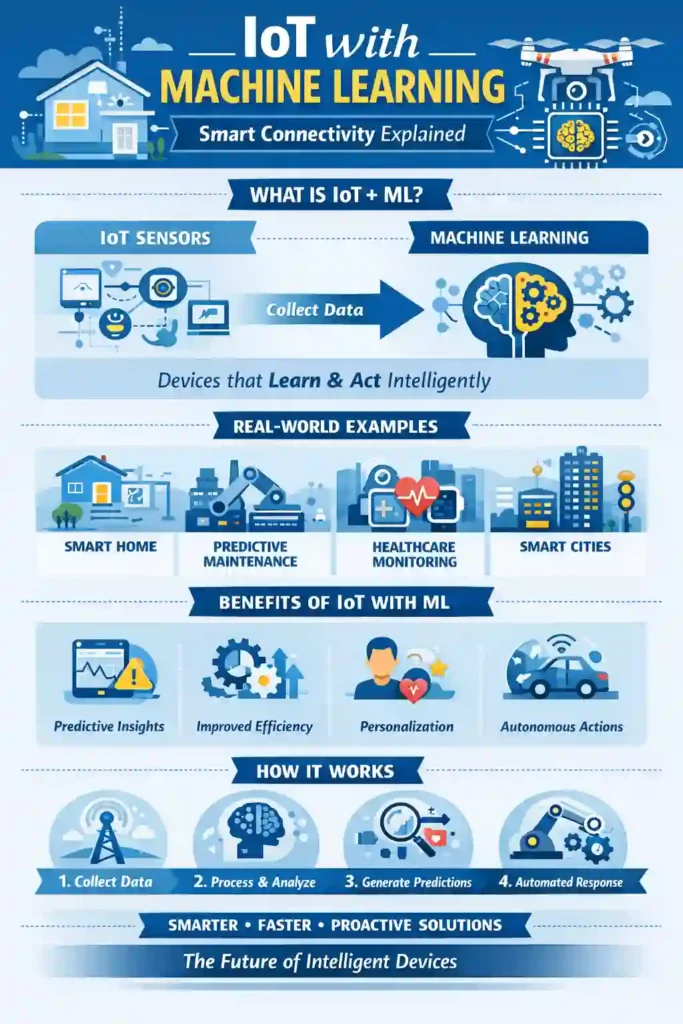
IoT and machine learning examples: Real-World Success Stories
Understanding how IoT with ML is already used helps bridge theory and reality. These use cases show how intelligent connectivity is improving lives and business outcomes:
Smart Home Automation
Devices like smart thermostats and voice assistants learn user behavior over time. For example, a smart thermostat adjusts your home temperature based on your activity patterns without manual settings. Over time, they become personalized and intuitive. geeksforgeeks.org
Predictive Industrial Maintenance
In manufacturing, IoT sensors collect machine data like temperature and vibration, and machine learning models analyze this data to predict equipment breakdowns before they happen — reducing downtime and maintenance costs dramatically. Dataconomy
Healthcare Monitoring
Wearables and medical IoT devices collect continuous health metrics like heart rate and blood oxygen. Machine learning analyzes trends to detect anomalies early, enabling proactive medical responses and personalized care. geeksforgeeks.org
Smart Cities and Traffic Management
Urban IoT sensors monitor everything from traffic flow to air quality. When combined with machine learning, systems can optimize traffic lights, forecast congestion, manage energy use, and make cities more responsive and efficient. geeksforgeeks.org
IoT Machine Learning projects: Hands-On Ideas to Build and Learn
If you’re learning or innovating, these projects show practical ways to apply it
1. Smart Energy Management
Use IoT sensors to collect data on energy consumption and train ML models to predict usage peaks, optimize load, and reduce costs. The IoT Academy
2. Predictive Maintenance System
Connect real-time sensor data from industrial equipment and build machine learning models that forecast failure risks, allowing for proactive repairs. The IoT Academy
3. Smart Agriculture Monitor
Build a system where IoT sensors detect soil moisture or weather conditions and a machine learning model predicts the best time to irrigate crops or apply fertilizers — boosting crop yield while conserving resources. The IoT Academy
4. Health Monitoring Application
Collect health data from wearable devices and train ML models to provide personalized wellness insights or early alerts for irregular patterns. The IoT Academy
Best IoT with machine learning Practices for Success
To build solutions that deliver meaningful impact, here are strategies for success with IoT and machine learning:
Define Clear Use Cases
Start by identifying specific problems you want to solve — whether improving efficiency, enhancing safety, or elevating customer experiences.
Prioritize Data Quality
IoT sensors generate vast data. Effective machine learning depends on accurate, consistent, and well-preprocessed data. Clean and structured data delivers better predictive results. www.tpointtech.com
Leverage Edge Intelligence
Processing machine learning in real time on the device (edge computing) reduces latency and improves responsiveness — crucial for safety and automation. Dataconomy
Iterate and Improve
ML models improve over time as they get more data. Continuously monitor model performance and refine to maintain accuracy, relevance, and reliability.
IoT full form: What It Really Means
The IoT full form is Internet of Things — a vast, interconnected ecosystem of devices that collect, communicate, and act on data over networks using technologies like Wi-Fi, Bluetooth, and cellular communication. These can range from smart appliances and wearables to industrial machines and infrastructure sensors. Investopedia
Understanding this lays the foundation for appreciating how machine learning elevates IoT into intelligent automation.
IoT AI projects: Combining Intelligence and Connectivity
IoT AI projects — sometimes called AIoT (Artificial Intelligence of Things) — integrate machine learning into IoT systems to enable autonomous decision-making.
Examples include:
Autonomous Vehicles
IoT sensors and AI algorithms process real-time data for functions like adaptive cruise control and lane detection. Dataconomy
Smart Retail Systems
In retail, IoT sensors track inventory levels and machines use AI to forecast restocking needs — helping stores improve customer experiences and reduce waste. Dataconomy
Urban Optimization Tools
Street and traffic sensors combined with AI optimize city operations — from traffic lights to waste management — enhancing sustainability and quality of life. geeksforgeeks.org
AI in IoT: What It Means and Why It Matters
AI in IoT refers to incorporating artificial intelligence — particularly machine learning — into connected systems so they can analyze sensor data, learn from it, and make automated decisions. By blending data analytics and connectivity, AI empowers IoT devices to act intelligently rather than merely collect data. TechTarget
This combination increases operational efficiency, improves automation, enhances prediction, and creates adaptive systems that continuously evolve. Metana
AI in IoT applications: Key Use Cases Across Industries
Here are some prominent AI in IoT applications transforming sectors today:
Industrial Optimization
Factories use data from IoT devices and machine learning models to improve processes, reduce waste, and forecast failures before they occur. EICTA
Transportation and Supply Chains
Machines collect real-time data across fleets and supply routes. AI analyzes this to optimize logistics, reduce fuel costs, and improve delivery times. EICTA
Healthcare Solutions
AI-powered IoT wearables and sensors enable continuous patient monitoring with predictive alerts — enhancing preventive care. geeksforgeeks.org
Smart Urban Services
Smart city systems analyze data from environmental, traffic, and energy sensors to adjust services and boost urban efficiency. geeksforgeeks.org
Impact of AI on IoT: Transforming Business and Society
The impact of AI on IoT is far-reaching:
Enhanced Decision Making
AI analyzes vast IoT data faster and more accurately than humans can, enabling adaptive systems that optimize themselves over time. TechTarget
Increased Efficiency and Reliability
Automated systems powered by machine learning improve operational performance, reduce manual errors, and optimize resource use across industries. Metana
Cost Savings and Predictive Insight
Predictive maintenance, anomaly detection, and autonomous response systems save money, reduce downtime, and deliver competitive advantages. Wezom
When IoT with ML is used in security systems, it helps devices spot unusual activity early, making machine learning in computer security more effective at protecting data and networks.
Final Insights:
By combining IoT with machine learning, you unlock systems that are not only connected but truly intelligent. These systems enhance automation, improve decision-making, and help organizations and individuals adapt to dynamic environments with confidence.
Whether you’re a student exploring IoT Machine Learning projects, a developer building smart solutions, or a business leader planning digital transformation, understanding this powerful integration empowers you to innovate and lead with assurance.
In a world where data fuels decisions, systems that can learn from that data — not just collect it — are no longer a luxury. They are essential for growth, resilience, and future-ready technology.
Frequently Asked Questions (FAQ)
1. What exactly is IoT, machine learning, and how do they work together?
It is when connected devices (like smart sensors, watches, cars, or appliances) not only send data, but also learn from that data to make decisions on their own.
Think of IoT devices as eyes and ears, collecting information from the real world. Machine learning is like the brain that looks at all that information, finds patterns, and predicts what might happen next — such as predicting when a machine might fail or how to save energy automatically. This combination means devices can act intelligently and without human supervision over time.Medium
2. Do all IoT systems need machine learning?
No — not all IoT systems need machine learning. Some simple IoT setups just send sensor data to a server or trigger actions based on fixed rules (like turning lights on at 6 PM every day). However, if your solution needs to recognize patterns, make predictions, or adapt behavior over time, then machine learning becomes essential.
For example, machine learning is helpful in predicting machine failures, detecting security threats, or personalizing experiences, which go beyond simple rule-based automation.
3. What are the main challenges of using machine learning in IoT systems?
While powerful, combining it brings a few real-world challenges:
Data Volume & Quality – IoT sensors generate lots of data quickly. Ensuring that the data is accurate and usable for machine learning can be tough. IoT For All
Security and Privacy – Devices collect personal and sensitive data (like health or location). Protecting this data is critical. IoT For All
Processing Power & Latency – Many IoT devices have limited computing power, so running complex models locally can be hard. Edge computing helps, but it’s still a challenge. Simplilearn.com
Integration Complexity – IoT systems often involve many different sensors, protocols, and platforms, making seamless integration with machine learning difficult. www.tpointtech.com
These challenges don’t mean it’s impossible — they simply mean careful planning and proper tools are required to make IoT + ML successful.
4. What benefits do machine learning bring to IoT systems that traditional IoT doesn’t provide?
Machine learning makes connected devices smarter in ways basic IoT cannot:
Predictive insights – Devices can forecast outcomes like equipment failure or energy demand before they happen. Offshore IT Services
🛡 Smarter Security – ML models can spot unusual patterns that may signal cyber threats and alert systems faster than fixed rules. Offshore IT Services
Personalized experiences – From smart home settings that adjust to your routines to fitness devices that tailor health advice, ML enables deeper personalization. Offshore IT Services
Autonomous decisions – Instead of waiting for a human to react, IoT systems can make decisions and act on data in real time, like adjusting energy use or traffic signals automatically. Offshore IT Services
In simple terms, machine learning turns data into smart action — helping IoT devices go from reactive to proactive and adaptive.