
In today’s digital world, data has become one of the most valuable assets an organization can possess — and one of the most targeted. While big data powers smarter decisions and innovation, it also increases cybersecurity risk. That’s why big data security solutions are essential for protecting information, complying with regulations, and maintaining stakeholder trust.
This article provides a complete, up-to-date guide to understanding how organizations safeguard massive datasets, why it matters, what challenges exist, and how to implement strong security defenses step by step.
- Types of Data Security: Protecting the Heart of Your Information Strategy
- Big Data Security Challenges: Why Protecting Large Data Sets Is Harder
- What Is Data Security and Why It Matters
- Understanding Data Protection Regulations: GDPR and Beyond
- 5 Importance of Data Security: Why It’s Mission-Critical
- Data Security Tools: Building Your Protection Stack
- What Is Data Loss Prevention (DLP)? A Critical Protective Layer
- Data Security Best Practices: Step-by-Step Guide
- Data Security Examples: Real-World Scenarios
- Final Thoughts: Safeguard Your Data With Confidence
- FAQs
Types of Data Security: Protecting the Heart of Your Information Strategy
Data security includes a range of tools, practices, and policies designed to protect sensitive data from theft, corruption, or loss throughout its life cycle. It focuses on ensuring that data remains secure, available, and reliable. Robust data protection cuts across people, processes, and technology — not just devices and firewalls.
Key types of data security that work together in modern environments include:
- Encryption — Scrambles data into unreadable text unless someone has the key.
- Role Based Access Control (RBAC) — Ensures individuals only get permission to the data they need for their job, helping prevent unauthorized access.
- Multi-Factor Authentication (MFA) — Adds extra layers beyond simple passwords.
- Data Masking & Data Erasure — Reduces exposure by hiding or permanently removing sensitive information.
- Data Loss Prevention (DLP) — Detects and protects against unauthorized data movements across networks and storage.
These types of data security form the foundation of any strong security program, helping organizations control access, enforce policies, and monitor protections across distributed systems.
Big Data Security Challenges: Why Protecting Large Data Sets Is Harder
Securing big data is far more complex than securing small volumes of information. That’s because big data tends to be voluminous, diverse, and distributed across hybrid environments — making it harder to monitor and control consistently.
According to modern security statistics, the average cost of a data breach in 2025 was about $4.44 million globally, and $10.22 million in the United States — demonstrating the financial imperative behind solid security practices.
Major big data security challenges include:
- Complex infrastructure growth: Many data pipelines now span cloud, edge, and on-premises systems.
- Scale of access points: More users and services mean a larger attack surface.
- Human errors: Most breaches involve mistakes by employees or misconfigured systems.
- Compliance pressures: Regulations such as the General Data Protection Regulation (GDPR) carry strict expectations and heavy penalties for non-compliance.
- Real-time threat detection: Monitoring and responding to threat vectors across rapid data streams requires advanced analytics and automation.
Addressing these obstacles demands a combination of strategy, culture, and technology.
What Is Data Security and Why It Matters
At its core, data security is about safeguarding digital information from unauthorized access, theft, and corruption. It guarantees the confidentiality, integrity, and availability of data — often called the CIA Triad in security frameworks.
Strong data security protects sensitive and proprietary data, ensures business continuity, and helps organizations avoid the costly security incidents that damage customer trust and operational stability.
Under the following infographic
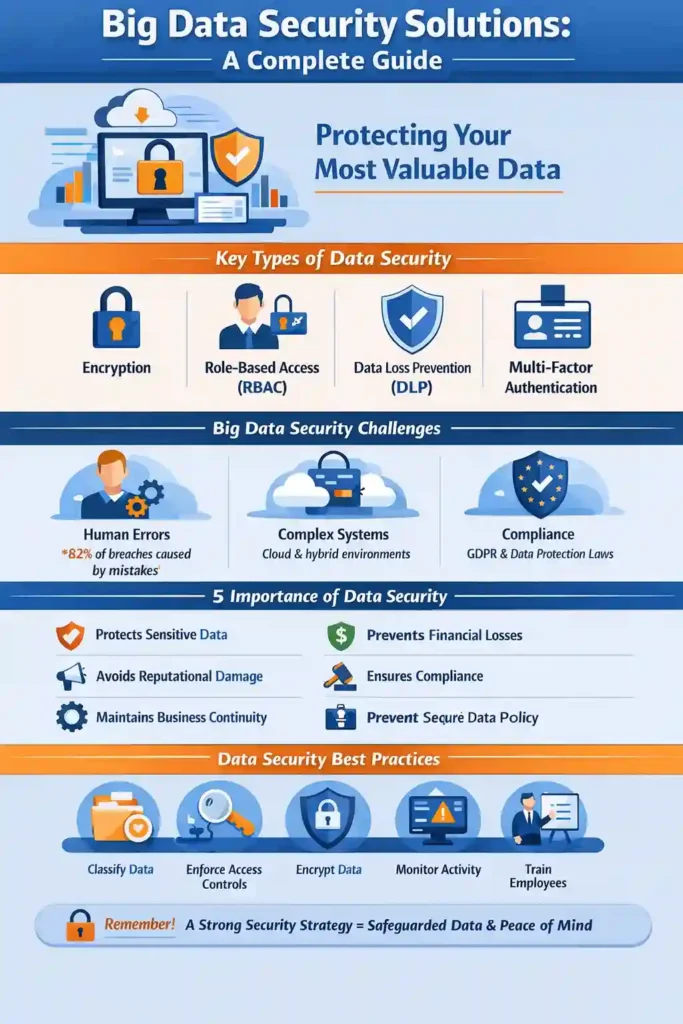
Today’s data security paradigm includes:
- Tools that prevent unauthorized access and system compromise.
- Policies that align with data protection regulations like GDPR and the California Consumer Privacy Act (CCPA).
- Governance by security teams and data managers who oversee risk, compliance, and incident response.
Put simply, data security is essential to preserving the value of information across the enterprise.
Understanding Data Protection Regulations: GDPR and Beyond
One of the biggest drivers of modern security strategy is regulatory compliance. The General Data Protection Regulation (GDPR) — a landmark data protection regulation in the EU — has set the tone for global expectations. It enforces strict duties for data handlers, including appointment of a Data Protection Officer (DPO), meaningful breach reporting timelines, and robust privacy controls.
Complying with GDPR and similar frameworks helps organizations:
- Minimize legal and financial penalties.
- Demonstrate transparency and accountability to customers.
- Improve operational security posture and readiness.
Regulatory compliance is not just a legal burden — it’s an essential component of trust.
5 Importance of Data Security: Why It’s Mission-Critical
Understanding the importance of data security helps explain why organizations invest heavily in protection measures. Here are five key reasons:
- It protects sensitive data from theft and misuse.
- It reduces financial risk: The global average cost of data breaches underscores the severity of impacts.
- It prevents reputational damage: Customers often abandon brands after breaches.
- It ensures compliance: Adhering to regulations like GDPR avoids fines and enhances market access.
- It strengthens operations: Effective controls help continuity and reduce downtime caused by breaches or data loss.
These benefits make data security not just a technology concern, but a strategic business priority.
Data Security Tools: Building Your Protection Stack
The right data security solutions bring together multiple technologies to lock down infrastructure and control data access.
Common tools include:
- Encryption Tools: Protect data in motion and at rest.
- IAM & RBAC Platforms: Manage identity, access policies, and access to sensitive data.
- Data Loss Prevention (DLP) Systems: Detect and block unauthorized transfers.
- Firewalls & Intrusion Detection Systems: Prevent network-level attacks.
- Backup & Recovery Tools: Ensure data can be restored after an incident.
Leading security platforms also weave in machine learning, behavioral analytics, and real-time monitoring to help security teams stay ahead of threats.
What Is Data Loss Prevention (DLP)? A Critical Protective Layer
Data Loss Prevention (DLP) is a category of tools and policies that prevent sensitive data from leaving secure environments — whether accidentally by an employee or maliciously by an attacker. DLP can monitor:
- Data in motion (e.g., email, uploads)
- Data at rest (in storage)
- Data in use (on workstations or servers)
Modern DLP solutions employ classification, contextual analysis, and machine learning to detect risks before they become security incidents, reducing exposure and aligning with governance requirements.
Data Security Best Practices: Step-by-Step Guide
Implementing effective data protection means aligning technology with security strategy and ongoing processes. Here’s a practical approach:
- Classify and Inventory Data Assets — Identify what data you have and which systems store it.
- Enforce RBAC and Least Privilege — Only grant users the minimal access required.
- Deploy Encryption & DLP — Protect data end-to-end and monitor its movement.
- Monitor Continuously — Use SIEM and analytics for real-time threat visibility.
- Test and Respond — Regularly simulate breaches and refine incident response.
- Educate Employees — Human errors contribute to most breaches, so training is essential.
- Align with Regulations — Map controls to frameworks like GDPR or CCPA for compliance.
These steps help transform security from reactive firefighting into a proactive, resilient ecosystem.
Solutions Big Data Security play a key role in Big Data and Security by helping businesses protect large amounts of important information from hackers, data leaks, and online threats.
Data Security Examples: Real-World Scenarios
To understand how these principles work in practice, consider these examples:
Financial Services Firm
A bank uses RBAC, encryption, and a SIEM platform. When unusual access patterns emerge, automated alerts notify security teams for rapid investigation — often stopping breaches before damage occurs.
Retail Analytics Company
A retail firm implements DLP and access controls to protect customer purchasing data. Analysts can explore trends without exposing personally identifiable information — balancing insight with privacy.
Final Thoughts: Safeguard Your Data With Confidence
In a world of evolving threats, big data security solutions are no longer optional — they are essential. These solutions empower organizations to:
- Safeguard sensitive data from theft and misuse
- Meet data protection regulation requirements such as GDPR
- Reduce risks of costly security incidents and reputational damage
- Strengthen customer trust, resilience, and operational continuity
By aligning technology, people, and processes — and investing in a strong data protection strategy — you can confidently protect your organization’s most valuable information.
FAQs
1. What exactly are solutions to bigdata security, and why do they matter?
SolutionsBig data security is the tools, practices, and technologies that help organizations protect large volumes of data from threats like cyber attacks, breaches, and unauthorized access. Unlike basic data protection, big data environments involve vast datasets that come from many sources — which makes protecting them more complex.
Think of your data as a library of valuable information — from customer records to operational logs. Without strong security systems, unauthorized users might access, steal, or damage that information. Big data security solutions help by:
Preventing unauthorized access with access controls like role-based access control (RBAC)
Protecting data privacy and integrity with encryption and monitoring
Detecting threats early using advanced analytics and alerts
These solutions ensure your business stays secure, compliant with laws like the General Data Protection Regulation (GDPR), and free from costly reputational damage and financial losses.
2. What are the biggest security threats to big data?
The biggest threats to big data generally stem from people or technologies that exploit gaps in security. Common risks include:
Unauthorized access — attackers or insiders getting access to data they shouldn’t.
Data breaches — when sensitive data is exposed or stolen.
Cyberattacks like ransomware — attackers lock or steal data and demand payment.
Human errors — mistakes like misconfigurations or weak passwords can open the door for exploitation.
Because big data stacks often involve many moving parts — multiple storage systems, cloud platforms, and user tools — attackers have more potential entry points. The more places data travels or lives, the more you need strong defenses like encryption, access controls, and monitoring.
3. How do big data security solutionsprotect sensitive datain real life?
In real world scenarios, big data security works much like layers of protection around a house vault. Instead of one lock, modern security combines several defenses:
Access Policies — Tools like RBAC restrict who can open which “doors” in a system.
Encryption — Scrambles data so that it’s completely unreadable without the correct keys.
Monitoring & Alerts — Systems watch activity for anything unusual and send alerts to security teams.
Auditing & Compliance Checks — Regular reviews ensure everything complies with standards like GDPR.
If an attacker tries to break in, these combined measures help: they stop unauthorized access, detect suspicious behavior early, and give your security teams time to respond. This layered approach helps keep sensitive and private data safe even when attacks happen.
4. What should businesses do to prevent security incidentswith big data?
Preventing security incidents isn’t just about technology — it’s also about planning, training, and policies. Most experts agree that these steps make a big difference:
Inventory and classify your data — Know what data you have and its sensitivity level.
Apply RBAC and least-privilege access rules — Only allow people to see what they need.
Use encryption everywhere — Keep data protected at rest and in motion.
Monitor real-time activity — Watch for anomalies or unusual user behavior.
Train employees — Because human errors cause a large portion of breaches, awareness and security education are essential.
Stay compliant with data protection regulations like GDPR and other laws.
Taking these steps helps you reduce risk, avoid costly breaches, and keep big data safe and reliable for decision-making and business growth.