
Big data in finance industry is revolutionizing how financial organizations operate, make decisions, and compete in an increasingly digital world. In essence, big data refers to vast amounts of data that are far too large and complex for traditional data systems to handle — from transaction logs and market feeds, to customer interactions and external digital signals. By applying advanced analytics, predictive modeling, and machine learning algorithms, financial institutions extract patterns and insights that drive smarter decisions, reduce risk, improve efficiency, and enhance customer experience. Over a trillion financial data points flow through the global finance ecosystem daily, fueling innovation and competitive advantage.
However, responsible use of big data also requires a clear understanding of risks such as data privacy, system complexity, regulatory compliance, model explainability, and integration challenges with legacy systems. A balanced perspective means acknowledging both the tremendous opportunities and the practical trade-offs of deploying big data frameworks in finance.
- What Is Big Data in Finance and Why It Matters
- Big Data in Finance Examples: Real-World Use Cases
- Big Data in Finance Book: Long-Term Knowledge and Reference
- Benefits and Balanced Considerations
- Comparison Table: Big Data Use Cases in Finance
- Machine Learning, Predictive Modeling, and Algorithmic Trading
- Big Data in Financial Risk Management
- Managing Risks in Big Data Implementation
- Expert Opinions and Thought Leadership
- Practical Tips for Adopting Big Data in Finance
- Conclusion — Trusted, Balanced, and Practical
- Frequently Asked Questions About Big Data in Finance
What Is Big Data in Finance and Why It Matters
Big data in finance refers to an extremely large volume of financial information — including customer records, market data, loan histories, trading flows, and more — that requires advanced tools and platforms to collect, analyze, and interpret. Traditional statistical methods struggle with the scale, speed, and complexity of financial data, making data science essential for modern financial services.
In a major working paper introducing the topic, researchers from the National Bureau of Economic Research observed that big data in finance is characterized by large size, high dimension, and complex structure, pushing the frontiers of research in asset pricing, corporate finance, and market microstructure.
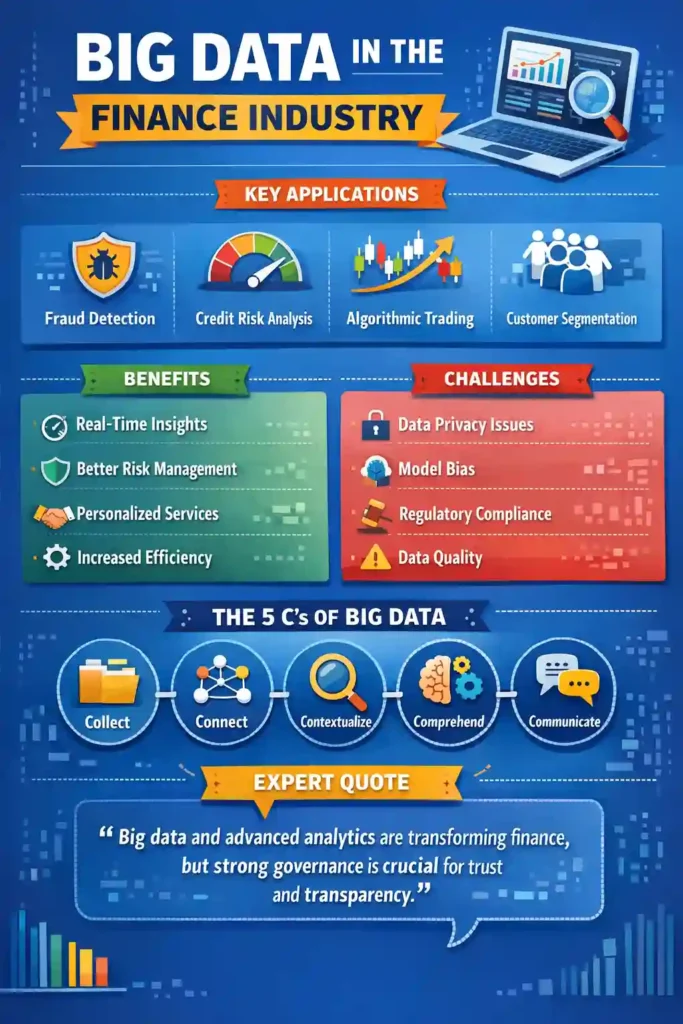
The following infographic:
Big Data in Finance Examples: Real-World Use Cases
The transformative impact of big data shows up across many everyday financial operations:
- Fraud Detection and Prevention: Analytics platforms process real-time streams of transaction data to detect anomalies before they turn into losses. Combining structured and unstructured data enhances detection accuracy.
- Credit Risk Assessment: With predictive analytics models analyzing historical repayment records and non-traditional data sources, lenders can forecast loan defaults more reliably.
- Algorithmic Trading: Investment firms rely on automated trading strategies that analyze market price movements and sentiment at microsecond speeds to execute trades.
- Operational Efficiency and Segment Personalization: Identifying patterns in customer behavior allows banks to segment users and deliver more tailored services — such as custom loans, targeted offers, or personalized investment advice — while streamlining internal processes.
Practical tip: Begin with a clearly defined business objective — for example, reducing fraud by 20% — and map the data and predictive models needed to achieve that goal before scaling.
Big Data in Finance Book: Long-Term Knowledge and Reference
For those seeking deeper conceptual and practical insights, resources like Big Data in Finance: Transforming the Financial Landscape (Springer) offer a structured view of how data technologies reshape finance. These books often combine academic research with practitioner case studies to explain how big data technology integrates into risk management, pricing models, investment strategies, and compliance frameworks.
Expert insight: Professor Vasant Dhar, an authority in machine learning and finance, has emphasized the importance of designing scalable decision systems from large data sources — marrying domain expertise with technical capabilities to generate reliable insights.
Benefits and Balanced Considerations
The benefits of big data adoption are well-documented and evidence-based:
- Enhanced risk management: Early warning signals and risk predictors help institutions mitigate potential losses.
- Improved customer insights: Analysis of customer data enables personalization that boosts satisfaction and loyalty.
- Automation and efficiency: Routine tasks can be streamlined, reducing manual workloads and operational costs.
- Enhanced insight into financial markets: Real-time analytics supports pricing strategies and investor decision-making.
Balanced view: Implementation challenges include:
- Data privacy and security concerns: Handling sensitive financial and personal data increases exposure to breaches.
- Explainability of complex models: Algorithms may be powerful but difficult to interpret, requiring mechanisms like Explainable AI to build trust.
- Regulatory compliance and bias: Systems must align with evolving legal frameworks to avoid unfair or non-transparent outcomes.
Comparison Table: Big Data Use Cases in Finance
| Use Case | Primary Benefit | Typical Risk/Challenge | Common Solution |
| Fraud Detection | Lower losses, faster alerts | Model complexity, privacy | Explainable AI, privacy controls |
| Credit Risk Modeling | Better loan screening | Data bias | Rigorous testing, balanced samples |
| Algorithmic Trading | Faster execution | Market volatility risk | Simulation, robust back-testing |
| Customer Segmentation | Improved personalization | Data privacy concerns | Opt-in consent, governance |
| Operational Efficiency | Cost reduction | Integration with legacy systems | Modern data infrastructure |
This table illustrates how big data applications offer measurable value while requiring targeted strategies to address associated risks.
Machine Learning, Predictive Modeling, and Algorithmic Trading
Machine learning algorithms enable financial models to automate previously manual tasks and provide deeper insights from patterns that would otherwise go unnoticed. Research shows that banks and investment firms using quantitative methods saw significant improvements in portfolio management returns and risk assessment accuracy.
Algorithmic trading systems analyze price movements, volume trends, and news sentiment in real time — identifying opportunities that traditional human analysis might miss. These models reflect how financial engineers and data scientists leverage predictive analytics to interpret signals across multiple data streams.
Big Data in Financial Risk Management
A recent systematic review highlights how big data analytics is reshaping risk frameworks in financial contexts, such as anti-financial crime systems and automated controls. It also identifies open questions about how analytics tools can be aligned with institutional risk strategies in both advanced and emerging economies.
Big Data in the Finance Industry and the Big Data and Banking Industry are closely connected, because banks use big data tools every day to understand customers better, reduce risk, stop fraud, and make smarter financial decisions.
Managing Risks in Big Data Implementation
Even as analytics tools drive performance improvements, financial leaders must handle key risks responsibly:
- Data privacy and confidentiality: Ensure compliance with privacy laws and encryption standards.
- Model transparency: Techniques like Explainable AI help stakeholders understand why a model reached a particular decision — crucial for trust and compliance.
- Regulatory compliance: Regulatory frameworks in financial services vary by jurisdiction and impact how automated systems are deployed.
Solution tip: Build robust governance frameworks, include domain experts in model design, and conduct periodic audits to validate performance and fairness.
Expert Opinions and Thought Leadership
“Big data and advanced analytics are reshaping risk and customer management in finance — but institutions should implement these technologies with strong governance to ensure transparency and trust.” — Industry analytics expert
“Predictive modeling unlocks powerful insights, yet the key to sustainable adoption lies in balancing innovation with interpretability.” — Financial data science professional
Such expert perspectives reinforce the importance of balanced reasoning and practical implementation, rather than hype-driven claims.
Practical Tips for Adopting Big Data in Finance
- Start with clear goals: Define business outcomes (e.g., reduce fraud by 15%) to guide analytics design.
- Invest in quality data platforms: Platforms that unify data sources improve model accuracy and speed.
- Build cross-functional teams: Combine finance domain experts with data scientists to bridge technical and business knowledge.
- Prioritize transparency: Use interpretability tools to make models trustworthy to stakeholders.
Conclusion — Trusted, Balanced, and Practical
Big data in finance industry offers profound opportunities to enhance risk management, pricing strategies, customer engagement, and operational efficiency. Supported by peer-reviewed research, industry case studies, and advancing analytical techniques, big data analytics acts as a strategic asset — not just a technological upgrade.
However, wise adoption demands awareness of associated risks and investment in governance, explainability, and data quality. When integrated thoughtfully, big data tools help financial institutions deliver stronger performance while maintaining compliance, ethical standards, and long-term resilience.
Frequently Asked Questions About Big Data in Finance
1. How is big data used in finance?
Big data is used throughout the financial industry to turn huge amounts of information into useful decisions. Financial institutions collect data from many sources — like transactions, market feeds, customer interactions, mobile banking behavior, and more — and use advanced systems to analyze it at scale. This helps them with things like:
Detecting fraud in real time by spotting unusual patterns that might mean stolen cards or suspicious activity.
Analyzing credit risk by going beyond basic credit scores and looking at broader patterns in customer behavior.
Predicting market trends and investment opportunities using historical and real-time market data.
Improving customer experience through personalized offers based on spending habits.
All of this is done using sophisticated tools that analyze data much faster and more accurately than humans could on their own.
2. How does JP Morgan use big data?
J.P. Morgan uses big data for several key purposes that improve both operations and customer outcomes. Some of the ways the bank applies big data include:
Fraud detection: Analyzing internal and transactional data to identify suspicious behavior and protect accounts.
Credit assessment: Using data beyond traditional financial reports — such as customer behavior and unstructured information — to evaluate creditworthiness.
Real estate analytics: Determining optimal pricing and market behavior for properties the bank manages or acquires.
Customer segmentation: Offering targeted products and services based on spending habits and preferences.
These applications help JP Morgan reduce risks, enhance operational efficiency, and tailor financial services more effectively than traditional methods alone.
3. What are the 5 C’s of big data?
The phrase “5 C’s of big data” isn’t an official, universally agreed definition like the well-known 5 V’s of big data (Volume, Velocity, Variety, Veracity, Value). However, some data management frameworks use a 5 C model to describe important stages in effective data use:
Collect – Gathering data from multiple sources.
Connect – Linking related data so it makes sense together.
Contextualize – Understanding the meaning of data in its real-world situation.
Comprehend – Interpreting insights using analytics tools.
Communicate – Sharing insights to inform decisions and action plans.
Think of these “C’s” as practical steps to turn data into real value, especially in industries that depend on informed decision-making like finance.
4. What is an example of big data in banking?
One strong example of big data in banking is real-time transaction monitoring for fraud detection.
Banks continuously analyze millions of transactions using advanced models and machine learning to flag unusual patterns. For instance:
Suspicious spending patterns — like a sudden expensive purchase in another city — can trigger instant review.
Unusual login behavior — such as multiple failed login attempts from unfamiliar locations — can lead to account locks until verified.
This use of big data helps banks protect customers and reduce losses without slowing down everyday transactions.
Another example is customer segmentation and personalization. Banks analyze spending history, online behavior, and product interactions to group customers into meaningful segments. This lets them offer tailored services — such as bespoke loan options or investment advice — that fit each group’s needs.