
In a world where digital information grows faster than ever, one thing stands clear: Big data for machine learning is the foundation behind smarter systems, predictive insights, and powerful automation.
From business decisions to scientific breakthroughs, this combination is reshaping industries. This guide explains everything you need to know — in simple language, step-by-step, and with real examples.
- Big Data Machine Learning PDF — Where to Start Learning
- What Is Big Data? — Simple Definition
- Big Data Examples That Affect Everyday Life
- Characteristics of Big Data You Should Understand
- Types of Big Data — Organized and Unorganized
- Big Data Machine, Learning Example — How It Works in Practice
- Big Data and Machine Learning Python — Tools You’ll Use
- Why Machine Learning Needs Big Data
- Real-World Big Data Machine Learning Applications
- Machine Learning Algorithms That Handle Big Data
- How to Approach Big Data and Machine Learning Together
- Summary: Why Big Data for Machine Learning Matters
- FAQ: Big Data & Machine Learning
Big Data Machine Learning PDF — Where to Start Learning
Many learners begin their journey with a big data & machine learning PDF — downloadable books or course handouts that explain concepts clearly offline.
These PDFs usually cover:
- What big data means
- How it works with machine learning models
- Tools like Hadoop, Spark, and Python libraries
- Practical case studies and examples
Look for PDFs from reputable sources like universities or industry experts to ensure accuracy and depth.
What Is Big Data? — Simple Definition
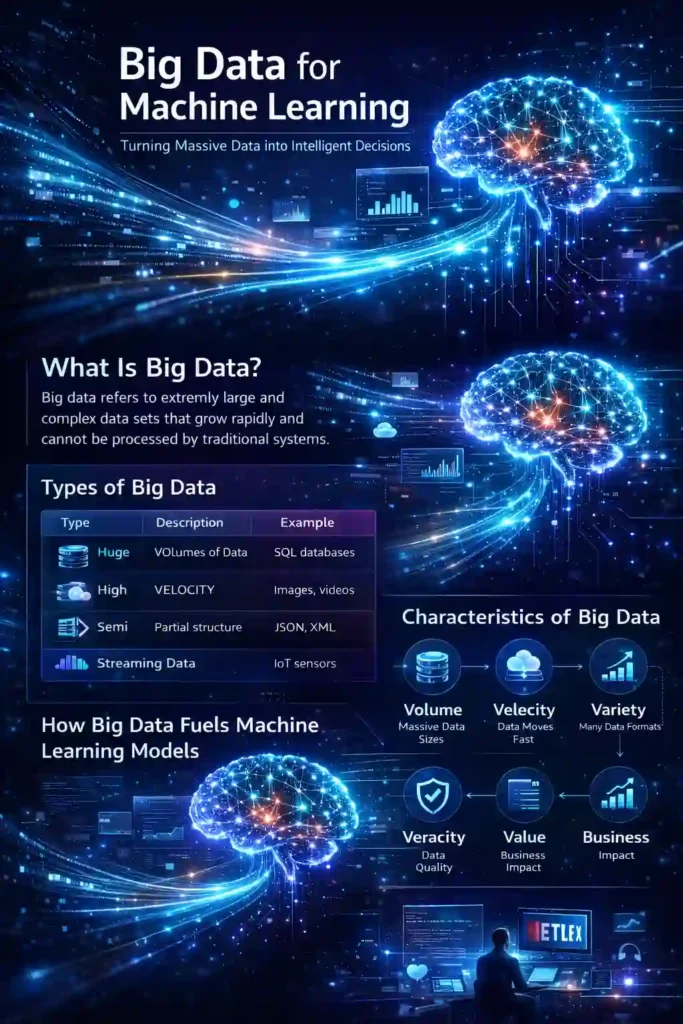
Big data refers to extremely large and complex datasets that traditional tools cannot handle efficiently.
These datasets grow continuously and come from multiple platforms like social media, sensors, transactions, and applications.
Unlike smaller datasets, big data needs advanced systems and algorithms to extract meaningful insights.
At its core, it’s all about finding patterns, predictions, and value hidden inside enormous information streams.
Big Data Examples That Affect Everyday Life
Big data isn’t a technical buzzword — it’s part of daily life, often behind the scenes:
- Personalized movie or music recommendations
- Fraud detection in financial transactions
- Traffic route optimization in GPS apps
- Targeted product suggestions in online shopping
These examples illustrate how big data analytics processes large and varied data to produce real-time decisions and value for users.
Characteristics of Big Data You Should Understand
Big data is often described by a set of defining qualities known as the Vs. These characteristics explain why big data needs special technologies and approaches:
- Volume — Massive amount of data
- Velocity — Speed of data generation and processing
- Variety — Multiple data formats (text, images, logs, etc.)
- Veracity — Quality and trustworthiness of data
- Value — Meaningful insights derived from the data
Understanding these traits helps clarify why machine learning becomes more accurate and powerful with more and richer data.
Types of Big Data — Organized and Unorganized
Big data is not all the same. It includes several types of data:
- Structured Data — Organized data in tables (spreadsheets and databases).
- Semi Structured Data — Text files with some tags, like XML or JSON.
- Unstructured Data — Content without a predefined format, like photos, videos, and social posts.
These different types matter because they determine how information is stored, cleaned, analyzed, and fed into machine learning systems.
Big Data Machine, Learning Example — How It Works in Practice
Let’s walk through an example you might relate to.
Imagine a global retailer that wants to predict customer purchases.
- Data Collection — The retailer gathers vast data from online clicks, purchases, product ratings, and browsing history.
- Data Integration — Structured sales data and unstructured customer reviews are combined.
- Big Data Analytics — Tools process this mixed data to find patterns at scale.
- Machine Learning Models — Algorithms learn from these patterns to predict what products a customer might buy next.
This practical workflow shows how big data and machine learning join forces to generate accurate, personalized recommendations.
Big Data and Machine Learning Python — Tools You’ll Use
Python is a leading language for working with big data and machine learning:
- Pandas & NumPy — For data manipulation
- Scikit-Learn — Classic machine learning toolkit
- PySpark — Python interface for large-scale data processing
- TensorFlow & PyTorch — Libraries for deep learning
With these tools, data scientists can clean datasets, train models, test results, and deploy insights — all within a robust and scalable environment.
Why Machine Learning Needs Big Data
Machine learning thrives on data.
Without access to large and diverse datasets, machine models perform poorly.
When the data is limited, algorithms struggle to detect patterns and make reliable decisions.
But with big data, machine learning improves in:
- Accuracy
- Speed
- Generalization to new situations
This is why modern AI systems rely on extensive data for training and optimization.
Real-World Big Data Machine Learning Applications
Across industries, the synergy between big data and machine learning delivers transformational results:
Healthcare
Systems analyze patient data to detect diseases earlier and personalize treatments.
Retail
Stores predict buying behavior and tailor offers to individual customers.
Autonomous Driving
Self-driving cars process sensor data to make split-second decisions in real time.
Finance
Banks detect fraud by analyzing millions of transactions each second.
These examples highlight not only how powerful this combination is but also how it’s used in diverse sectors to solve real problems.
When artificial intelligence works with big data, machines learn faster, think smarter, and make better decisions from real-world information.
Machine Learning Algorithms That Handle Big Data
When dealing with big data, certain machine learning algorithms are commonly used:
- Linear Regression — For continuous outcome prediction
- Decision Trees — For decision paths visualization
- Clustering (like K-Means) — Sorting data into groups
- Neural Networks — For complex pattern recognition in large datasets
Each of these helps data scientists convert big datasets into useful insights.
How to Approach Big Data and Machine Learning Together
Here’s a recommended workflow you can follow:
- Collect and store data — Use a data lake for flexible storage that supports structured and unstructured formats.
- Clean and preprocess — Remove errors and organize data.
- Select features — Identify insights that matter most to your model.
- Train machine learning models — Use algorithms at the right scale.
- Evaluate and refine — Test model accuracy and update as needed.
- Deploy and monitor — Use predictions to improve operations in real time.
This step-by-step method ensures not only accuracy but also scalability and reliability.
Summary: Why Big Data for Machine Learning Matters
At a time when data is generated by billions of users, devices, and systems every second, big data is more than just a source of information — it’s a core asset. Combined with machine learning, it fuels:
- Better predictions
- Faster decisions
- Smarter systems
- Scalable intelligence
Organizations that harness this power will lead in innovation and competitive advantage.
FAQ: Big Data & Machine Learning
1. What is big datain machine learning?
Big data in machine learning refers to huge and fast-growing collections of information that machine learning systems use to learn and improve.
In simple terms, big data is data that is so large or complex that traditional tools can’t handle it efficiently. This data can be structured (like spreadsheets), semi-structured (like JSON or XML files), or unstructured (like text, images, and videos).
In machine learning, this big data becomes the “fuel” for models to learn patterns. The more and better the data you feed into a model, the smarter and more accurate its predictions or decisions become.
2. Does machine learning use big data?
Yes — machine learning does use big data, especially in real-world applications.
Machine learning systems learn from data. When that data is large, diverse, and detailed, models can pick up richer patterns, make better predictions, and adapt to new situations more accurately. Big data is especially helpful for tasks like:
Predicting customer behavior
Detecting fraud
Auto-suggesting content
Driving autonomous systems
In fact, big data and machine learning often work together: big data provides the raw information, and machine learning extracts valuable insights from it.
3. What are the 4 types of big data?
This question can be answered in two ways — depending on the context you’re using:
A. Data Format Types
When we talk about types of big data in common use, there are three major kinds:
Structured data – Organized in tables and familiar formats, like customer purchase lists.
Semi-structured data – Data that has some organization (tags) but not strict tables — like JSON and XML files.
Unstructured data – No fixed format at all — like text messages, videos, audio, and social media posts.
B. Four Common Data Categories (alternative view)
Sometimes, people talk about four broad data categories — structured, semi-structured, unstructured, and metadata (data about other data). Metadata helps systems understand what the other data represents, which makes big data analysis easier.
So if someone asks about 4 types of big data, they often mean those categories.
4. What is the difference between machine learning and big data?
Although they often work together, machine learning (ML) and big data are different concepts:
Aspect
Big Data
Machine Learning
Purpose
Manages and processes huge datasets
Learns from data to make predictions
Main Work
Stores, cleans, and analyzes very large & complex data
Uses algorithms to train models and make decisions
Focus
Data volume, variety, and speed
Patterns, learning, and prediction
Output Example
Dashboards, summaries, and analytics reports
Predictions, classifications, recommendations
Tools
Hadoop, Spark, SQL/NoSQL systems
Python libraries (Scikit-Learn, TensorFlow), ML algorithms
In simple words:
Big data is all about handling massive and complex information that’s too big for traditional tools.
Machine learning uses patterns from data (big or small) to make predictions or take actions.
Even though machine learning doesn’t require big data, having more data usually makes machine learning better at learning and making accurate predictions & decisions.