

In today’s digital era, big data and security are inseparable. Organizations around. The world relies on data analytics tools and advanced analytics to make smarter data-driven decisions, optimize operations, and enhance customer experiences. However, as data grows in volume and complexity, so do the threats to that information — from cyber attackers seeking to exploit vulnerabilities to costly data breaches that damage trust, finances, and reputation.
This guide explores the challenges, opportunities, and practical strategies for safeguarding big data — so you can confidently harness its power while managing risk and compliance.
- Big Data and Security 2022: Trends, Threats, and Lessons Learned
- Privacy Security Issues in Big Data Research Papers: What Science Tells Us
- Big Data Security Challenges: What Makes Security Hard
- 10 Advantages of Big Data: Why It Matters for Organizations
- Disadvantages of Big Data: Understanding the Trade-Offs
- Advantages and Disadvantages of Big Data: A Balanced Perspective
- Big Data Privacy Concerns: Protecting Personal Data
- Big Data in Cyber Security: Analytics as a Defense
- Expert Insight: Integrating Security and Analytics
- Step-by-Step Guide to Strengthening the Security Of Big Data
- 🏁 Final Thoughts: Why Invest in Professional Big Data Security
- Frequently Asked Questions (FAQ)
Big Data and Security 2022: Trends, Threats, and Lessons Learned
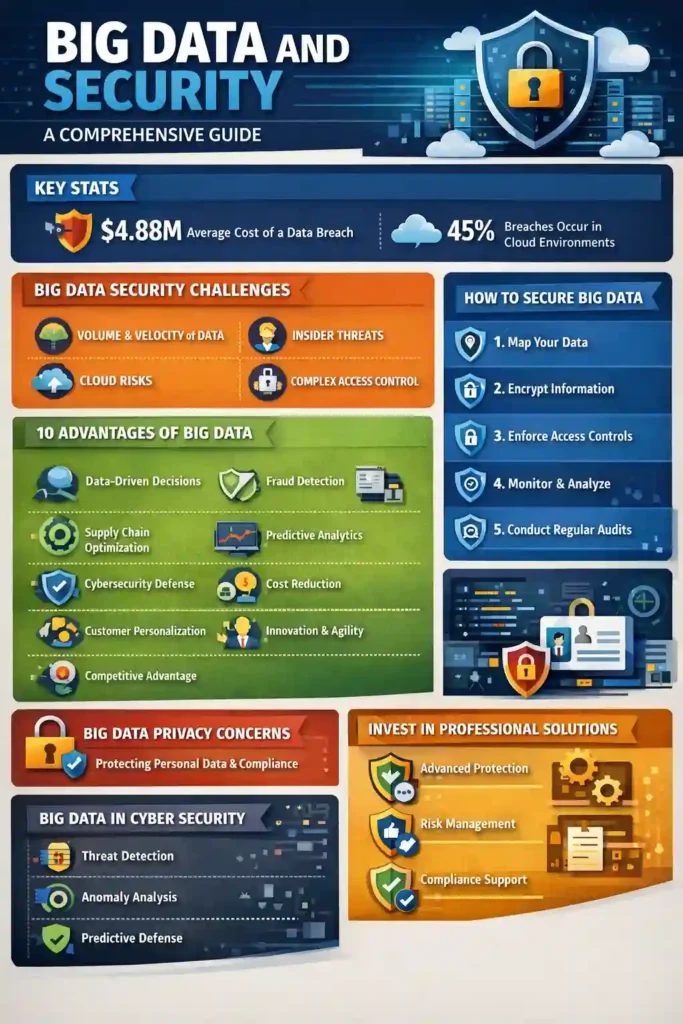
In the context of modern digital business, the year 2022 marked a turning point for security awareness as organizations faced a surge in high-impact breaches and scrutiny over data protection practices. The global average cost of a single data breach in recent years reached $4.88 million, reflecting a 10% increase over 2023 levels.
One major concern arises from the fact that many breaches involve personal data, such as email addresses or phone numbers, which can be used for identity theft or sold on underground markets for profit.
Additionally, cloud computing environments — while enabling scalability and agility — have contributed to making data available across distributed platforms. About 45% of data breaches occur in cloud environments when configurations are not properly secured.
These lessons highlight the importance of proactive defenses as part of any comprehensive big data security plan.
Privacy Security Issues in Big Data Research Papers: What Science Tells Us
Research into privacy and security issues in big data systems shows that merely collecting and storing information isn’t enough — organizations need robust safeguards to protect structured and unstructured data, maintain privacy, and ensure compliance with evolving regulations. In one study, researchers warn that without adequate privacy safeguards, even “de-identified” information can be linked back to individuals — a phenomenon known as the mosaic effect.
Another scholarly review highlights how traditional security mechanisms often fail in big data environments due to the sheer scale and complexity of data collection, processing, and analysis.
In short, academic research reinforces what security professionals already know: privacy and security must be built into big data technologies from the ground up.
The following infographic
Big Data Security Challenges: What Makes Security Hard
When it comes to big data, organizations face specific big data security challenges:
⚠ Volume and Velocity of Data
Big data systems generate massive amounts of information in real time, making it difficult to monitor, secure, and respond to threats.
⚠ Managing Structured and Unstructured Data
Data comes in many formats — from neatly structured spreadsheets to unstructured text and logs — which complicates governance and protection.
⚠ Complex Access Control
As platforms scale, assigning and enforcing permissions across systems becomes more difficult.
⚠ Insider Threats
Many privacy incidents result from employees with legitimate access misusing or mishandling sensitive data.
⚠ Processing Big Data in Real Time
Rapid processing workflows can expose data during movement and integration with analytics tools.
Together, these challenges increase the risk of unauthorized access and make risk management essential for any large-scale data operation.
10 Advantages of Big Data: Why It Matters for Organizations
When safeguarded properly, big data drives significant business value:
- Enhanced data-driven decision making
- Predictive analytics for future trends
- Improved fraud detection using real-time insights
- Better operational efficiency and scalability
- Optimized supply chain performance
- Enhanced customer personalization
- Reduced costs via automation
- Smarter cybersecurity incident response
- Greater innovation through big data technologies
- Competitive advantage over rivals
These benefits help organizations operate more intelligently and react faster to changing conditions.
Disadvantages of Big Data: Understanding the Trade-Offs
While big data provides powerful insights, it also brings several drawbacks:
- Heightened Security Risks – Larger datasets attract more malicious actors.
- Privacy and Compliance Pressures – Laws like (GDPR) and (CCPA) require strict governance of personal data.
- Resource Intensity – Big data initiatives demand investment in tools, hardware, and data scientists.
- Operational Complexity – Coordinating distributed data sources increases management burden.
These disadvantages don’t negate the advantages below, but they do emphasize the need for well-structured security frameworks.
Advantages and Disadvantages of Big Data: A Balanced Perspective
If you boil it down, the advantages and disadvantages of big data reflect a simple truth: although massive datasets unlock incredible insights and efficiency gains, they also make businesses more attractive targets for cybersecurity threats and operational risks. Taking both sides into account enables leaders to build resilient strategies that maximize value while containing risk.
Big Data Privacy Concerns: Protecting Personal Data
One of the most sensitive issues in modern data environments is big data privacy concerns. According to privacy research, breaches and misuse of personal information can erode trust, damage reputations, and invite costly legal action. Strong governance and encryption policies help protect personal data and maintain compliance with regulatory requirements like GDPR and CCPA.
Moreover, real-world breach costs still climb: the average total cost of a security incident across industries has hovered around $4.4 million to $4.9 million globally in recent years.
Big Data in Cyber Security: Analytics as a Defense
Today, big data plays a significant role not just in business but also in defense. Big data in cyber security empowers organizations to:
- Correlate event data across multiple systems
- Detect anomalies early using machine learning
- Predict attack patterns before they escalate
This kind of proactive defense taps into predictive analytics and real-time monitoring to identify threats that traditional tools might miss — turning massive datasets into a powerful advantage.
When we talk about Big Data and Security, we must also understand that proper protection is important during every step of Analysis on Big Data, so the information stays safe while it is being studied and used.
Expert Insight: Integrating Security and Analytics
Leading security experts underscore a critical point:
“Security must be integrated into the design of data systems, not treated as an afterthought.”
This mindset transforms security from a reactive cost into a strategic advantage that enhances trust, enables compliance, and supports smarter decision cycles across the organization.
Step-by-Step Guide to Strengthening the Security Of Big Data
Here’s a practical roadmap any organization can follow:
1. Map Your Data Landscape
Identify all sources of structured and unstructured data and classify them based on sensitivity.
2. Encrypt Data Everywhere
Apply strong encryption for data at rest and in transit to block unauthorized access.
3. Enforce Access Control
Use role-based access and multi-factor authentication to minimize misuse.
4. Monitor with Analytics Tools
Implement tools that flag anomalies and enable real-time threat detection.
5. Audit Regularly
Conduct security audits and testing to identify vulnerabilities before attackers do.
Following these steps builds a multi-layered defense that adapts as your data systems evolve.
Enterprise Big Data Solutions help businesses manage and secure large amounts of data safely, making big data and security stronger, smarter, and easier to handle at scale.
🏁 Final Thoughts: Why Invest in Professional Big Data Security
In a world where data breaches can cost millions and disrupt entire industries, investing in professional big data and security isn’t just smart — it’s essential. High-quality security frameworks help organizations:
- Detect threats before they escalate
- Protect sensitive information
- Support compliance with privacy laws
- Maintain customer confidence
- Optimize analytical workflows with built-in safeguards
Your data is one of your most valuable assets — and protecting it empowers your organization to innovate, grow, and thrive in an increasingly competitive, digital world.
Frequently Asked Questions (FAQ)
1. How does big data affect security?
Big data affects security in both positive and challenging ways. Large datasets — often made up of structured and unstructured data — give organizations deep insights into trends and behavior, but they also make protecting that data harder because the more data you have, the more there is to secure.
Big data systems often store vast amounts of information across many platforms and networks, which increases the number of points where attackers can try to gain access. This means organizations must adopt smarter security strategies that scale with their data, use stronger access controls, and constantly monitor systems for threats. With the right analytics tools and risk management practices, big data can also help security teams spot unusual patterns and threats earlier than traditional methods.
2. How is big data used in cyber security?
Big data plays a major role in strengthening cybersecurity. Instead of simply collecting data, security teams use big data analytics to watch for unusual behavior — like spikes in login attempts or strange network traffic — that may signal a breach or attack. Tools that process large volumes of security event data can aid in real-time threat detection and help teams prioritize responses faster than traditional systems alone.
For example, predictive analytics powered by big data allows security teams to forecast where attacks might happen and respond proactively. In many modern systems, big data also supports automated responses and machine learning models that continuously improve how threats are identified. This makes defenses smarter and more adaptive over time.
3. What are the 4 pillars of data security?
When people talk about the core foundations of data security, they’re often referring to a set of basic principles that guide how information is protected. The most common framework includes:
Confidentiality – Ensures only authorized people can see or use data.
Integrity – Keeps data accurate and unchanged by unauthorized users.
Availability – Makes sure data and systems are accessible when needed.
Accountability / Authenticity – Verifies who accessed data and confirms that it is genuine and not tampered with.
Different professionals sometimes use slightly different terms, but all of them focus on making sure data remains private, correct, available, and traceable throughout its lifecycle.
4. What is the salary of big data vs cybersecurity?
Salaries in both big data and cybersecurity are strong, but they vary based on role, experience, and region.
In many tech hubs, entry-level cybersecurity roles start around $60,000–$80,000 per year, with mid-level professionals earning $90,000–$130,000+ and senior specialists (like Cybersecurity Engineers or CISOs) often earning well over $150,000 annually.
In big data and analytics, roles such as Data Analysts or Data Engineers typically start in the $70,000–$90,000 range, with experienced data scientists and senior analytics professionals commonly earning between $100,000–$150,000+ per year.
Both fields offer high growth potential, and salaries tend to increase significantly with specialized skills, certifications, and experience. Some leadership roles — like Chief Information Security Officer — can command six-figure compensation packages that exceed those of many data roles, especially in large organizations.