
In today’s data-intensive world, companies aren’t just dealing with more data — they’re dealing with large amounts of data from every direction: customer interactions, online activity, sensor feeds, supply chains, and more. What separates leaders from laggards isn’t how much data they collect, but how effectively they turn that information into insight and action.
That’s where big data and analytics solutions come in — frameworks, technologies, and strategies that empower businesses to make informed decisions, improve performance, uncover hidden opportunities, and solve real business problems using analyzed data. This article explains what these solutions are, why they matter, how they work, and how you can adopt them with confidence.
- What Is Big Data Analytics in Simple Words
- Big Data Analytics Examples: Real-World Impact
- Types of Big Data Analytics
- The Strategic Purpose of Big Data Analytics
- Benefits of Big Data Analytics for Business
- Core Components: Data Collection, Integration, and Storage
- Data Analytics Tools: The Technology Behind the Insights
- Who Powers Analytics? Data Analysts and Data Scientists
- Big Data Analyst Salary (U.S. Focused)
- Expert Tips for Implementing Analytics Successfully
- Conclusion: Gain Insights, Drive Growth, and Make Confident Decisions
- FAQ: Your Top Questions About Big Data and Analytics Solutions
What Is Big Data Analytics in Simple Words
Big data analytics refers to the advanced process of examining massive and diverse data sets to uncover meaningful patterns and insights that help businesses make data driven decision. Unlike traditional analytics that work with small, tidy data sets, big data analytics handles vast, complex information from many sources.
Imagine having millions of puzzle pieces from different boxes — big data analytics not only helps you piece them together efficiently, but also reveals patterns that would otherwise be invisible.
According to IBM, this process uses techniques including predictive modeling, statistical analysis, and machine learning to extract real-world insights and forecast future trends from raw information.
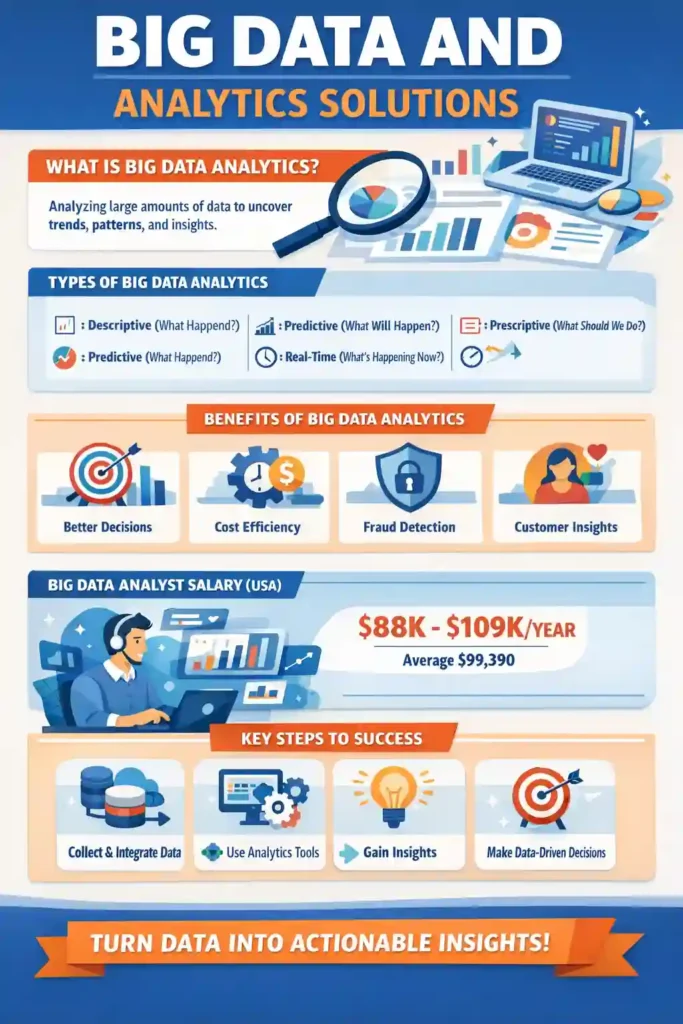
In the following infographic:
Big Data Analytics Examples: Real-World Impact
Seeing analytics in action makes the concept real. Here are big data analytics examples from different industries:
- Retail Personalization: E-commerce platforms use customer behavior data to recommend products and tailor offers that increase conversions and loyalty.
- Fraud Detection: Banks analyze transactions in real time to detect anomalies and flag suspicious patterns before losses occur.
- Predictive Maintenance: Manufacturers analyze equipment sensor data to forecast failures and minimize downtime.
- Supply Chain Optimization: Logistics firms integrate shipment, demand, and weather data to improve routing and reduce delays.
- Healthcare Insights: Hospitals use analytics to track patient outcomes and improve treatment plans.
These examples show how businesses reduce costs, streamline operations, and use data integration to solve pressing challenges and create new opportunities.
Types of Big Data Analytics
Understanding the different types of analytics helps organizations apply the right approach for each challenge. Big data analytics generally includes:
- Descriptive Analytics – Answers what happened by summarizing past data.
- Diagnostic Analytics – Explores why it happened by identifying causal patterns.
- Predictive Analytics – Predicts what will happen using historical trends and predictive modeling.
- Prescriptive Analytics – Recommends what should be done by optimizing decisions.
- Real-Time Analytics – Processes data as it arrives, essential for rapid risk management and fraud detection.
Together, these analytics types form a roadmap from insight to action — helping organizations stay agile and competitive.
The Strategic Purpose of Big Data Analytics
The ultimate goal of adopting big data and analytics is to convert large volumes of data into a strategic advantage. This means using data collection, data integration, and advanced analytics to:
- Increase operational efficiency
- Improve customer experience
- Predict future trends and demands
- Strengthen competitive positioning
- Enhance risk management and compliance
High-performing companies use analytics not just to answer questions, but to anticipate change and innovate proactively.
Benefits of Big Data Analytics for Business
Investing in analytics delivers measurable results across the enterprise:
✔ Better Business Decisions
Analytics enables leaders to make decisions based on evidence, not intuition. Dashboards and reports from analytics tools provide clarity and confidence.
✔ Enhanced Operational Efficiency
By identifying inefficiencies and optimizing processes, analytics drives reduced costs and higher performance.
✔ Improved Customer Experiences
Understanding customer behavior enables personalization that increases engagement and loyalty.
✔ Stronger Risk Detection
Modern analytics systems detect anomalies and irregular patterns, minimizing financial losses and improving fraud prevention.
✔ Data-Driven Innovation
Organizations can uncover new business models, improve products, and explore market opportunities using insights from their data.
Analytics transforms data from a passive record into a strategic asset.
Core Components: Data Collection, Integration, and Storage
To generate insights, companies rely on strong data foundations:
- Data Collection: Gathering raw data from various sources — customer touchpoints, sensors, applications, and external feeds.
- Data Integration: Unifying disparate data into a cohesive format so analytics engines can process and analyze it.
- Data Warehouse: Centralized storage systems that organize structured and unstructured data for analysis and reporting.
Together, these building blocks support scalable analytics and ensure that insights are accurate and actionable.
Data Analytics Tools: The Technology Behind the Insights
Analytics requires specialized platforms capable of handling analyzed data, massive scale, and complex processing. Tools and frameworks commonly used include:
- Apache Hadoop – Distributed storage and processing of big data.
- Apache Spark – Fast analytics and machine learning operations on large datasets.
- Cloud Data Platforms – Scalable infrastructure that supports flexible analytics workloads.
- Visualization tools – Dashboards and reports that make insights accessible to business users.
Choosing the right tools ensures performance, scalability, and a smoother path to deriving actionable insights.
Who Powers Analytics? Data Analysts and Data Scientists
A successful analytics initiative depends on skilled professionals who know how to interpret data:
- Data Analysts – Specialists who clean, transform, visualize, and interpret metrics.
- Data Scientists – Experts who build predictive models, apply machine learning, and uncover deeper patterns.
- Big Data Analysts – Professionals focused on handling complex, large-scale data sets and extracting strategic insights.
These roles are central to helping organizations leverage data effectively.
Big Data Analyst Salary (U.S. Focused)
For those considering a career in analytics, the compensation reflects the field’s strategic value. According to recent data:
- The average Big Data Analyst salary in the United States is approximately $99,390 per year.
- Typical annual pay ranges from about $88,875 to $109,402, depending on experience and location.
Salaries tend to be higher in major tech hubs like California and the District of Columbia. Professionals with advanced skills in analytics tools and predictive modeling often command top-tier pay, reflecting the high demand for talent.
Expert Tips for Implementing Analytics Successfully
To ensure analytics initiatives deliver value:
✔ Start with clear objectives: Define business outcomes before selecting tools.
✔ Build a strong data foundation: High-quality data and integration support reliable insights.
✔ Use the right mix of analytics tools: Balance processing power with business needs.
✔ Promote data literacy: Encourage teams to ask the right questions and trust insights.
These best practices support adoption and help unlock continuous improvements.
Solutions Big Data and Analytics work best when supported by reliable Big Data and Analytics Services that help businesses collect, manage, and analyze data smoothly from start to finish.
Conclusion: Gain Insights, Drive Growth, and Make Confident Decisions
In a world where data grows exponentially, organizations must move beyond simply storing information to extracting meaning from it. With the right big data and analytics solutions, businesses gain powerful capabilities to analyze patterns, forecast trends, improve processes, and make faster, more accurate business decisions.
Whether you’re optimizing operations, enhancing customer experiences, or preparing for future opportunities, mastering analytics positions your organization for long-term success.
Embrace analytics with clarity, and let data guide your strategic journey.
FAQ: Your Top Questions About Big Data and Analytics Solutions
Here are four of the most commonly asked questions about solutions of big data and analytics, answered in clear, easy-to-understand language. These answers are designed to help people who are new to this topic, as well as those looking to make better decisions in business or career paths.
1. What exactly is big data analytics, and why does it matter?
Big data analytics is the process of using advanced tools and methods to examine large amounts of data from many different sources to find patterns, trends, and insights. These insights help businesses make faster and better data driven decisions that improve performance, reduce costs, and create a competitive advantage. Think of it as turning a huge pile of data into meaningful answers that you can act on — rather than just storing information without understanding it.
In simple terms, big data analytics lets companies discover things about their customers and operations that they couldn’t see before because the data was too big or too complex for regular tools to handle. It’s why companies use analytics to personalize customer experiences, improve supply chains, or even detect fraud early.
2. How does big data analytics help businesses make better decisions?
When a business uses solutions of big data and analytics, it’s able to move beyond guesswork and make informed decisions based on evidence. By analyzing historical and real-time data, analytics uncovers patterns that show what is happening now and what might happen next. For example:
Retailers might analyze purchase history and web behavior to decide what products to stock.
Healthcare systems use analytics to track patient patterns and improve treatments.
Logistics teams optimize routes using weather and traffic data.
Instead of acting on instinct, leaders use data to understand why things happen and what to do next. These insights can improve performance, reduce avoidable errors, and help companies respond quickly when situations change.
3. What are the biggest challenges people face with big data, and how do companies solve them?
Handling big data isn’t easy — especially at scale. Some of the common challenges include:
Volume and speed: Data is generated continuously and rapidly from many places like sensors, online systems, or mobile apps.
Complexity: Data comes in many formats — from clean tables to messy text, social media posts, or images.
Integration: Companies often struggle to combine data from different systems into one place where it can be analyzed.
Data quality: Bad or incomplete data leads to misleading insights if it isn’t cleaned and managed properly.
To address these challenges, businesses use specialized architectures like distributed frameworks and scalable storage, and they follow strong data governance and cleaning practices. They also choose appropriate data analytics tools (like Hadoop, Spark, or cloud platforms) that can process data quickly and support advanced models for analysis.
4. How does big data analytics influence careers, and what skills do employers look for?
For big data and analytics individuals, solutions aren’t just powerful for business — they’re also the foundation of many high-growth careers in tech and business. Roles such as data analysts, big data analysts, and data scientists focus on transforming raw data into actionable recommendations that help companies improve performance and strategy.
In the United States, the Big Data Analyst salary reflects the demand for these skills, with competitive pay as professionals gain experience and expand their technical capabilities. Employers typically look for skills in data analytics tools, SQL, Python, or R, the ability to interpret analytics results, and an understanding of machine learning or predictive modeling techniques.
Strong communication skills are also essential because interpreting analytics for decision-makers is just as important as performing the analysis itself. In short, big data analytics not only shapes business outcomes — it opens doors to rewarding careers with real world impact.