
When people talk about artificial intelligence or machine learning, they love to focus on shiny things—deep learning, neural networks, or the latest AI breakthroughs. But behind every great model is something far less glamorous yet far more important: data preparation for machine learning.
Think of it like cooking. Even if you have world-class recipes, using ingredients that aren’t washed, chopped, or measured correctly will ruin the meal. Machine learning works the same way. If your data isn’t clean, organized, and ready, no algorithm—no matter how powerful—can save the final result.
In this article, you’ll learn exactly how to prepare your data the right way, with real examples, expert insights, and actionable steps you can apply immediately. You’ll also find essential tools, recommended learning paths, and resources to help you buy or choose the right solutions with confidence.
- Why Data Preparation for Machine Learning Matters
- 1. Data Preparation for Machine Learning PDF — A Quick-Starter Resource
- 2. Understanding the Data Preparation Lifecycle
- 3. Data Preparation for Machine Learning Python — The Most Popular Approach
- 4. Data Preparation for Machine Learning Book — Top Recommended Reads
- 5. A Real Data Preparation for ML Example
- 6. Data Preparation for Machine Learning Databricks — Enterprise-Level Solution
- 7. Data Preparation for Machine Learning GitHub — Real Code Examples
- 8. Data Preparation for ML Algorithm — What to Use & When
- 9. Data Preparation for ML Course — Learning the Right Way
- Step-by-Step Guide: How to Prepare Data for Machine Learning
- Final Thoughts — And Why You Should Feel Confident Moving Forward
- FAQ:
Why Data Preparation for Machine Learning Matters
“80% of a data scientist’s time is spent cleaning and preparing data.” — DJ Patil, former U.S. Chief Data Scientist
This quote gets repeated often because it’s true.
Machine learning models don’t magically understand:
- messy spreadsheets
- missing values
- inconsistent labels
- duplicate records
- text mixed with numbers
- irrelevant noise
Without proper preparation, you’re simply feeding poor-quality data into the system. And as the classic saying goes:
Garbage in, garbage out.
That’s why it is not just a step. It is the foundation.
1. Data Preparation for Machine Learning PDF — A Quick-Starter Resource
Before we go deep, here’s a helpful, Its PDF that many professionals use to get an overview of concepts.
You can download similar guides to reference the steps, flowcharts, and examples whenever needed.
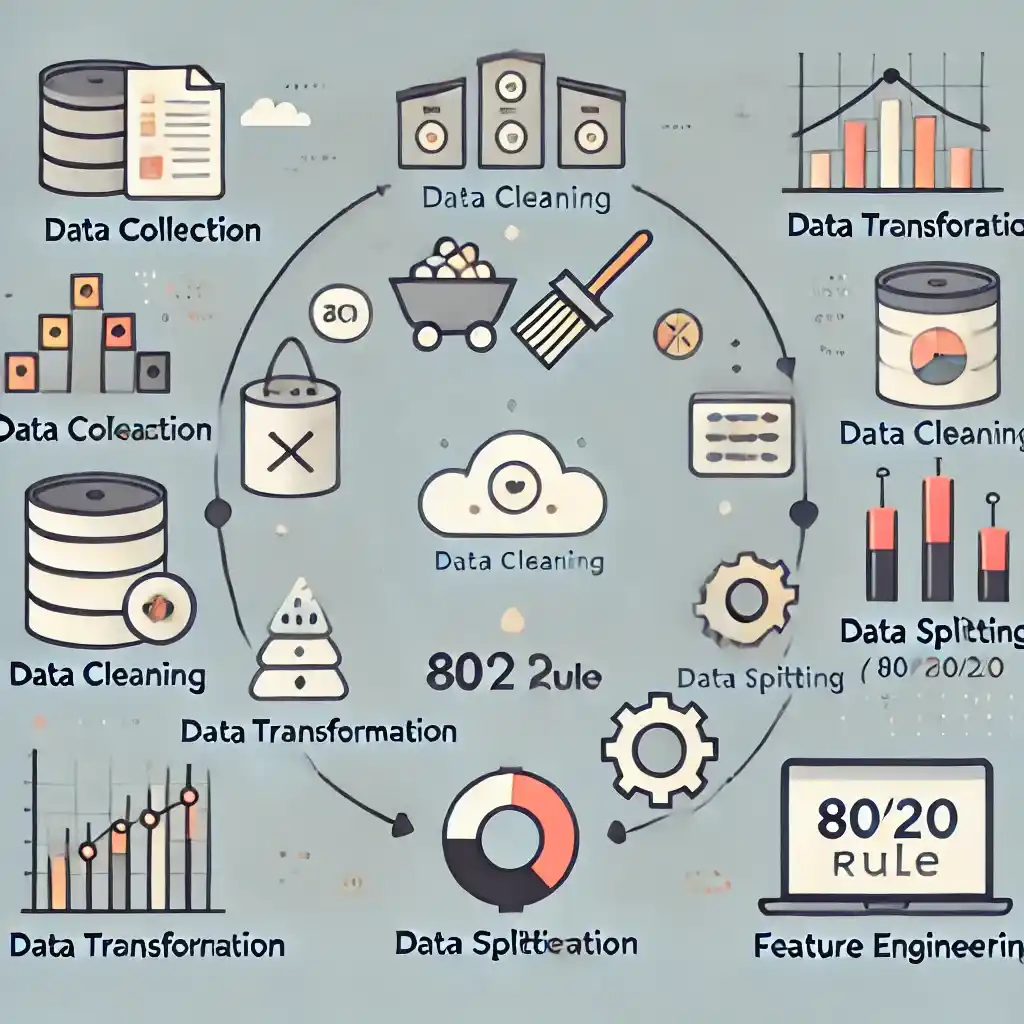
2. Understanding the Data Preparation Lifecycle
To simplify things, let’s break the full process into clear, digestible stages:
- Data Collection
- Data Cleaning
- Data Transformation
- Feature Engineering
- Data Splitting
- Validation & Testing Preparation
Each step ensures your model has the best foundation to learn and perform.
3. Data Preparation for Machine Learning Python — The Most Popular Approach
Most professionals use Python because of its rich ecosystem:
- Pandas for data cleaning
- NumPy for numerical transformations
- Scikit-learn for preprocessing and algorithms
- Matplotlib for visualization
If you analyze data regularly, using Python for data preparation dramatically reduces time, effort, and errors.
Example Python Workflow
import pandas as pd
from sklearn.preprocessing import StandardScaler
df = pd.read_csv(“data.csv”)
df.fillna(df.mean(), inplace=True)
scaler = StandardScaler()
df_scaled = scaler.fit_transform(df)
This small snippet shows how quickly Python handles tasks that would take hours manually.
4. Data Preparation for Machine Learning Book — Top Recommended Reads
To get more in-depth knowledge, the Data Preparation for ML book by Jason Brownlee is considered one of the best resources in the field.
It covers techniques such as:
- Data cleaning strategies
- Outlier detection
- Transformation methods
- Feature selection
- Real datasets and examples
If you’re serious about mastering the topic, it’s a valuable long-term investment.
5. A Real Data Preparation for ML Example
Imagine you’re working for a retail company analyzing customer behavior. You receive a dataset that looks like this:
- Missing ages
- Mis-typed gender labels (M, Male, male, MALE)
- Transaction amounts stored as text strings
- Outliers like negative values
- Duplicate entries
- Non-English characters
- Unstructured notes in the comments column
In one real project, a data scientist shared how a model kept predicting customer lifetime value inaccurately. The issue wasn’t the algorithm—it was a tiny column storing dates in mixed formats like:
2025/01/12
12-01-2025
January 12, 2025
Only after standardizing this did the predictions improve dramatically.
This is a perfect reminder of why it is not optional.
6. Data Preparation for Machine Learning Databricks — Enterprise-Level Solution
If you’re working with large datasets, Databricks is one of the best platforms for automated data preparation and scalable pipelines.
Features include:
- Collaborative notebooks
- Auto-scaling clusters
- Built-in ETL optimization
- MLflow integration
- Delta Lake for versioned data
Companies choose Databricks because it cuts preprocessing time while improving reliability.
5 PILLARS OF HIGH-QUALITY DATA
┌─────────────────────────┐
│ 1. Accuracy │
│ No typos, errors, or │
│ wrong values. │
└─────────────────────────┘
┌─────────────────────────┐
│ 2. Completeness │
│ No missing critical │
│ information. │
└─────────────────────────┘
┌─────────────────────────┐
│ 3. Consistency │
│ Same formats, labels, │
│ and units everywhere. │
└─────────────────────────┘
┌─────────────────────────┐
│ 4. Timeliness │
│ Data that’s up-to-date. │
└─────────────────────────┘
┌─────────────────────────┐
│ 5. Relevance │
│ Only what helps the │
│ model learn. │
└─────────────────────────┘
7. Data Preparation for Machine Learning GitHub — Real Code Examples
Developers often look for real examples on GitHub to speed up implementation.
Search repositories such as:
- “machine learning preprocessing”
- “data cleaning templates”
- “sklearn preprocessing workflows”
These offer reusable code snippets, Jupyter notebooks, and production-ready examples.
8. Data Preparation for ML Algorithm — What to Use & When
Some of the most common algorithms used during preparation include:
- StandardScaler (normalize numerical values)
- LabelEncoder (convert text to numbers)
- OneHotEncoder (categorical encoding)
- SMOTE (fix imbalanced classes)
- PCA (dimension reduction)
Choosing the right algorithm ensures your data becomes smarter, not just cleaner.
9. Data Preparation for ML Course — Learning the Right Way
If you’re interested in mastering this topic quickly, consider enrolling in a data preparation for ML course.
These courses teach you:
- Core preprocessing steps
- Handling noisy data
- Real project workflows
- Hands-on exercises with Python
- Industry best practices
It’s perfect for beginners and professionals who want structured learning.
Step-by-Step Guide: How to Prepare Data for Machine Learning
Step 1: Understand the data
Study the structure, distributions, and patterns using exploratory data analysis.
Step 2: Handle missing values
Use strategies such as mean imputation, median replacement, or predictive models.
Step 3: Remove duplicates
Keep your dataset clean and consistent.
Step 4: Fix data types
Ensure numbers, text, and dates are correctly formatted.
Step 5: Deal with outliers
Use visualization tools to spot unusual values.
Step 6: Encode categorical variables
Convert categories into numbers models can understand.
Step 7: Scale numerical features
Standardization or normalization is often necessary.
Step 8: Perform feature engineering
Create meaningful new features.
Step 9: Split your data
Create training, validation, and test sets.
Just like Python makes building machine learning models easier, properly preparing your data ensures those models can learn and perform accurately
Final Thoughts — And Why You Should Feel Confident Moving Forward
Great machine learning performance always begins with great preparation. Whether you’re using Python, Databricks, GitHub samples, or learning through a dedicated course, your investment in proper data preparation for machine learning ensures you get reliable, trustworthy, and meaningful results.
By following the steps in this guide, you’re not just cleaning data—you’re securing the accuracy, strength, and scalability of your entire AI project. This empowers you to invest in the right tools, platforms, or books with complete confidence.
FAQ:
1. What is data preparation for machine learning, and why is it important?
It is the process of cleaning, organizing, and transforming raw data so that it can be used effectively by machine learning models. Raw data often contains missing values, errors, duplicates, or inconsistent formats. If we feed this messy data into a model, the results can be inaccurate or misleading. Proper data preparation ensures your data is reliable, consistent, and structured, which allows your models to learn patterns more accurately. Think of it as preparing ingredients before cooking—good prep leads to better results.
2. How do I handle missing data in machine learning?
Missing data is common in real-world datasets. There are a few ways to handle it:
Remove rows or columns that have too many missing values (if it won’t affect your analysis).
Impute missing values using statistical methods, like filling with the mean, median, or mode.
Predict missing values using other features in the dataset (regression or machine learning-based imputation).
The choice depends on how much data is missing and how important the feature is. Proper handling prevents your model from making wrong predictions due to incomplete information.
3. What are the best tools for data preparation in machine learning?
There are many tools, depending on your needs and dataset size:
Python libraries: Pandas, NumPy, and Scikit-learn are widely used for cleaning, transforming, and preparing data.
Databricks: Great for large-scale or enterprise-level datasets.
Excel: Simple and quick for small datasets.
Data preparation platforms: Trifacta, KNIME, and RapidMiner offer visual interfaces and automation features.
Choosing the right tool depends on your dataset, project size, and your comfort level with coding.
4. Can data preparation improve the performance of my machine learning model?
Absolutely! The quality of your model heavily depends on the quality of your data. Proper data preparation improves model performance by:
Removing errors and inconsistencies that could confuse the model.
Scaling and normalizing data so all features are treated fairly.
Encoding categorical variables so the model can understand them.
Handling outliers and imbalances to reduce bias.
In short, well-prepared data helps your model make more accurate predictions, generalize better to new data, and reduce errors. As they say in data science: “A model is only as good as the data it learns from.”