
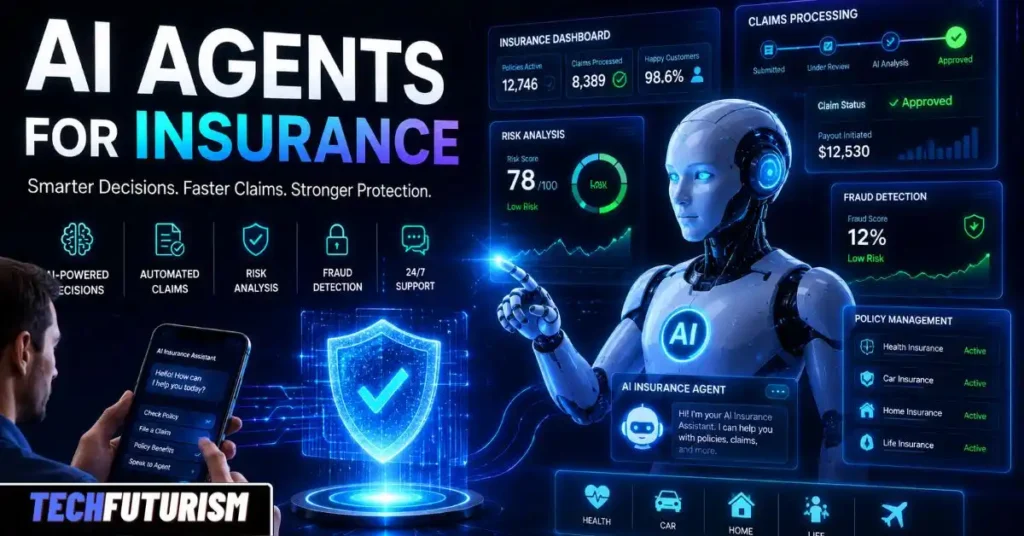
Published: May 2025 | Category: Insurance Technology, AI & Automation | Reading time: ~12 min
How AI agents for insurance are transforming claims, underwriting, sales, and customer service — and why your business cannot afford to wait.
- What are AI agents for insurance?
- Top AI agents in insurance
- Best AI agents insurance: how to evaluate them
- How to use AI in insurance sales
- AI assistant for insurance agents: daily use cases
- Roots AI insurance and the rise of vertical AI
- AI insurance leads: generating and converting smarter
- AI in insurance underwriting: precision at scale
- Will AI replace insurance agents?
- Step-by-step: how to implement AI agents insurance in your business
- Final verdict: Are AI agents for insurance worth it?
- Frequently asked questions
Key statistics at a glance
| Metric | Figure |
| Global AI-in-insurance market size (2023) | $4.5 billion |
| Reduction in claims processing time | Up to 40% |
| Faster underwriting decisions | 3× improvement |
| Average drop in fraud-related losses | ~25% |
| Embedded insurance market projected by 2030 | $722 billion |
What are AI agents for insurance?
Imagine it is 11 p.m. A tree has just crashed through your roof during a storm. You are soaking wet, stressed, and unsure what to do next. You open your insurer’s app and, within seconds, a smart digital agent walks you through filing a claim, checks your policy, schedules an inspector, and books a contractor — all without a single human on the other end. That is not science fiction. That is insurance AI agents in action, today.
At their core, they are software programs that observe, decide, and act — without requiring human intervention at every step. They combine machine learning, natural language processing (NLP), and robotic process automation (RPA) to handle tasks that once required large teams of claims adjusters, underwriters, and customer service representatives.
Every AI agent runs on the same four-step loop. First, it perceives — collecting data from policy documents, telematics devices, customer messages, damage photographs, and public records. Next, it reasons — using machine learning models and business rules to analyse patterns, risks, and the best available action. Then it acts — approving a claim, flagging potential fraud, generating a personalised quote, or routing a complex case to a human specialist. Finally, it learns — refining its internal model after every interaction so that each claim, conversation, and data point makes it measurably smarter.
Crucially, this shift is not just about reducing costs. It is about delivering a faster, fairer, and more personalised experience that traditional insurance operations simply cannot provide at scale.
Top AI agents in insurance
The market for AI agent insurance has matured rapidly. Several platforms now stand out for their depth of insurance-specific functionality, regulatory compliance coverage, and measurable return on investment. Here are the top solutions that industry analysts and carriers consistently recommend.
Lemonade AI (Jim) — Claims and customer experience. Processes claims end-to-end in seconds using computer vision and behavioural AI. Handles first notice of loss (FNOL), fraud checks, and instant payouts without human involvement.
Guidewire PolicyCenter AI — Underwriting automation. Integrates predictive risk scoring and automated rule engines directly into carrier policy administration workflows, reducing manual referrals and improving consistency.
Salesforce Einstein for Insurance — Sales and leads. Powers lead scoring, next-best-action recommendations, and automated follow-up sequences for insurance sales teams, improving producer efficiency across the full sales funnel.
Duck Creek OnDemand AI — Agent assistance. Delivers real-time policy suggestions, renewal alerts, and compliance guidance directly inside the agent’s existing workflow — reducing administrative time without disrupting familiar tools.
Shift Technology — Fraud detection. Uses AI to detect fraud and subrogation opportunities across claims portfolios at carrier scale, consistently catching patterns that human investigators miss.
IBM watsonx Assistant — Conversational AI. Deploys multilingual virtual service agents for policyholder enquiries, claims intake, and document collection, with deep integration into enterprise data environments.
Each platform excels in a specific domain. The right choice depends on your carrier’s size, existing technology stack, and the workflow you prioritise first — a decision the evaluation framework in the next section will help you make confidently.
Best AI agents insurance: how to evaluate them
Not every solution marketed as an AI agent delivers equal results in an insurance context. When assessing the best insurance, AI agents apply five non-negotiable criteria before signing any contract.
1. Insurance-domain training. General-purpose AI models lack the contextual depth to interpret policy language, regulatory nuance, or claims terminology with precision. Prioritise vendors whose models are trained on insurance-specific datasets — policy documents, actuarial tables, claims histories, and adjuster notes.
2. Regulatory compliance coverage. Confirm that the platform addresses NAIC model bulletins, applicable state-level requirements, GDPR for any European operations, and CCPA in California — out of the box, not as expensive add-ons priced separately.
3. Integration depth. The best tools connect natively to your existing policy administration system (PAS), CRM, and claims platform via documented, stable APIs — not fragile custom connectors that create maintenance risk.
4. Explainability and auditability. Regulators increasingly require that AI-driven decisions be explainable. Platforms that produce auditable decision logs protect your organisation from enforcement risk and build internal trust in the technology.
5. Measurable ROI benchmarks. Ask every vendor for live case studies — not slide-deck projections — showing claim cycle time reduction, cost per policy, and customer satisfaction score (CSAT) deltas from comparable deployments at carriers of similar size and line-of-business mix.
Applying these five criteria consistently narrows a crowded field quickly and protects against expensive platform migrations 18 months into deployment.
How to use AI in insurance sales
Sales is where many carriers first experience the commercial impact of insurance for AI agents— because the results appear fast, and they are easy to measure. The technology does not replace the human relationship at the centre of insurance sales. Instead, it removes every friction point that stands between an agent and a closed policy.
AI in insurance sales works across four distinct stages of the funnel. At the top, AI tools identify and score prospects using intent signals, alternative data sources, and behavioural analytics — surfacing the leads most likely to convert before a human producer spends a minute of time on outreach. In the middle of the funnel, AI generates personalised product recommendations based on the prospect’s risk profile, life stage, and existing coverage gaps, making every conversation more relevant from the very first contact.
At the point of sale, conversational AI agents handle routine objections, answer coverage questions instantly, and guide prospects through the application process — reducing drop-off at every step. After the sale, AI monitors policyholder behaviour and signals the optimal moments for cross-sell and upsell opportunities, ensuring the book of business grows without proportional headcount growth.
One regional P&C carrier integrated an AI sales assistant into its outbound workflow in Q1 2024. Within 90 days, its close rate on warm leads improved by 34 percent, and average quote-to-bind time fell from four days to six hours. — InsurTech Insights, 2024 Sales Transformation Report
The transition to AI-assisted sales does not happen overnight. However, carriers that invest in pilot programmes and train their producers to work alongside AI tools consistently outperform peers that rely on traditional prospecting methods alone.
AI assistant for insurance agents: daily use cases
An AI assistant for insurance agents is not a replacement for the agent — it is the agent’s most valuable colleague. Think of it as a tireless, always-available support resource that handles every administrative and research task, freeing the human professional to focus entirely on client relationships and complex judgment calls.
In a typical working day, an AI assistant for insurance agents handles the following tasks without any manual input from the producer: pulling a client’s full policy history and claims record before a renewal call; drafting a personalised renewal summary in the client’s preferred language; flagging coverage gaps in an existing portfolio and recommending appropriate riders; summarising incoming claims documents and routing them to the correct adjuster queue; and generating compliant, pre-filled application forms based on a prospect’s intake responses — all before the agent has finished their morning coffee.
Platforms such as Salesforce for Insurance, Microsoft Cloud for Financial Services, and emerging InsurTech tools like Agentero now embed these capabilities directly into the agent’s existing system of record — meaning adoption is measured in days, not months, and the learning curve is minimal.
Moreover, the impact on producer satisfaction is measurable. Agents who use AI assistants consistently report spending more time on revenue-generating activity and less time on documentation and data retrieval — a shift that improves both retention and performance across the agency.
Roots AI insurance and the rise of vertical AI
Roots AI represents a broader and strategically important trend reshaping the insurance technology landscape: the rise of vertical AI — purpose-built systems designed exclusively for a single industry, rather than adapted from general-purpose models and fine-tuned after the fact. Understanding this distinction is essential for any carrier evaluating an AI investment today.
Unlike horizontal platforms that apply generic AI to insurance workflows, vertical AI agents are trained from the ground up on insurance-specific datasets: policy documents, claims histories, regulatory filings, actuarial tables, adjuster notes, and court decisions. The practical difference in performance is significant. A vertical AI agent understands that a “total loss” in auto insurance means something categorically different from the same phrase in a commercial property context. It knows the regulatory distinction between admitted and non-admitted carriers. It reads an ACORD form as fluently as an experienced underwriter and interprets a pathology report with the precision of a life insurance medical reviewer.
This depth of domain knowledge produces materially better outcomes across every application: fewer false positives in fraud detection, more accurate risk scoring in underwriting, faster claims resolution, and more compliant policy documentation. Compared to general-purpose models fine-tuned on limited insurance data, vertical AI agents produce results that are consistently more accurate, more explainable, and more defensible to regulators.
As the vertical AI movement grows, carriers that partner with domain-specialist vendors build a compounding data advantage over those relying on horizontal tools. Every claim processed, every policy written, and every customer interaction handled by a vertical AI agent adds to a proprietary training dataset that makes the model progressively more accurate. The decision you make today about which platform to adopt determines the quality of the data you accumulate — and that data, over time, becomes your competitive moat.
AI insurance leads: generating and converting smarter
AI insurance leads are not simply digital leads delivered faster. They are algorithmically scored, contextually enriched prospects that your producers work at precisely the moment those prospects are most likely to buy. The difference in conversion rates between a conventional purchased lead list and an AI-qualified lead pipeline is substantial — consistently exceeding 30 to 40 percent in controlled comparisons.
Here is how AI-led generation for insurance works in practice. First, AI models ingest diverse intent signals: web search behaviour, social media activity, life-event triggers such as home purchases, vehicle registrations, or new business filings, and third-party data from credit bureaux and public records. Next, the AI scores each prospect against your agency’s or carrier’s historical close data, identifying the profile characteristics — geographic location, coverage history, household composition, risk appetite — that correlate most strongly with conversion in your specific book of business.
The system then prioritises your outreach queue in real time, ensuring producers call the highest-propensity prospects first and at the statistically optimal time of day for that prospect’s profile. Following up too late is one of the most common and most expensive failure modes in insurance sales — AI eliminates it by triggering automated outreach at the exact moment a prospect’s intent signal peaks.
Platforms such as EverQuote, MediaAlpha, and Bold Penguin have built substantial businesses around this AI-powered lead intelligence model. Independent agencies now access equivalent capabilities through modern agency management systems and CRM integrations — making AI lead optimisation available well below enterprise price points.
AI in insurance underwriting: precision at scale
AI in insurance underwriting is arguably the highest-value application in the entire insurance technology stack — because underwriting accuracy is the foundation on which every carrier’s profitability is built. Poor underwriting decisions do not surface immediately. They compound quietly inside a loss ratio until they become a crisis. AI changes the risk equation fundamentally and permanently.
Traditional underwriting relies on a structured set of variables: credit score, prior claims history, property age, and demographic data. AI-driven underwriting analyses all of those variables — plus hundreds of additional signals that human underwriters cannot efficiently process at volume. Satellite imagery assesses roof condition, flood proximity, and vegetation density around a property. Telematics data evaluates actual driving behaviour rather than demographic proxies. Social and commercial signals assess small business health for commercial lines accounts. Climate risk modelling stress-tests property portfolios against forward-looking weather scenarios rather than historical averages alone.
The result is a risk model with demonstrably superior predictive accuracy. Deloitte research shows that AI underwriting models reduce combined ratios by an average of three to five points — a transformational improvement in an industry where a single point of combined ratio represents tens of millions of dollars at carrier scale. Furthermore, AI underwriting processes applications in seconds rather than days, dramatically improving the customer experience at the point of sale without sacrificing risk discipline.
After deploying an AI underwriting engine across its commercial property book in 2023, one top-20 U.S. carrier reduced manual referrals by 62 percent. It improved new business loss ratios by 4.3 points within the first policy year. — Property Casualty 360, Underwriting Innovation Awards, 2024
Beyond pure accuracy, AI in insurance underwriting also improves consistency. Human underwriters, however skilled, make different decisions on different days depending on workload, fatigue, and subjective interpretation of ambiguous information. An AI model applies the same logic to every submission, every time — eliminating the variance that quietly erodes portfolio performance.
Will AI replace insurance agents?
This is the question that generates more anxiety than any other in the industry — and the evidence-based answer is clear: no. AI will not replace insurance agents. It will, however, decisively replace agents who refuse to use AI.
The distinction matters enormously. Insurance involves trust, empathy, and complex judgment in high-stakes personal situations — qualities that no AI system currently replicates in moments that matter most. When a family loses their home to a fire, they do not want a chatbot. They want a knowledgeable, compassionate professional who understands their policy, advocates for their interests, and guides them through the most stressful experience of the year. That professional relationship is not replicable by software, and it remains the irreducible core of the insurance agent’s value.
What AI does replace is the administrative burden that currently consumes 40 to 60 percent of a typical agent’s productive working day: data entry, document retrieval, routine follow-up, compliance checking, premium calculation, and form generation. When those tasks migrate to AI, agents recover hours every day to do what humans do best — build relationships, earn trust, handle complexity, and close cases that require genuine expertise.
Frequently asked questions on this topic:
What tasks are AI agents already handling without human involvement? First notice of loss (FNOL) intake, routine claims triage, policy renewal outreach, certificate of insurance generation, premium payment processing, and customer FAQ resolution are all being handled autonomously at carriers today.
What will always require a human insurance agent? Complex commercial underwriting, high-value personal lines consulting, disputed claims negotiations, regulatory proceedings, crisis support for catastrophic losses, and strategic account relationship management all require human expertise, empathy, and accountability that AI cannot replicate.
The Bureau of Labor Statistics projects that insurance sales agent employment will remain stable through 2032, even as AI adoption accelerates across the industry. What the data shows is not displacement but evolution: agents who use AI tools for insurance consistently outperform those who do not — and that performance gap is widening every year.
Step-by-step: how to implement AI agents insurance in your business
Understanding the technology is one thing. Deploying it successfully across a real insurance operation requires a structured approach that accounts for data readiness, regulatory exposure, and organisational change. The following seven-step roadmap applies whether you run a national carrier or an independent agency.
Step 1: Audit your current workflows. Before evaluating any technology, map your highest-volume, most repetitive processes — claims intake, quote generation, policy renewal outreach, and customer FAQ handling are the most common starting points. These are your prime automation candidates because the AI has the most structured data to work with, and the ROI case is easiest to measure.
Step 2: Select the right platform. Apply the five-criteria evaluation framework from the section above. Cross-reference vendor claims with peer references from carriers of comparable size and line-of-business mix. Avoid platforms that cannot demonstrate live insurance-specific deployments with auditable outcome data.
Step 3: Consolidate and clean your data. AI agents perform only as well as the data they train on. Before any model goes into production, centralise your policy, claims, and customer records in a unified data lake or warehouse with clean, consistent, real-time access. This step takes longer than most organisations expect — budget accordingly.
Step 4: Run a controlled pilot. Resist the impulse to automate everything simultaneously. Select one high-volume workflow — FNOL intake is the most common choice — and run a 90-day pilot with defined success metrics: processing time, accuracy rate, escalation frequency, and CSAT score. The pilot data becomes your internal business case for full deployment.
Step 5: Train your team alongside the AI. Sustainable AI implementation depends on genuine human-machine collaboration. Equip claims adjusters, underwriters, and service agents to work confidently with AI tools from day one. Position automation explicitly as the system that removes tedium so that people can focus on complex, high-empathy, high-value work — and communicate that message consistently from senior leadership.
Step 6: Define KPIs and measure consistently. Establish clear, pre-agreed performance indicators: claim cycle time, customer satisfaction score (CSAT), fraud detection rate, cost per policy, and producer time recovered. Review results monthly and let the data — not vendor presentations — direct each subsequent expansion phase.
Step 7: Scale with confidence. Once your pilot validates the model, expand to adjacent workflows in order of volume and impact. The marginal cost of scaling a proven AI agent is near zero. The same system that handles 1,000 claims processes 100,000 with no additional headcount — and it keeps getting better with every additional data point.
Just like AI-powered SEO agents help websites grow by doing tasks faster and with fewer mistakes, AI agents for insurance help companies save time, reduce errors, and serve customers better.
Final verdict: Are AI agents for insurance worth it?
The answer is an unqualified yes — and the window for competitive advantage is narrowing.
They are not a technology to plan for. They are a measurable, deployable reality operating right now at carriers, agencies, and InsurTech challengers around the world. Companies that move early capture durable structural advantages in underwriting accuracy, claims speed, lead conversion, and customer loyalty. Companies that delay face a widening efficiency gap that capital investment alone cannot close — because the advantage compounds through data, and competitors are accumulating that data today.
The market evidence is consistent.McKinsey documents 30 percent reductions in claims costs. Deloitte documents four-point improvements in combined ratios. TheNAIC has published guidelines recognising AI as a permanent feature of the regulatory landscape, not a fringe experiment. The industry has made its judgment.
Whether you are a Chief Claims Officer at a national carrier, an underwriting manager at a regional mutual, or an independent agent running a boutique practice, a credible AI agent solution exists that fits your scale, budget, and regulatory context. The decision is not whether to adopt. It is how quickly and strategically you can move.
Start with one workflow. Measure everything with rigour. Scale what the data validates. The technology is proven, the regulatory path is clearer than it has ever been, and your customers already expect the faster, fairer experience that only AI agents for insurance can deliver at scale.
Frequently asked questions
Can an AI agent sell insurance?
Yes — and it is already happening at insurance companies around the world. But there is an important nuance worth understanding before you picture a robot closing policies on its own.
An AI agent can handle a large portion of the insurance sales process from start to finish. It can identify potential customers, reach out at the right moment, answer questions about coverage options, generate personalised quotes, walk a prospect through an application, and even bind straightforward policies automatically — all without a human agent lifting a finger. For simple, lower-cost products like renters insurance, basic auto coverage, or short-term travel policies, AI agents are already doing exactly this every single day.
Lemonade is the most well-known example. Their AI can sell a renters or homeowners policy in under 90 seconds, collect payment, and issue a policy document — the entire transaction happens without a human involved. That is a fully AI-driven insurance sale, and it works remarkably well for straightforward products.
However, the picture changes when the sale becomes more complex. Think about a business owner shopping for commercial general liability coverage, or a high-net-worth individual building a comprehensive personal lines package. These conversations involve nuanced risk assessment, coverage customisation, regulatory explanation, and relationship trust that an AI agent currently cannot replicate with the same depth a skilled human broker brings. In these situations, AI plays a powerful supporting role — preparing the conversation, surfacing the right products, handling paperwork — while the human agent drives the relationship and closes the deal.
So the honest answer is this: AI agents can and do sell insurance independently for simple products. For complex coverage, they make human agents dramatically more effective. Either way, the sales process moves faster, the customer experience improves, and the agency produces more business with the same team.
What is the best AI for insurance agents?
The best AI for an insurance agent depends on what you need it to do — there is no single tool that wins across every use case. That said, several platforms consistently stand out based on real-world results reported by agencies and carriers.
For day-to-day agent productivity, Salesforce Einstein for Insurance is widely considered the market leader. It lives inside the CRM most agencies already use, so adoption is fast. It handles lead scoring, next-best-action recommendations, automated follow-up sequences, and renewal alerts — essentially acting as a smart co-pilot for every producer on your team.
For handling customer enquiries and policy service, IBM watsonx Assistant delivers one of the most capable conversational AI experiences available. It handles complex, multi-turn conversations in multiple languages, integrates with back-end policy systems, and escalates to a human agent seamlessly when the situation calls for it.
For quote generation and application processing, Duck Creek OnDemand is a strong choice for agencies and carriers that want AI embedded directly into their policy administration workflow — cutting the time from application to bind without changing the systems your team already knows.
For lead generation and prospect scoring, EverQuote and MediaAlpha use AI to deliver pre-scored, high-intent leads to agents — meaning your producers spend time talking to people who are genuinely ready to buy rather than cold-calling unqualified lists.
For smaller independent agencies that do not have the budget for enterprise platforms, tools like Agentero and HawkSoft are building AI features directly into agency management systems at accessible price points — making the technology available well below the carrier-grade price tier.
The practical advice here is straightforward. Start by identifying your biggest bottleneck — whether that is lead quality, quote turnaround time, customer service volume, or renewal retention — and select the AI tool built specifically to solve that problem. A focused AI tool solving one real problem delivers far better results than a broad platform your team does not fully adopt.
Is AI likely to replace insurance agents?
This is the question every agent is quietly asking — and the answer, based on all available evidence, is no. AI is not going to replace insurance agents. It is, however, already replacing the parts of the job that agents do not particularly enjoy anyway.
Here is the key distinction. AI is extraordinarily good at tasks that are repetitive, data-driven, and rule-based: processing applications, generating quotes, answering standard coverage questions, sending renewal reminders, flagging fraud indicators, and filling out forms. These are administrative tasks, and AI handles them faster and more accurately than any human team.
But insurance — at its heart — is a deeply human business. When someone’s house burns down, when a business owner faces a liability claim that could end their company, when a family loses a breadwinner and suddenly needs to understand a life insurance claim — those moments require empathy, judgment, advocacy, and trust. They require a professional who listens, who understands nuance, who can navigate a complicated situation and fight for their client’s best interests. No AI system available today — or on the near-term horizon — does that well enough to replace a skilled, experienced agent.
The Bureau of Labor Statistics backs this up. Their projections show insurance sales agent employment remaining stable through 2032, even as AI adoption accelerates across every segment of the industry. The jobs are not disappearing. They are changing.
What is actually happening is this: AI is removing the administrative burden that currently eats 40 to 60 percent of an agent’s working day. When data entry, document retrieval, follow-up emails, and compliance checking move to AI, agents get those hours back. The agents who embrace this shift — who use AI to work smarter, serve more clients, and focus their energy on relationships and complex cases — are already outperforming their peers by a wide margin. The agents who resist it are the ones at genuine risk — not from AI replacing them, but from AI-powered agents out-competing them for the same customers.
The bottom line: AI is not your replacement. It is your upgrade. The agents who thrive in the next decade will be the ones who treat AI as the most valuable tool in their kit.
Can you use AI in insurance?
Absolutely — and not only can you use it, but the insurance industry is also already one of the most active adopters of AI technology in the entire financial services sector. From the moment a customer first searches for a quote to the final settlement of a claim years later, AI is being used at almost every touchpoint of the modern insurance experience.
Here is a straightforward look at where AI is being used in insurance right now, and what it actually does at each stage.
At the sales and marketing stage, AI analyses prospect data to identify who is most likely to buy, personalises outreach based on each individual’s profile, powers the chatbots that answer questions on insurance websites at any hour of the day, and scores leads so producers focus their time on the most promising conversations first.
At the underwriting stage, AI processes applications in seconds rather than days, analyses hundreds of risk variables simultaneously — including satellite imagery, telematics data, credit signals, and weather exposure — and generates risk scores that are consistently more accurate than manual assessment. This means fairer pricing for customers and better loss ratios for carriers.
At the policy management stage, AI monitors customer behaviour throughout the policy period, identifies coverage gaps and proactively recommends relevant products, manages renewal communications automatically, and flags customers who are showing signs of dissatisfaction before they lapse.
At the claims stage — arguably where AI delivers its most dramatic impact — intelligent agents handle first notice of loss intake around the clock, review submitted documentation, cross-reference claims against policy terms, detect indicators of potential fraud, and in many cases approve and pay straightforward claims without any human review at all. What used to take two weeks now takes two hours, or less.
At the fraud detection stage, AI fraud detection systems analyse claim patterns, compare them against millions of historical cases, and flag suspicious submissions in real time — catching staged accidents, inflated damage claims, and duplicate submissions that human investigators would take weeks to identify.
The short answer, then, is this: yes, you can absolutely use AI in insurance — and the more precisely you match the AI tool to the specific problem you need to solve, the better the results you will get. Whether you are a solo independent agent looking to reclaim your time or a national carrier processing millions of claims annually, there is a proven AI solution already working in your segment of the market. The question is not whether to use it. The question is where to start.