

In today’s interconnected world, big data and privacy are more than just buzzwords — they’re essential parts of how technology shapes our lives. From the moment you use your phone, browse online, join social networks, or shop digitally, your sensitive data is collected, processed, and analyzed. While this fuels innovation through big data analytics, it also raises serious questions about how your personal information is shared, protected, and controlled.
This comprehensive guide unpacks key concerns like privacy of big data, issues, real-world legal cases, how data laws like the General Data Protection Regulation (GDPR) and other data privacy laws work, and most importantly — how you can protect your personal information step by step. Let’s dive in with clear explanations, examples, and expert insight.
- Big Data and Privacy Issues: Why They Matter to You
- Big Data Privacy Law: Understanding Legal Protections
- Big Data Privacy Concerns: The Real Risks Behind the Tech
- Big Data and Privacy Cases: Lessons from the Real World
- How Your Personal Privacy Is Affected by Big Data
- Privacy Issues in Data Science: When Analytics Gets Personal
- Step-by-Step Guide: How to Take Control of Your Privacy
- Final Thoughts:
- FAQs
Big Data and Privacy Issues: Why They Matter to You
At its core, big data analytics involves collecting and analyzing large volumes of information from diverse data sources, often including individual behaviors, preferences, and identifiers. These systems use powerful computation — such as predictive analytics and machine learning algorithms — to uncover patterns and deliver personalized experiences.
The following infographic
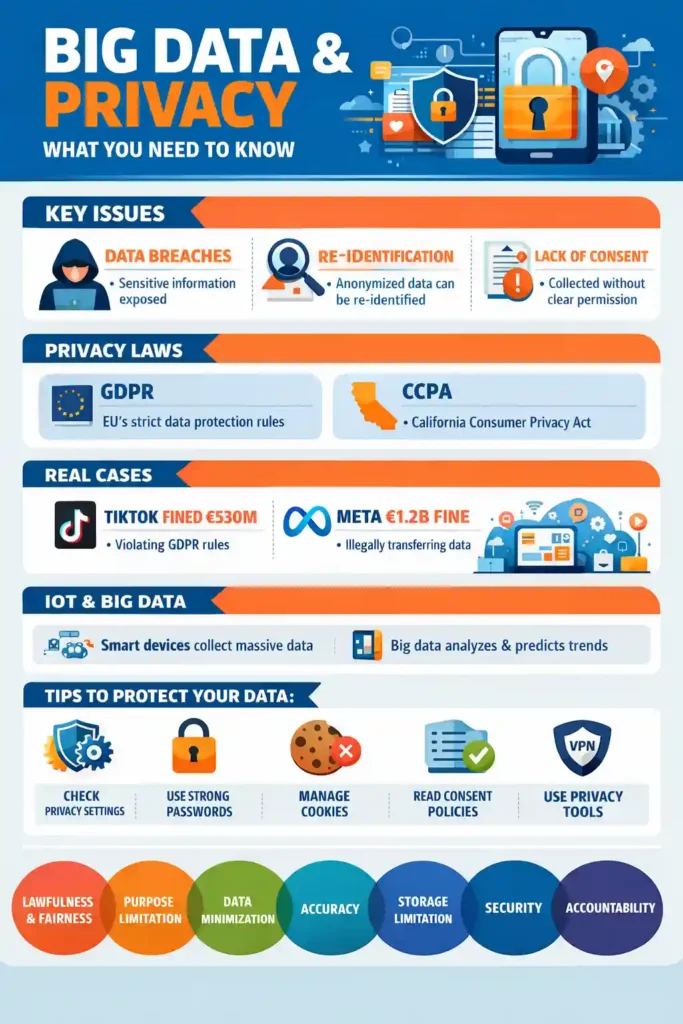
For example, social media platforms track your activity to recommend content and ads tailored to you, while online retailers analyze purchase histories to suggest products. Although this can make technology more useful, it also amplifies risks around personal data. Big data privacy issues include:
- Unauthorized access and data leaks, where sensitive information gets exposed.
- Re-identification of individuals even in anonymized datasets due to the mosaic effect.
- Algorithmic bias, where analytics inadvertently lead to unfair or discriminatory outcomes.
- Lack of transparency in how consumer data is used or shared.
In short, your digital actions create information that’s valuable — and potentially vulnerable — across the global digital economy.
Big Data Privacy Law: Understanding Legal Protections
Governments around the world have recognized the need to regulate how personal data is handled and protected. These privacy laws aim to give individuals more control over their personal information and put obligations on organizations to follow responsible practices.
General Data Protection Regulation (GDPR)
The General Data Protection Regulation (GDPR) is one of the strongest privacy laws globally. It applies to organizations that process the data of European residents, even if the company is based outside the EU. GDPR emphasizes:
- Transparency about data use
- User rights like access, correction, and deletion
- Requirement for explicit consent before processing personal data
GDPR has also shaped litigation and enforcement trends. For instance, TikTok was fined €530 million ($600 million) by EU regulators for issues related to data transfers to China and inadequate transparency.
Even high-profile companies like WhatsApp are engaging courts over GDPR fines — illustrating how seriously these regulations are taken.
Big Data Privacy Concerns: The Real Risks Behind the Tech
Even with strong regulations, privacy concerns persist:
Data Breaches and Security Risks
When companies collect and store massive amounts of personal information, breaches become a serious threat. For example, the British Airways data breach exposed personal and payment details of nearly half a million customers due to security vulnerabilities, leading to regulatory action.
Re-Identification and the Mosaic Effect
The mosaic effect describes how seemingly harmless bits of data — when aggregated — can reveal a detailed portrait of someone’s life. This means even ‘anonymized’ datasets can pose privacy risks when combined with other information.
Algorithmic Bias and Discrimination
When data models rely on biased or incomplete datasets, they can unintentionally lead to unfair decisions — especially in areas like lending, hiring, and healthcare.
Opaque Practices in AI and Automation
Emerging technologies such as generative AI raise new questions about how data is used and whether individuals have adequate control and transparency over how their information is consumed or analyzed.
Big Data and Privacy Cases: Lessons from the Real World
Real examples show how big data practices intersect with privacy enforcement:
Meta and GDPR Fines
The EU has been active in enforcing GDPR. One of the largest fines to date — €1.2 billion — was issued to Meta (Facebook’s parent company) for transferring user data without adequate protections.
Clearview AI’s Biometric Data Controversy
Facial recognition company Clearview AI was fined over £7.5 million by UK regulators for building biometric databases without user consent — underscoring growing scrutiny over biometric data.
Facebook–Cambridge Analytica
One of the most infamous cases involved Facebook–Cambridge Analytica, where personal data of millions of users was harvested without proper consent and used for targeted political advertising.
These high-profile cases not only influence corporate behavior but also educate users about the reach and impact of data collection.
How Your Personal Privacy Is Affected by Big Data
Your digital footprint extends across devices, apps, and services, which means your consumer data flows into multiple systems:
- Mobile apps and smart devices continuously share performance and usage data.
- Social media platforms track interaction patterns and preferences.
- Online services use your data for everything from product recommendations to behavioral marketing.
This information — when analyzed with predictive analytics and machine learning algorithms — can create powerful profiles that reveal preferences, identity markers, and personal habits. While these insights enable technology to be more personalized and efficient, they also blur the line between utility and privacy risk.
According to research, the more datasets used for analysis, the greater the chance that individuals can be re-identified or profiled without their clear understanding or consent.
Privacy Issues in Data Science: When Analytics Gets Personal
In disciplines like data science, advanced analytics continue to evolve and rely on rich data sources. However, these fields raise their own challenges:
- Sensitive health or biometric data may unintentionally leak through large-scale analytics.
- Algorithms trained on personal data may deliver predictions that affect real-world decisions without sufficient transparency or accountability.
Academic studies highlight privacy risks in health big data — where complex data types and cross-system processing challenge privacy protections.
These concerns show why data scientists and businesses must adopt privacy-by-design practices — meaning privacy considerations are built into systems from the start.
Step-by-Step Guide: How to Take Control of Your Privacy
Here’s how to protect your personal information in practice:
1. Review Privacy Settings
Check permissions in apps and services. Turn off what you don’t need, especially location, camera, and microphone access.
2. Use Strong Security Measures
Use unique passwords and multi-factor authentication to reduce the risk of account compromise.
3. Manage Tracking and Cookies
Clear cookies regularly, use privacy-focused browsers, or install extensions that limit unwanted tracking.
4. Understand and Limit Data Sharing
Always read privacy policies and give explicit consent only for necessary purposes.
5. Adopt Tools That Protect Privacy
Consider reputable privacy protection services to monitor breaches, secure your connection, and reduce exposure to data misuse.
Strong Big Data Security Solutions are important because they help keep your personal information safe while companies collect, store, and analyze large amounts of data.
Final Thoughts:
Big data and privacy are deeply connected. On the one hand, data fuels innovation through analysis, automation, and personalization. On the other hand, it exposes individuals to risks when transparency, consent, and security are weak or absent.
Regulations like GDPR and emerging data privacy laws help define the rules of the game, but true control also lies with individuals who understand how data is used and take proactive steps to protect themselves.
Your personal information isn’t just digital noise — it’s a part of your identity and deserves intentional handling, clear protection, and responsible governance.
Stay informed. Claim your rights. And make privacy a priority in every interaction online.
FAQs
What is data privacy in IoT?
Data privacy in the Internet of Things (IoT) refers to protecting personal information that is collected, processed, and stored by connected devices — like smart thermostats, fitness trackers, or home cameras — from unauthorized access, misuse, or exposure.
Many IoT devices gather very detailed personal information, such as usage habits, health metrics, location data, and daily routines. Because this data is often sent to remote servers or shared with third parties, IoT privacy focuses on ensuring this information:
Is collected and used only with your informed permission.
Is encrypted and secured against hackers.
Isn’t kept or shared longer than necessary.
Isn’t used in ways you didn’t agree to.
IoT devices often don’t make clear what they collect, and users may not know where their data goes or how it’s used — which raises serious privacy concerns.
What are the top 3 big data privacy risks?
When handling big data — especially personal or sensitive information — three major privacy risks affect everyday users like you:
1. Data Breaches
Because big data involves huge amounts of personal data, it becomes a target for cybercriminals. If systems are not protected, hackers can steal sensitive information like addresses, health details, or financial data.
👉 This is often one of the most damaging privacy risks, as it leads to identity theft and fraud.
2. Lack of Awareness and Consent
Many companies collect your data without clear transparency or explicit consent. Users may not know what information is gathered, how long it’s stored, or who it’s shared with — and that leads to privacy violations.
3. Re-Identification in Large Datasets
Even when data is anonymized, combining different datasets can reveal private information. This is known as the mosaic effect, where individual bits become meaningful when linked together, exposing personal details.
These three risks — breaches, unclear consent, and re-identification — are at the heart of most big data privacy problems today.
What is the relationship between IoT and big data?
The Internet of Things (IoT) and big data are strongly connected because IoT devices are among the biggest sources of data in the digital world.
Here’s how they relate:
IoT devices collect data continuously — from sensors, wearables, vehicles, smart appliances, and more.
That data flows into big data systems, which can store and analyze information from millions of devices at once.
Analytics and machine learning then process that data to spot patterns, make predictions, or improve services — such as optimizing traffic flow or predicting maintenance needs.
In essence, IoT feeds the raw material (data) and big data tools turn that information into insights and actions. But this integration also amplifies privacy challenges since data about individuals can be shared widely, stored indefinitely, and processed in ways users didn’t expect.
What are the 7 pillars of data privacy?
When people talk about the “7 pillars of data privacy,” they usually mean the core principles that guide responsible handling of personal information. These principles help ensure organizations respect individual privacy rights and comply with laws like the General Data Protection Regulation (GDPR).
The seven most widely recognized data privacy principles — reflected in GDPR and many global privacy frameworks — are:
Lawfulness, fairness, and transparency – Personal data must be handled fairly and legally, and individuals should know how their data is used.
Purpose limitation – Data should only be collected for specific, legitimate reasons.
Data minimization – Only the data needed for a purpose should be collected.
Accuracy – Personal data should be accurate and kept up to date.
Storage limitation – Data shouldn’t be kept longer than necessary.
Integrity and confidentiality (security) – Data must be secured against unauthorized access or breaches.
Accountability – Organizations must take responsibility for protecting data and show they comply with these principles.
Together, these principles serve as the foundation for ethical, lawful, and user-centric data handling in modern systems.