
In today’s business environment, organizations are flooded with data — everything from customer interactions and market trends to IoT sensor streams and operational logs. However, data in its raw form is only potentially valuable. To transform this into strategic insight requires the structured analysis, interpretation, and data driven decisions that come from modern analytics frameworks like Business Intelligence (BI) and Big Data systems.
This article explains bi and big data, highlights how they work together, and outlines their differences, so you can confidently use them to improve performance and growth.
- Bi and Big Data Similarities
- Difference Between BI or Big Data
- Big Data and Business Intelligence PDF
- When Should BI Tools Be Used Instead of Big Data Tools?
- What Are Some Similarities and Differences in Business Intelligence and Big Data Tools
- Difference Between Intelligence and Big Data
- What Is the Impact of Big Data on Business Intelligence in an Organization
- Big Data vs Data Warehouse
- Final Thoughts: Turning Data Into Strategic Advantage
- FAQs
Bi and Big Data Similarities
At their core, Business Intelligence (BI) and Big Data aim to convert data into value. Both:
- Collect information from multiple sources
- Support data visualizations like dashboards and reports
- Empower organizations to make data driven decisions
- Can integrate structured and unstructured data to uncover insights
While their methods and scale differ, the goals are aligned: make sense of data to drive better business outcomes.
Even though Big Data often involves larger systems and unstructured datasets, modern BI solutions increasingly embrace diverse data types to provide richer insights across business units.
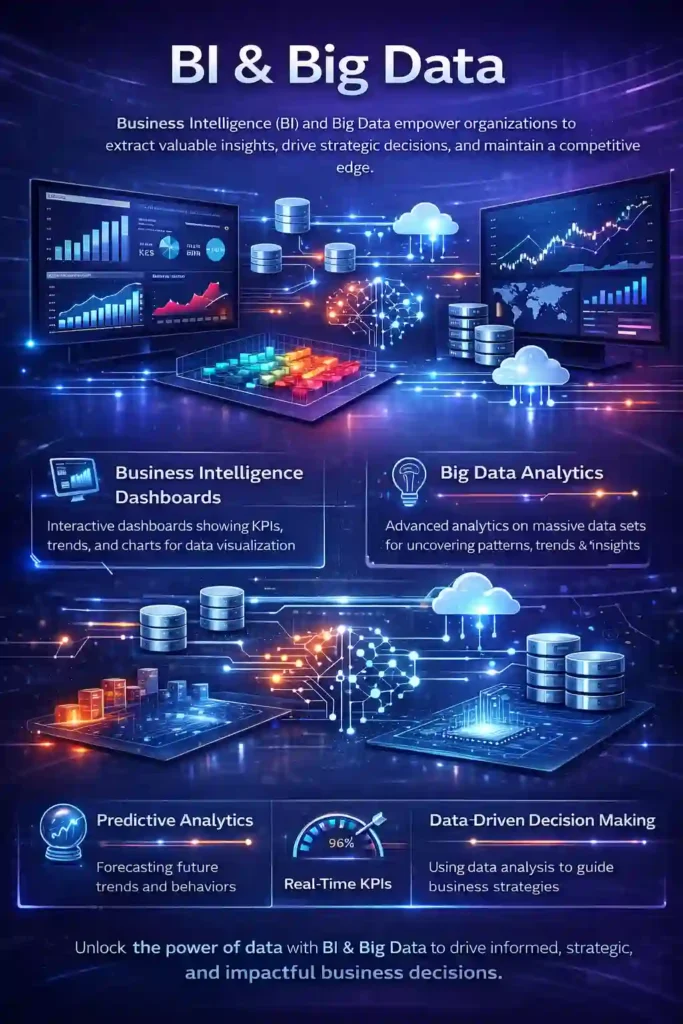
The following infographic
Difference Between BI or Big Data
Understanding the difference between these two fields is essential for choosing the right tools and strategies.
1. Purpose
- Business Intelligence BI focuses on analyzing historical and current data to summarize performance and guide operational decisions.
- Big Data refers to the analysis of massive, high-velocity datasets to discover deeper patterns and enable predictive analytics.
2. Scale and Data Types
- BI typically works with structured data, such as sales records and financial transactions stored in relational databases or data warehouse systems.
- Big Data handles large amounts of data of all types — structured, semi-structured, and unstructured data like social media posts, emails, and multimedia.
3. Tools
- BI uses business intelligence tools like Power BI and Tableau for reporting and visualization.
- Big Data relies on big data technologies such as Hadoop, Apache Spark, and NoSQL databases to process and analyze data at scale.
4. Insight Depth
- BI provides clarity and performance monitoring through dashboards and charts.
- Big Data extends insight to include trend detection, pattern discovery, and predictive models that forecast future opportunities.
Big Data and Business Intelligence PDF
To explore these concepts even further, consider downloading structured learning resources like a Big Data and Business Intelligence PDF from educational or industry institutions. These documents often offer diagrams, use cases, and base definitions that are ideal for team training or strategy planning.
Pro Tip: Make PDF guides part of onboarding for analytics teams — they provide a timeless reference for both business intelligence and Big Data frameworks.
When Should BI Tools Be Used Instead of Big Data Tools?
Knowing when to use a bi tool versus Big Data solutions can save time and expense.
Use BI Tools When:
- You need clear data visualizations, such as dashboards and scorecards
- Your data is mostly structured and stored in traditional systems
- The focus is on summarizing past performance and generating actionable reports
Examples include monthly performance dashboards or customer satisfaction scorecards.
Use Big Data Tools When:
- The volume and velocity of data exceed traditional system limits
- You require real-time analysis and complex pattern detection
- You are building predictive models or conducting AI-assisted analysis
Industries like finance and healthcare often use Big Data for large-scale risk modeling and prediction.
Expert Insight: Many analytics leaders say, “BI tools are excellent for operational clarity, but Big Data tools deliver strategic foresight when combined with machine learning.”
What Are Some Similarities and Differences in Business Intelligence and Big Data Tools
Understanding how the tools themselves compare helps shape implementation decisions.
Similarities:
- Both ingest data from various internal and external sources
- Both provide interfaces to support data driven decisions
Differences:
- Business Intelligence tools emphasize ease of use, enabling analysts and leaders to self-serve insights
- Big Data tools often require technical expertise and support from data scientists for processing and advanced modeling
For example, a BI dashboard might show monthly revenue trends, while Big Data engines can uncover customer segments that behave differently in real time.
“BI and Big Data rely on powerful big data analytics tools to collect, process, and turn large amounts of raw data into clear and useful business insights.”
Difference Between Intelligence and Big Data
Although they sound similar, intelligence and Big Data are distinct:
- Intelligence is about interpreting and applying data for actionable decisions
- Big Data is about handling and analyzing massive volumes of information
In short, Big Data supplies the detailed material, and intelligence (through BI) gives it meaning.
What Is the Impact of Big Data on Business Intelligence in an Organization
Integrating Big Data with Business Intelligence BI expands what organizations can do:
- Enables more advanced forecasting and predictive analytics
- Improves responsiveness to external changes when combined with real-time streams
- Enhances improving customer experiences through deeper segmentation and personalization
According to industry forecasts, BI adoption continues to grow rapidly, with cloud-based analytics expanding access and integration into strategic planning.
This trend shows that combining Business Intelligence and Big Data isn’t just technical — it’s strategic.
Big Data vs Data Warehouse
A common question involves comparing Big Data systems with a data warehouse — a cornerstone of BI.
| Aspect | Big Data | Data Warehouse |
| Data Variety | Structured, unstructured, semi-structured | Mostly structured |
| Scale | Massive and scalable horizontally | Large, but optimized for structured workloads |
| Typical Use | Exploration, trend detection, prediction | Reporting, dashboards, historical analysis |
| Tools | Hadoop, Spark, NoSQL | Snowflake, Redshift, BigQuery |
Often, modern architectures combine both, with data warehouses feeding BI tools while Big Data systems support advanced analytics.
Final Thoughts: Turning Data Into Strategic Advantage
In simple terms, bi and big data empowers modern enterprises to listen to what their data truly says. Big Data unlocks deep and complex patterns across large amounts of data, while Business Intelligence tools deliver clarity through data visualizations, dashboards, and reports for decision-making.
Whether you’re managing operations or forecasting future trends, mastering both will help you make informed, confident decisions that accelerate growth and resilience in a competitive landscape.
👉 Ready to unlock the full potential of your data strategy? Embrace integrated Business intelligence and Big Data solutions today to lead with insight and confidence.
FAQs
What is the difference between Business Intelligence (BI) and Big Data?
Although both Business Intelligence (BI) and Big Data help businesses make smarter decisions with data, they focus on different things. BI mainly works with structured data — the organized kind you find in databases and data warehouses — to create reports, dashboards, and summaries that explain what has happened and why. It’s about understanding past and current performance in a simple, visual way. Meanwhile, Big Data deals with very large and complex datasets — including social media posts, sensor readings, and clickstream data — that traditional systems can’t handle easily. Big Data often uses advanced tools to explore patterns and trends, sometimes in real time, and can help answer what might happen next through predictive analytics.
How do BI and Big Data work together in a business?
Instead of being competitors, these technologies are partners (business intelligence and big data). Big Data technologies gather and process huge amounts of information — including both structured and unstructured data — using tools like Hadoop or Spark. Once that data is processed, BI tools take over to turn it into clear, actionable visuals and reports. This means Big Data can uncover deep trends, and BI can make those trends easy to understand and act on. For example, a retailer might use Big Data to find patterns in millions of customer interactions, then use BI dashboards to share those findings with marketing or sales teams.
Can BI work with real-time Big Data?
Yes! Traditionally, BI focused on historical data — things that happened in the past — but modern BI platforms increasingly support real-time and near-real-time data input. This means that BI can now work alongside Big Data systems that stream live information (like social media activity or sensor feeds) to give timely insights. In practice, this lets businesses notice trends as they happen and make decisions faster, which is especially useful for things like monitoring customer behavior, tracking real-time sales, and responding to sudden changes in the market.v
Do small businesses need Big Data or just BI tools?
It depends on the size and type of data your business uses. If your data mostly comes from internal systems like sales records, customer lists, and spreadsheets — and you want to visualize performance, track KPIs, and improve operations — then BI tools alone may be enough. But if your business collects large amounts of diverse data from many sources — such as website interactions, social media, IoT devices, customer feedback, and more — then a Big Data system becomes valuable because it can process and analyze those large and varied datasets. Most small businesses start with BI for reporting and add Big Data tools later as their data needs grow.