

Becoming a machine learning engineer is one of the most in-demand careers in tech today. How to Become a Machine Learning Engineer: It’s professionals who design systems that learn from data and power everything from recommendation engines to autonomous systems. This comprehensive guide will walk you through exactly how to make that transition — whether you’re a complete beginner, career changer, or aspiring expert — while weaving in real timelines, salary insights, learning paths, Reddit community tips, and professional wisdom to help you succeed with confidence.
- Machine Learning Engineer Salary: What You Can Expect in 2025
- Become a Machine Learning Engineer Without a Degree
- Become a Machine Learning Engineer Reddit: Real Community Wisdom
- How to Become a Machine Learning Engineer From Scratch: Your Step-by-Step Roadmap
- Machine Learning Engineer Course: Choosing the Right Learning Path
- Machine Learning Engineer Roadmap: Organizing Your Learning Path
- How Long Does It Take to Become a Machine Learning Engineer?
- Machine Learning Engineer Jobs: What Employers Look For
- Final Thoughts: Your Path to Becoming a Machine Learning Engineer
- Frequently Asked Questions (FAQ)
Machine Learning Engineer Salary: What You Can Expect in 2025
One of the biggest motivators for aspiring engineers is compensation. Machine learning engineers are typically well-paid, often earning above-standard salaries due to the specialized skill set required. According to recent industry data, junior roles typically start in the six-figure range, with salaries ranging from $105,000 to $150,000 per year. Meanwhile, mid-level engineers commonly earn between $150,000 and $ 200,000 annually. Senior engineers can command well above $200,000, especially at large tech companies.OpODab
In some high-profile cases like Reddit, total compensation packages (including base salary, bonuses, and stock options) have been reported in the $330,000–$500,000+ range at higher levels.Levels.fyi
While these figures vary based on experience, location, and company, they highlight the strong financial potential of this career.
Become a Machine Learning Engineer Without a Degree
Many people assume a university degree is essential — but that’s not always true in this field. While traditional degrees can help build fundamentals, many successful machine learning engineers have entered the field without one. What matters most to employers is demonstrable skills and real projects, not just certificates. Platforms like Reddit host ongoing discussions where self-taught learners share their journeys and resources, offering peer support to those studying independently.Reddit
Many people ask whether you can work in machine learning without a traditional degree. The good news is: yes, it’s possible, though it may require more initiative and project proof:
Key Strategies Without a Degree:
A few tips for those without a degree:
- Build a strong portfolio of real projects. Build a strong project portfolio with samples of real models and systems
- Contribute to open-source repositories. Master key tools and languages through self-study and online courses (e.g., Python, ML frameworks)
- Engage with communities (e.g., Reddit, GitHub). Network in tech groups and forums like Reddit communities focused on ML
- Earn industry-recognized certifications relevant to machine learning
- Participate in coding challenges or MOOCs (Massive Open Online Courses)
This approach can help you stand out even if you don’t hold a formal computer science degree.
Most employers value demonstrated ability — that means projects, collaborations, and open source contributions may compensate for the lack of a formal degree. Xpheno
Become a Machine Learning Engineer Reddit: Real Community Wisdom
The Reddit community is full of firsthand experiences from learners at all levels. You’ll find discussions on learning pathways, tools, and how people balance education with real-world challenges. For example, users often share personal roadmaps that include starting with Python and progressing toward specialized ML and AI skills.Reddit
Other Reddit threads explore topics such as balancing university with self-study, deciding whether to focus on AI or machine learning first, and portfolio development strategies.Reddit
Engaging with topics like how to prepare, where to start, and what tools matter most provides context you can’t always get from a simple course syllabus.
How to Become a Machine Learning Engineer From Scratch: Your Step-by-Step Roadmap
If you’re starting from zero, here’s a practical roadmap to take you from beginner to employable:
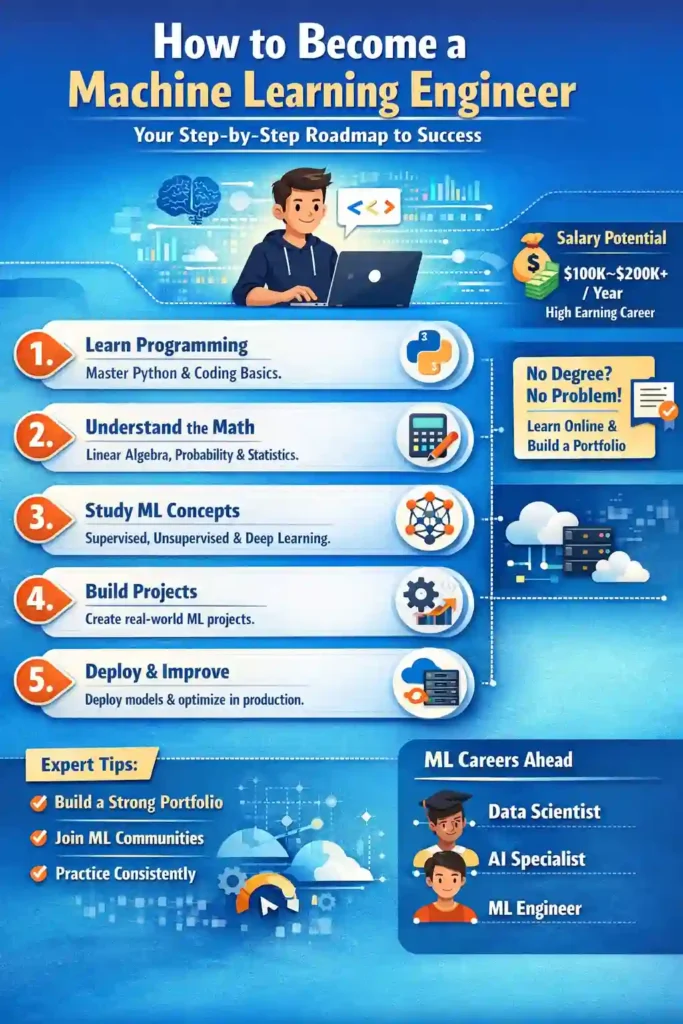
Step 1: Build Strong Programming Fundamentals
Python is the industry’s most common language for machine learning — and for good reason. Its readable syntax and powerful libraries (like NumPy and Pandas) make it perfect for data work and model building.
Step 2: Learn Essential Mathematics
Machine learning relies on core concepts from:
- Linear algebra
- Probability & statistics
- Calculus basics
These help you understand how models learn and perform.
Step 3: Master Machine Learning Fundamentals
Learn key areas like:
- Supervised and unsupervised learning
- Common algorithms (e.g., regression, classification, clustering)
- Model evaluation and selection
Step 4: Gain Hands-On Experience With Tools
Practicing with real tools — from libraries like Scikit-learn to frameworks like TensorFlow and PyTorch — is critical. Build small projects, like prediction models or classification systems, to strengthen your portfolio.
Step 5: Learn Deployment and Real-World Skills
Modern roles often involve taking models into production. Learn basics of cloud platforms, containerization (such as Docker), and deployment frameworks.
Step 6: Practice and Build Projects
Projects demonstrate your skills in ways resumes can’t. Ideas include recommendation systems, natural language models, or image recognition applications.
Step 7: Refine with Advanced Topics
Once you have the basics, dive into advanced areas:
- Deep learning
- Neural networks
- Reinforcement learning
This holistic roadmap helps you grow from novice to confident practitioner in a structured way.
Machine Learning Engineer Course: Choosing the Right Learning Path
While self-study works for many, structured machine learning engineer courses can significantly accelerate your progress — especially if they include core curriculum, portfolio projects, mentor support, and career services.
Good courses walk you through:
- Programming fundamentals
- Core machine learning concepts
- Real projects
- Tools and frameworks
- Interview preparation
This combination helps you learn faster and stay focused.
Machine Learning Engineer Roadmap: Organizing Your Learning Path
An effective roadmap is a learner’s compass. According to expert industry guides, your learning journey typically follows phases:
- Foundation – Python and math basics
- Core Machine Learning – algorithms and evaluation
- Advanced Skills – deep learning frameworks
- Engineering – deployment, MLOps, and scalability
- Specialization – choosing areas like NLP or computer vision
- Portfolio and Career Prep – projects, interviews, and networking AI Engineer Insights
This kind of structured approach prevents overwhelm and ensures you build practical skills at each stage.
How Long Does It Take to Become a Machine Learning Engineer?
The time required varies — but typical journeys look like this:
- Full-time dedicated study (20–40 hours/week) may see beginner-to-job-ready progress in 4–6 months.
- Part-time study (e.g., while working) often takes 7–12+ months.
- Those with no programming or math background might take 1–2 years to reach professional skill levels.
The key is consistent practice and progressive learning — quality matters more than speed.
Machine Learning Engineer Jobs: What Employers Look For
Job postings for machine learning engineer jobs typically require:
- Proficiency in Python
- Experience with ML frameworks
- Understanding of data preprocessing and model evaluation
- Real project experience
- Ability to communicate technical ideas
Some employers prefer candidates with formal degrees, but increasingly many will hire based on demonstrated skills and portfolio strength.
Online job boards, LinkedIn listings, and networking communities like Reddit or GitHub can help you find opportunities and practice interview readiness.
Final Thoughts: Your Path to Becoming a Machine Learning Engineer
Becoming a machine learning engineer is a journey — and a rewarding one. With structured learning, practical projects, and real community engagement, you can build confidence and stand out in a competitive job market.
👉 Start with the fundamentals
👉 Build hands-on projects
👉 Choose the right courses or structured paths
👉 Get involved in communities
👉 Prepare for real roles with portfolio and interview practice
The world of machine learning is growing rapidly, and your opportunity to be part of it is real — especially if you take action now.
Your journey can start today — and with dedication, the career you envision can become reality.
Understanding the Machine Learning Life Cycle helps you know how data is collected, models are trained, tested, deployed, and improved — which is a core skill you need when learning how to become a machine learning engineer.
Frequently Asked Questions (FAQ)
Here are clear, friendly answers to some of the most common questions about becoming a machine learning engineer.
How long does it take to become a ML engineer?
There’s no single answer, because the time it takes to become a machine learning engineer depends on your starting point and how much time you can commit:
If you’re learning full-time and starting from scratch, many learners reach a job-ready level in about 6–8 months with dedicated study and hands-on practice. Zero To Mastery
If you’re studying part-time (like evenings or weekends), it may take around 9–12+ months to build skills and a portfolio.
If you don’t have any prior programming or math background and you’re learning more slowly, it’s realistic to expect it could take 1–2 years or more. Refonte Learning
In short, many people can learn the core skills in under a year with focused effort, but becoming highly proficient and job-market ready can take longer depending on experience and how deep into topics you go.
Is ML a high paying job?
Yes — machine learning engineering is generally considered a high-paying career in the tech world. According to salary surveys and industry data:
In the U.S., average base salaries for ML engineers often range around $150,000+ per year, with additional cash compensation boosting total pay even higher. Vettio
Entry-level roles still tend to start above typical software engineering salaries in many markets, and experienced engineers can earn well into the six-figure range with bonuses and equity. Alpha Apex
Because ML skills are highly specialized and in demand, companies are willing to pay well for engineers who can build and deploy intelligent systems. You’ll also find that those with hands-on experience, strong portfolios, or advanced techniques (like deep learning) often command even higher salaries.
Is ML better than AI?
This is a common question, but it’s important to understand the relationship:
Artificial Intelligence (AI) is a broad field that includes many ways computers mimic human thinking — from symbolic reasoning to robotics.
Machine Learning (ML) is a subset of AI that focuses on algorithms that learn from data. All About AI
So it’s not that one is “better” than the other — they’re related:
If you want to focus on systems that learn from data, machine learning is the core skill.
If you’re drawn to a wider range of systems, including reasoning, planning, or perception, then AI encompasses ML plus other areas.
In general career terms, machine learning engineering is a practical and highly employable specialization within the broader world of AI.
Is it hard to become a ML engineer?
Yes — and no. Becoming a machine learning engineer is challenging, but it’s also absolutely achievable if you set a clear learning path and stay consistent.
Here’s why it can feel difficult:
You need both programming skills (usually in Python) and an understanding of math like statistics and linear algebra. Coursera
You’ll learn a mix of theory (how algorithms work) and practice (how to build models and deploy systems).
The field evolves quickly, so part of the challenge is continuous learning.
But here’s the encouraging part:
Many people successfully transition into ML roles from diverse backgrounds (not just computer science). Teal
Hands-on projects and real practice help you learn much faster than just reading theory.
Communities like Reddit and GitHub can make the journey feel more supported and shared. Reddit
So yes — it requires effort and time — but it isn’t impossible if you break it into manageable steps and stay consistent with practice.