
In today’s digital-first world, data is created every second. Every website visit, product purchase, customer message, and business transaction adds to a growing pool of information. But collecting data is no longer the problem. The real challenge is understanding it and using it to make better decisions. This is exactly where business intelligence using machine learning becomes a game changer.
Many businesses still depend on traditional reports and dashboards. These reports show numbers, charts, and trends—but often leave leaders asking, “What should we do next?” I once spoke with a business owner who said, “We had all the data, but none of the answers.” After adopting machine learning–powered BI, that same business started predicting problems before they happened—and growth followed.
- What Is Business Intelligence Using Machine Learning?
- Why Traditional Business Intelligence Is No Longer Enough
- How Machine Learning Enhances Business Intelligence
- Business Intelligence Using Machine Learning Examples Across Industries
- Business Intelligence Using Machine Learning Algorithm: How It Works
- Step-by-Step Guide to Implement Business Intelligence Using Machine Learning
- Challenges and Ethical Considerations
- AI Business Intelligence Tools
- Generative AI for Business Intelligence
- Why Business Intelligence Using Machine Learning Builds Buyer Confidence
- The Future of Business Intelligence Using Machine Learning
- Final Thoughts
- Frequently Asked Questions (FAQs)
What Is Business Intelligence Using Machine Learning?
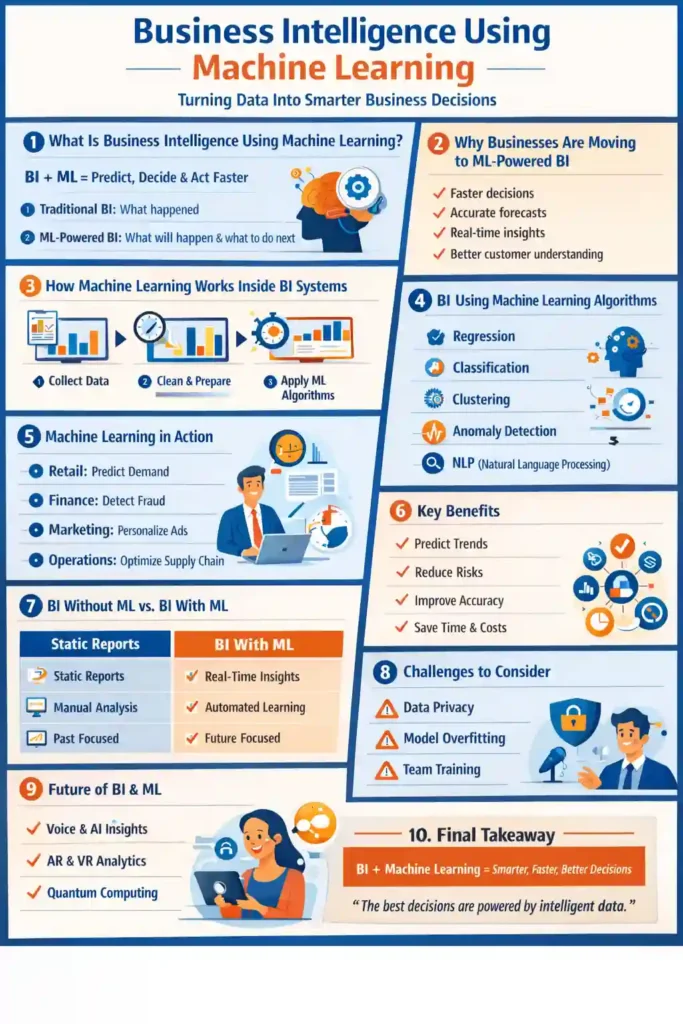
It combines business intelligence (BI) tools with machine learning (ML) technologies to analyze data, learn from patterns, and improve insights automatically over time.
In simple terms:
- Business Intelligence explains what happened and why
- Machine Learning predicts what is likely to happen next
Together, they turn data into actionable intelligence, not just reports.
“The value of data lies not in collecting it, but in learning from it.” — Business Analytics Expert
Why Traditional Business Intelligence Is No Longer Enough
Traditional BI systems rely on fixed rules, manual analysis, and historical data. While useful, they struggle to keep up with today’s fast-changing markets.
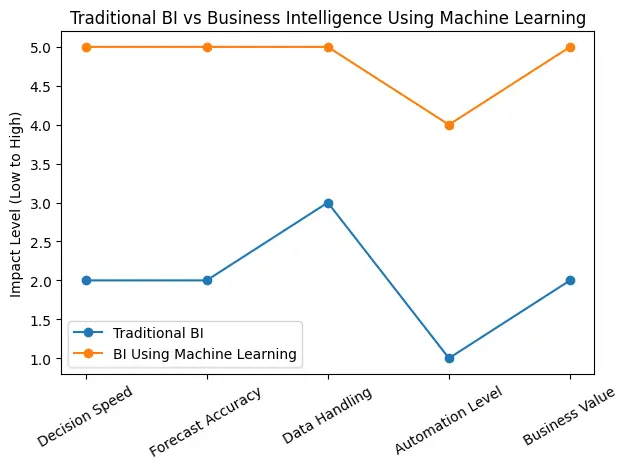
Common limitations include:
- Static dashboards that don’t adapt
- Heavy dependence on analysts
- Difficulty handling unstructured data like text and reviews
- No built-in predictive capabilities
In contrast, business intelligence machine learning continuously improves. It adapts as new data arrives, detects hidden patterns, and delivers insights in real time—helping leaders move from reactive decisions to proactive strategies.
How Machine Learning Enhances Business Intelligence
Predictive Analytics for Forward Thinking
Traditional BI looks at the past. Machine learning-powered BI looks into the future. Predictive analytics helps businesses forecast sales, demand, customer behavior, and risks before they occur.
Retailers, for example, can predict which products will sell faster. Finance teams can anticipate cash flow issues. This shift alone can save time, money, and missed opportunities.
Anomaly Detection for Early Problem Solving
Machine learning is excellent at spotting unusual patterns. These anomalies may signal fraud, system failures, or performance issues that humans might miss.
With business intelligence machine learning, businesses can:
- Detect fraud early
- Identify system issues instantly
- Reduce operational risks
Natural Language Processing Makes BI Easier
With Natural Language Processing (NLP), users can ask questions in plain language like:
- “Why did sales drop last week?”
- “Which product performed best this month?”
This removes technical barriers and allows everyone—not just data experts—to use BI tools confidently.
Automated Data Cleaning and Accuracy
Data quality is critical. Machine learning automates data cleaning by removing duplicates, fixing missing values, and correcting errors. This ensures decisions are based on clean, reliable data, not guesswork.
Business Intelligence Using Machine Learning Examples Across Industries
Real-world examples show how powerful this approach is.
Retail
Retailers use ML-driven BI to forecast demand, personalize offers, and manage inventory more efficiently.
Healthcare
Hospitals analyze patient data to predict outcomes, improve care plans, and manage resources better.
Manufacturing
Manufacturers rely on predictive maintenance to reduce downtime and avoid costly equipment failures.
Finance
Banks use machine learning-powered BI to detect fraud, assess credit risk, and forecast market trends.
These examples clearly show how insights turn into measurable results.
Business Intelligence Using Machine Learning Algorithm: How It Works
This algorithm processes large datasets to identify patterns and predict outcomes.
Common algorithm types include:
- Predictive algorithms for forecasting trends
- Classification algorithms for customer segmentation
- Anomaly detection algorithms for fraud and errors
- Natural language algorithms for text and sentiment analysis
Unlike traditional BI rules, these algorithms improve over time, becoming more accurate as more data is processed.
Step-by-Step Guide to Implement Business Intelligence Using Machine Learning
Step 1: Define Clear Business Goals
Start with clear objectives—such as increasing revenue, reducing costs, or improving customer experience.
Step 2: Centralize Your Data
Bring data from sales, marketing, finance, operations, and customer feedback into one system.
Step 3: Choose the Right BI Platform
Modern BI platforms integrate dashboards with machine learning features, making adoption easier.
Step 4: Train and Monitor ML Models
Machine learning models must be trained, tested, and reviewed regularly to stay accurate and fair.
Step 5: Act on Insights Daily
The real value comes when insights guide everyday decisions—not just reports.
Challenges and Ethical Considerations
While powerful, business intelligence with machine learning also comes with responsibilities.
Key challenges include:
- Data privacy and security
- Bias in algorithms
- Resistance to change within teams
Strong governance, ethical AI practices, and proper training help overcome these challenges effectively.
Business intelligence machine learning helps companies understand past data and, with demand forecast machine learning, clearly predict what customers will need next so businesses can plan better and avoid shortages.
AI Business Intelligence Tools
Today’s AI-driven business intelligence tools help companies make sense of large amounts of data without manual effort. These tools automatically spot trends, predict outcomes, and highlight risks in real time, allowing teams to act faster and smarter. Instead of only showing past results, they guide businesses toward better future decisions by turning raw data into clear, easy-to-understand insights.
Generative AI for Business Intelligence
Generative AI is changing business intelligence by making data easier to understand and use. It can explain insights in simple language, create reports automatically, and answer business questions instantly. This means decision-makers no longer need great technical skills to understand data—Generative AI delivers clear explanations and practical recommendations that help businesses respond quickly and confidently.
Why Business Intelligence Using Machine Learning Builds Buyer Confidence
When decisions are backed by data and predictive insights, businesses operate with confidence. Customers experience faster responses, personalized services, and consistent quality.
“Confidence grows when decisions are supported by insight, not instinct.” — Business Strategy Advisor
This is why companies that adopt business intelligence machine learning often outperform competitors and earn stronger customer trust.
The Future of Business Intelligence Using Machine Learning
The future of BI is intelligent, real-time, and predictive. With advancements in cloud computing, IoT, and AI, machine learning-driven business intelligence will not just support decisions—it will recommend and automate them.
The focus will move from reporting data to anticipating outcomes and guiding action.
Final Thoughts
this technology turns raw data into clarity, confidence, and competitive advantage. It empowers organizations to shift from reacting to events to shaping outcomes.
In a data-driven world, success belongs not to businesses with the most data, but to those that use it wisely. By investing in business intelligence machine learning today, organizations prepare themselves for smarter decisions, stronger customer relationships, and sustainable growth tomorrow.
Frequently Asked Questions (FAQs)
What is machine learning in business intelligence?
Machine learning in business intelligence means using smart algorithms that can learn from data and improve over time to support better business decisions. Instead of only showing past reports, business intelligence machine learning helps businesses understand patterns, predict future outcomes, and suggest what actions to take next. For example, it can forecast sales, spot unusual activity, or recommend ways to improve customer experience—often automatically and in real time.
What are the 4 types of ML?
There are four main types of machine learning, each used for different business needs:
Supervised learning This type learns from labeled data. Businesses use it for predictions like sales forecasting, fraud detection, and customer churn analysis.
Unsupervised learning This type works with unlabeled data to find hidden patterns. It is often used for customer segmentation and discovering new market trends.
Semi-supervised learning This is a mix of supervised and unsupervised learning. It helps when only some data is labeled, which is common in real business situations.
Reinforcement learning This type learns by trial and error. It is useful for decision-making systems, such as dynamic pricing or recommendation engines that improve with user behavior.
What are the four types of business intelligence?
Business intelligence is usually grouped into four main types:
Descriptive BI Explains what happened in the past using reports and dashboards.
Diagnostic BI Focuses on why something happened by analyzing trends and relationships.
Predictive BI Uses data and machine learning to forecast what is likely to happen next.
Prescriptive BI Suggests the best actions to take based on predictions and business goals.
Together, these types help businesses move from basic reporting to smart, action-driven decisions.
How is AI used in business intelligence?
AI is used in business intelligence to make data analysis faster, smarter, and more useful. It helps automate data preparation, detect patterns, and generate insights without heavy manual work. With AI, BI tools can predict trends, identify risks, personalize dashboards, and even answer questions in plain language. In short, AI turns business intelligence from simple reporting into a powerful decision-support system that helps leaders act with confidence.